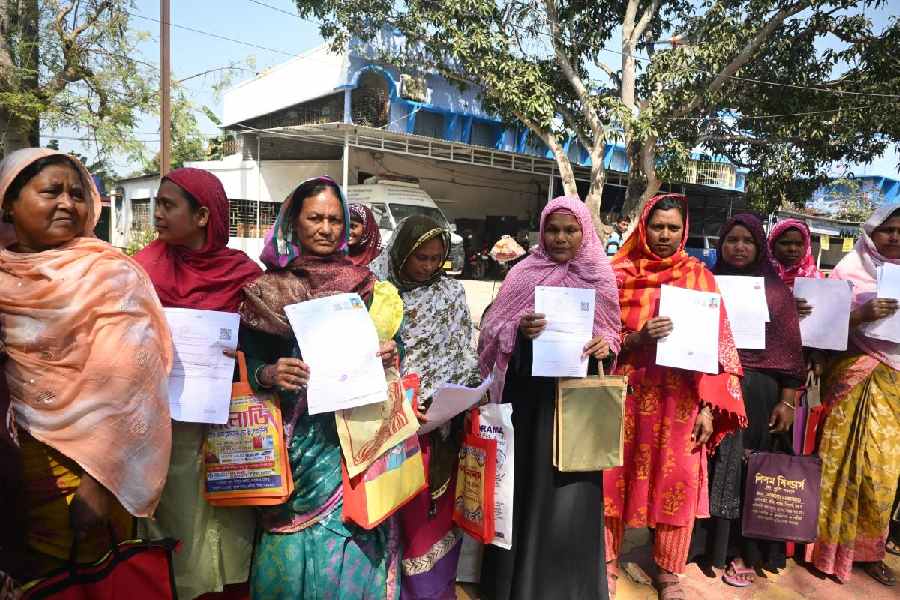
It wasn’t just the pain of the long queues. A Calcutta-based research institute estimates that the SIR has inflicted a cumulative financial loss of nearly ₹2,000 crore on the families of the around 1.5 crore voters called for hearings.
The Sabar Institute based its calculations on the assumptions that in an average case, a person summoned to a hearing was accompanied by a working family member, and that both lost their day’s income.
It also added a “minimum” figure of ₹100 as out-of-pocket expenses on travel, food and documentation per person.
Apart from this, the Institute also highlighted the administrative cost of work stalled because of officials’ SIR assignments, and the impact on social sectors such as school education with many teachers away on BLO duty.
“The informal sector workers faced the highest financial pressure in addition to (the general) harassment (of being called to hearings),” said Sabir Ahamed, a prominent social researcher associated with the Institute.
Ashin Chakraborty and Souptik Halder, two other researchers from the platform, participated in analysing the data and preparing the estimates.
The researchers estimated the income losses based on three alternative parameters: Bengal’s per capita GDP and two different wage rates.
Many elderly and ailing voters were accompanied to the hearings by one or more adult family members. Many of those called for issues relating to progeny mapping came with three or four people — parents and children — many of them working adults.
For the purposes of the calculation, the researchers decided that on average, a person summoned came with one family member. This took the number of attendees to 3 crore, given that 1.5 crore were summoned.
Based on Bengal’s per capita GDP, the annual income of individual wage earners was estimated as ₹204,781 for the current financial year. This translates into an average daily income of ₹561.
Given the assumption that those summoned came in teams of two, an average family would have lost ₹1,122 in daily earnings. Multiplied by 1.5 crore — the number of people summoned — the total income loss is estimated at ₹1,683 crore.
Adding out-of-pocket expenses of ₹300 crore (assuming only ₹100 per head), the total financial loss comes to ₹1,983 crore.
The researchers also adopted two other methods of calculating per capita incomes —one based on the MGNREGA wages of ₹260 per day (rural areas) and a mid-range daily income of ₹400, reflecting the average minimum wage rates for rural and urban areas combined.
If all the attendees earned ₹260 a day, the total financial loss would be ₹1,080 crore. If they earned ₹400 a day, the loss would be around ₹1,500 crore.
The estimate has highlighted that 88,100 personnel — including over 80,000 booth-level officers and 8,100 micro-observers — were deployed for the SIR exercise. A researcher said that such a large deployment, for nearly 90 days, meant public servants were diverted from critical sectors such as health, education and core governance functions.
The study has flagged that during the SIR, many government schools have functioned mainly as centres for distributing midday meals. With teachers assigned SIR duty in an already teac er-starved system, many schools have gone without regular classes.
According to the estimate, around 21.78 lakh students, mostly from marginalised and low-income households, were affected.