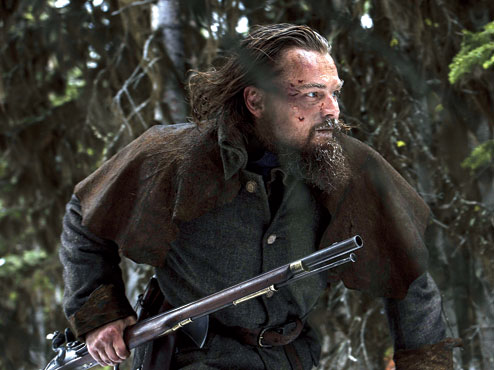

In The Revenant, Leonardo DiCaprio plays Hugh Glass, a fur trapper and frontiersman who is left for dead deep in the unchartered American wilderness by a traitorous member of his team, John Fitzgerald (Tom Hardy). With sheer will as his only weapon, Glass must navigate a hostile environment, a brutal winter and warring native tribes in a relentless quest to survive and exact vengeance on Fitzgerald. Inspired by a true story, the Alejandro G. Inarritu film is nominated for 12 Oscars, with DiCaprio the firm favourite to take home the Academy Award for Best Actor — his first ever — when the Oscars play out on (India time) Monday morning.
What drew you to The Revenant and the role of Hugh Glass?
The prospect of working with Alejandro. He’s a great visionary, and there are very few filmmakers like him who can make a poetic, existential epic piece. Here, you have a linear story that is somewhat of a campfire legend of American history: the American survivalist, the fur trapper, the mountain man mauled by a bear, then travelling hundreds of miles through the harshest conditions, driven by instinct. But through Alejandro’s eyes it became something much more than that. It tells a story of triumph, of the human spirit and what it is to overcome massive obstacles. It became less of a revenge story and something, I think, much more profound than that.
Was that always the ambition, to make it less linear and more… ‘poetic’, for want of a better word?
Yes… that was the intention for this film. To achieve this, we submerged ourselves in these elements and had to plan accordingly for what was going to happen. To bring the film to life, we worked for months to prepare for and execute well-choreographed shots, we learned everything we could about the time period — reading as much as we could — but at the end of the day, nature consumed all of it. We tried our best to make this film like a documentary, and almost like virtual reality in a lot of ways. I think when people see this movie they’re going to feel submerged in a completely different world and a completely different and difficult time in history.
The ‘bear sequence’ (running into several minutes in which Hugh Glass is mauled mercilessly by a bear) has come up in a few conversations as being incredible...
This film is based on the true story of Hugh Glass as he leads this fur-trapping unit through the wilderness — or rather its remaining survivors, because a Native American tribe, the Arikara, attacked their base camp and killed many of its members. Along the way he goes out scouting and comes across two bear cubs and ends up mauled by a fully-grown mother grizzly bear. Nearly dead, he becomes isolated from his group.
The bear scene is one of the most incredible cinematic experiences I think audiences will ever have. It was a difficult and arduous sequence to put together, but it ended up profoundly moving because of Alejandro’s ability to put the audience in the middle of the scene. They will see it as if they are a fly buzzing around the attack. They will practically feel the breath of the bear. It’s almost like another sense is awakened — fully immersed in this moment. It really takes your breath away. I think that what he achieved is beyond anything that I’ve seen in movie history, really.
The period this film is set in is not particularly well documented. That must have created challenges…
That’s right. Making this film was almost like making a science-fiction movie because there was little historical information to work with. Not only do cinema audiences not know much about this time period (1823), expert historians don’t either. This is because America hadn’t become America. This region was a wilderness at that time, like the Amazon is today. It was inhabited by indigenous people and the period depicted in the film saw the first infiltration of the white man into this untouched region, and how it was manipulated for capitalistic purposes. The fur trade was before the gold rush and the oil rush, it was the first bit of nature that could be extracted and exported to Europe. So, here you have the French, the English, the early Americans, all instilled in what is the American Amazon of that time. And this was before Lewis and Clark [The Lewis and Clark Expedition was the first American expedition to cross what is now the western portion of the US], before we sent explorers out to understand what this new landscape was like. It was truly nature in every sense of the word.
How did you research the period?
Much of our research was done using the actual journals of the fur trappers of the time, because there were no novels, no writers or journalists going into this wilderness. There was nobody there at all! It was just men who were hunting. There were no photographs, so there were etchings and drawings or stories from American Indians about what it was like. We had to create this world.
Tell us about working with the genius called Inarritu…

There is so much to say about Alejandro — he is a genius of filmmaking. What I love about his approach is that he’s an old-school filmmaker and an outsider. He’s within and without. While he’s been within the industry, he’s been influenced by an entire lifetime of studying cinematic history and other great masters, and he really wants to make his own mark on film history. He’s developed his own approach and his own style for making movies over the years — a style that has become synonymous with him now. And there are very few filmmakers who I believe have achieved this, who really make a true mark and who do not fit into the Hollywood mould but can still develop films like this one on an epic scale.
Was it a tough shoot?
Hell yeah! (Laughs) We all worked incredibly hard. The entire crew dealt with extreme circumstances. Whether it was constant extreme weather, or cameras not working because it was 40 degrees below zero, or the snow melting in unprecedented warming period because of climate change in the territory causing the entire landscape to go dry and barren within five hours. At one point, we shut down for weeks. Everyone involved was committed to this film, committed to making this vision a reality — but we all knew these elements would consume us. There were very tough conditions, and we knew that. But that’s why this film was so interesting to make. It was fascinating to do a film where I didn’t have to articulate what was being put up on screen. I have very little to say in this film, but I have to articulate by emoting my struggle. Often times there was nobody else to play off. There are periods where it’s me, alone, at the mercy of the elements. That was challenging — but I have to say, in place of other actors, the places we were, the surroundings, gave us a lot to react to.
The locations seem a key factor in creating the feeling of authenticity...
Alejandro wanted to find the last untouched forest land that Glass experienced, which for us was up in Canada. A lot of the forests there still remain. A lot of the rivers still remain. But many of these locations were incredibly difficult to get to. We had a pretty large crew, which had to move with us from location to location. It took a tremendous amount of scouting beforehand on Alejandro’s part to find each particular shot. He really wanted to make the film like an immersive painting, so he was very specific about each location. The real journey, the arc of Glass through this harsh winter landscape, was difficult for everyone to pull off.
Did you ever have times where you thought, ‘Man, I didn’t know it was going to be this hard!’
Absolutely! I don’t think anyone could have predicted the challenges that this film gave us. It threw at us every possible challenge you could imagine. But the great thing about making movies is what you’re documenting. You’re documenting struggle and you’re documenting all the things that you went through in making it. To me, this is the closest thing I’ve ever done to a documentary even with CGI elements in the film — because there are certain things that we could have never done with animal work. If you watch the bear sequence, mark my words, you’ll never see anything like it in cinema history. You feel it’s almost like there’s another sense that’s arisen in you as an audience member. It is so powerful what Alejandro and Chivo (two-time Academy Award-winning cinematographer Emmanuel Lubezki) achieved together.
Is it true that you kind of had to go to boot camp and learn a bunch of new skills?
That’s right, I had to learn survival skills, and there was a lot of detail embedded in the script. We worked with specialists to learn about the muskets we used, which take a minute to reload. And the bear fur I had to wear, which is this carcass of an animal that nearly kills me in the film and that all of a sudden becomes my means of surviving the elements. I learned how to start fires using the elements, how to eat, or how to survive cold temperatures. We needed to learn all of this, and the journals that fur trappers wrote gave us a sense of the difficult conditions they lived through. These men were incredibly tough, a different era of men, so to speak. I love nature and engage in environmental work which exposes me to the wild all the time, but by no means would I ever be able to say I’m a Bear Grylls [British adventurer widely known for his television series Man vs. Wild] type! I couldn’t do what these men did.
You and Tom Hardy worked together in Inception. Are you friends in real life?

Oh, yes, we’re great pals. Alejandro and I thought about whether to go older with the Fitzgerald character.... I’m a huge fan of Tom’s work. I saw him in Bronson (2008). He has raw, amazing talent and great instincts — there’s never a false moment with him. Obviously he’s the antagonist, but both of these men are two sides of the same coin in a lot of ways. They’re both survivalists and trying to do what they can to persevere. Their approaches are different, but in a lot of ways, they’re the same character.
Do you think this is a political film? Overtly or not, it does touch upon a lot of issues about commerce and the environment...
I think those elements are there. Personally, I’d love to find a film about the environment that’s even more literal. To me, this is done for the poetry of it. This is done through the idea of what happens when we have gone into untouched territory and tried to manipulate that environment. And that’s what is still systematically happening all over the world. Oil companies go into Papua New Guinea or the Amazon or Canada and kick the native indigenous people off their lands or poison their lands and cut down their trees. This is an age-old story, and to me this film is set at the beginning of that in the history of America. This is the first time that we’ve gone to these territories and started to extract things for capitalistic reasons. So yes, there is that theme embedded underneath the film. I don’t think it’s overt. And it’s hopefully something that people can pick up in the way the story is told.
DID YOU KNOW?
♦ An avalanche was created: Instead of waiting around for an avalanche to happen, the crew used planes to drop explosives on to a mountain. The actors only had one chance to get the shot right — the producers couldn’t be expected to make two avalanches happen.
♦ Leo’s phlegm is real: When asked how they created Leo’s phlegm in many scenes, Inarritu admitted that they didn’t have to. Leo got seriously sick a few times because of the weather, so he had plenty to cough up naturally.
♦Things got violent on set: Apparently Tom Hardy, who was concerned that the actors were being put at risk, got into a physical altercation with Inarritu, going to the point of almost choking him!
♦ T-shirts with images of Hardy choking Inarritu were printed: And were handed out on set! Guess the incident wasn’t taken too seriously in the end.
♦ Leo ate raw bison liver: Pretty disgusting yes, and all the more difficult for Leo considering he is normally a vegetarian. He also slept in animal carcasses during the shoot.
♦ Ants were imported for the shoot: It was far too cold for ants to exist where they were shooting (Montana and South Dakota), so the crew actually imported live ants for the movie. For what, you ask? To cover Leo with, of course!
•The Revenant •Spotlight •The Big Short •Bridge of Spies •Brooklyn •Mad Max: Fury Road
•The Martian •Room
And the Best Film Oscar will go to.... Tell t2@abp.in