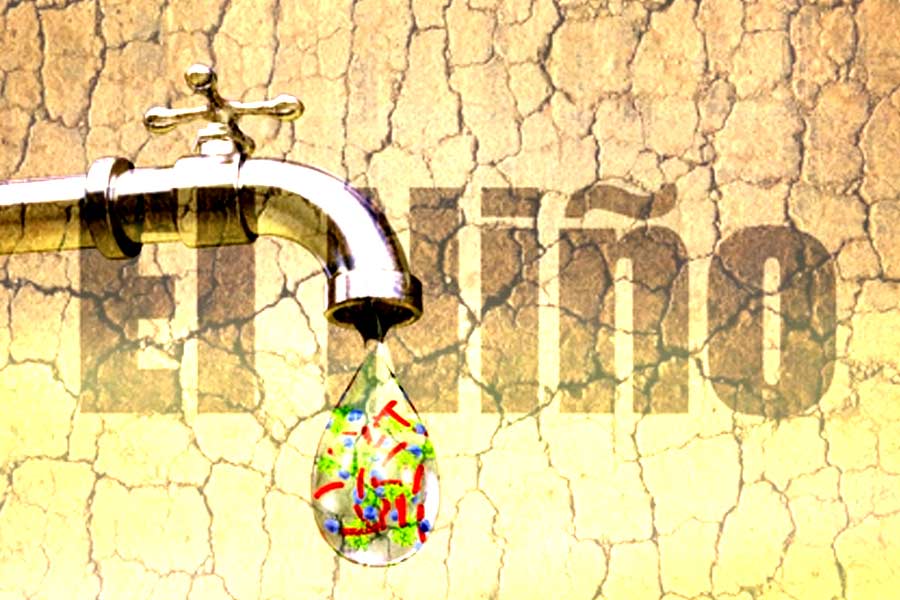
With forecasts pointing to a below-normal monsoon amid El Niño conditions, the Centre on Monday said the agriculture ministry has set up crop weather watch and crisis management groups and shared a contingency plan with state governments to minimise risks to kharif crops.
The assurance came during an inter-ministerial briefing convened in the backdrop of recent developments in West Asia, where officials also addressed concerns over food and fertiliser security.
States have been asked to maintain a seed reserve equivalent to one per cent of requirement, with a focus on short- and medium-duration crop varieties.
The India Meteorological Department's latest forecast pegs the southwest monsoon at around 90 per cent of the long-period average, indicating a below-normal season and raising concerns over crop risks if El Niño conditions strengthen later in the year.
"A crop weather watch group has been constituted and meets every Monday to study rainfall patterns, sowing progress, reservoir status, input availability, pest incidence and price trends," said Anupam Mishra, Additional Secretary in the Food and Consumer Affairs Ministry.
He added that a separate crisis management group comprising relief commissioners and state disaster management authorities has also been formed. The agriculture ministry is preparing district-level contingency plans in collaboration with ICAR and holding regular video conferences with state officials to review monsoon preparedness.
Taking into account the El Niño outlook, the ministry has revised fertiliser demand estimates downward for the kharif 2026-27 season. Urea demand is now projected at 194 lakh tonnes, 4 lakh tonnes lower than earlier estimates, while demand for di-ammonium phosphate (DAP) has been reduced by 6 lakh tonnes to 60 lakh tonnes.
Fertiliser stocks currently stand at 51 per cent of the kharif requirement, significantly higher than the conventional buffer level of 33 per cent, aided by advance stocking and improved logistics.
Domestic fertiliser production after the West Asia crisis stood at 104.81 lakh tonnes, while imports totalled 27.62 lakh tonnes, taking overall availability to about 132.43 lakh tonnes, said Aparna S Sharma, Additional Secretary in the Fertiliser Ministry.
India has also secured supplies of 25 lakh tonnes of urea and 50 lakh tonnes of DAP from sources outside the Strait of Hormuz, with shipments expected to arrive during June and July. In addition, a global tender for 70 lakh tonnes of urea is under process.
On the food security front, wheat stocks stood at 513 lakh tonnes against the July 1 buffer norm of 275 lakh tonnes, while rice stocks were at 397 lakh tonnes compared with the prescribed norm of 135 lakh tonnes, according to C Shikha, Joint Secretary in the Food, Public Distribution and Consumer Affairs Ministry.
Mishra said prices of cereals, pulses and sugar have remained stable, while those of potato, onion and tomato continue to remain range-bound, with no unusual volatility reported in essential commodities.
Officials also said edible oil availability remains comfortable, supported by regular imports of palm oil from Indonesia and Malaysia, sunflower oil from Russia and Ukraine, and soybean oil from Argentina and Brazil through trade routes largely unaffected by the West Asia situation.