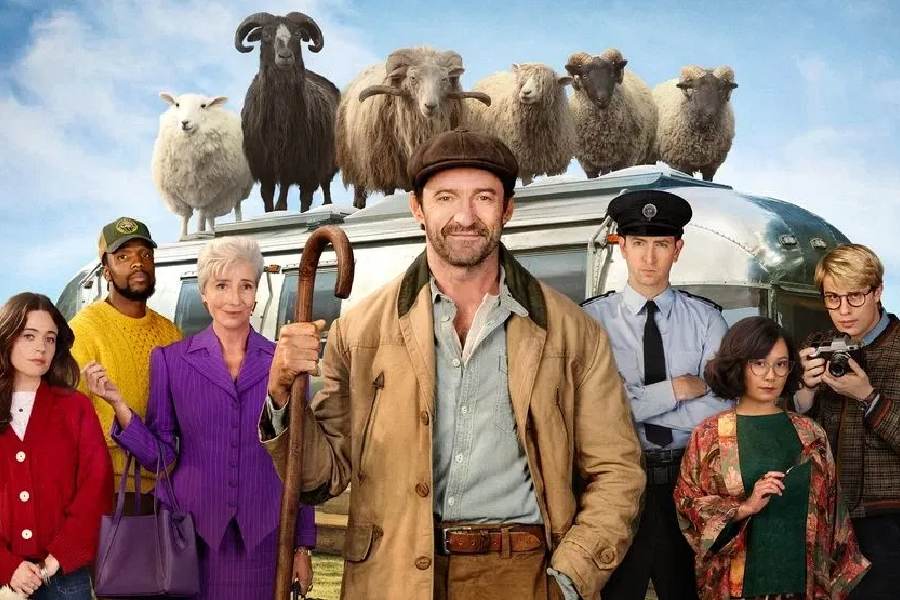
Murder mysteries have enjoyed a resurgence in recent years, from the glossy twists of Knives Out to the cozy charm of The Thursday Murder Club. The Sheep Detectives is a proud new member of the murder-mysteries club that will put a smile on your face.
The premise of the film sounds almost too absurd to work: a flock of sheep attempting to solve the murder of their beloved shepherd. Yet what could have easily been a one-note gimmick turns into one of the year’s most unexpectedly heartfelt family entertainments.
Directed by Kyle Balda, making his live-action debut after helping shape the Despicable Me franchise, The Sheep Detectives is based on Leonie Swann's bestselling novel Three Bags Full.
The story unfolds in the idyllic English village of Denbrook, where shepherd George Hardy (Hugh Jackman) lives a simple life caring for his flock. George is no ordinary shepherd. He knows every sheep by name, treats them with affection and respect, and spends his evenings reading detective novels aloud to them. What he doesn’t realise is that the sheep understand every word.
Among the flock are Lily (voiced by Julia Louis-Dreyfus), the sharpest and most observant sheep; Mopple (Chris O'Dowd), whose exceptional memory makes him indispensable; the dignified Sir Ritchfield (Patrick Stewart); and the solitary Sebastian (Bryan Cranston).
Their peaceful existence is shattered when George is found dead under suspicious circumstances.
While the human residents of Denbrook scramble to understand what happened, Lily becomes convinced that George was murdered. Armed with years of detective-story knowledge absorbed during George's nightly readings, she sets out to identify the killer.
The challenge, of course, is that sheep can’t exactly interview suspects or present evidence. What follows is a highly entertaining investigation conducted through observations, misunderstandings, accidental clues, and a great deal of bleating.
The film’s greatest strength is its understanding that the murder mystery itself is not the main attraction. The identity of the culprit matters, but the screenplay wisely focuses on the process rather than the destination. The investigation becomes a vehicle for character interactions, comic situations, and larger thematic ideas like the sense of belonging, and empathy.
Craig Mazin’s script takes obvious pleasure in poking fun at the conventions of detective fiction. The sheep frequently discuss mystery-story tropes, speculate about suspects, and attempt to apply literary logic to real life. These sequences generate some of the film's funniest moments. There is a self-awareness to the humour that feels refreshing.
What truly elevates the film, however, is the emotional depth woven into its comedy. Beneath the jokes lies a surprisingly mature exploration of how individuals cope with loss and discomfort. The sheep possess a peculiar tendency to ignore unpleasant realities, essentially choosing not to dwell on painful experiences. As the story progresses, this behaviour becomes a metaphor for the ways people often avoid grief, conflict, or difficult truths.
The screenplay handles these ideas with admirable restraint. Rather than delivering heavy-handed lessons, it allows emotional revelations to emerge naturally through the characters’ journeys.
The characterisation of the sheep deserves particular praise. Each member of the flock possesses a distinct personality, making them feel like genuine characters rather than cute visual effects creations. Lily is an engaging protagonist whose intelligence never comes across as forced. Mopple provides much of the comic relief, while Sebastian's outsider perspective adds unexpected poignancy. Their relationships evolve organically, creating an emotional investment that strengthens every aspect of the narrative.
Among the live-action performers, Hugh Jackman lends George a touch of patriarchal affection that makes his loss genuinely felt throughout the story. The emotional foundation of the film depends heavily on the audience believing in George's bond with his flock, and Jackman accomplishes that with ease.
Nicholas Braun is particularly memorable as Tim, the village police officer who initially appears hopelessly incompetent. Braun turns what could have been a simple comic caricature into a surprisingly endearing character. Emma Thompson, meanwhile, makes the most of her limited screen time with a delightfully authoritative performance as lawyer Lydia Harbottle.