
Acclaimed producers Tim Bevan and Kate Solomon didn’t set out to become experts in cinematic depictions of real-life terrorism; it just turned out that way.
Ten years after bringing the Oscar-nominated 9/11 drama United 93 to the screen, the pair was approached about overseeing another fact-based film centred on a passenger jet hijacking. This time the focus was on the remarkable true story of Air France Flight 139, which was hijacked by terrorists in 1976 and held for ransom at Uganda’s Entebbe Airport.
“Ron Halpern at Studiocanal approached Kate and me several years ago and said he thought the Entebbe raid could make for an interesting film,” says Bevan.
Halpern’s original concept was to tell the story from the perspective of the French pilots, so Solomon flew to France to interview several members of the real-life flight crew, including engineer Jacques Lemoine, who would eventually be portrayed in the film by actor Denis Menochet. “When Jacques told me about the week he spent in Entebbe, I knew there was something really interesting here,” she says.
Solomon recalls Lemoine describing a pivotal moment during the raid when he and the remaining hostages were lying on the floor and the hijackers were in the terminal with them. “He was lying very close to Wilfried Bose, the German terrorist, as all of the Israeli commandos were coming. They could hear gunshots outside. He said he locked eyes with Bose, who turned his weapon away and told him to stay down. In that moment, after having spent a week with the hostages, Bose realised he couldn’t actually kill them. To me, that was a moment worth exploring.”
PRISMATIC APPROACH, COMPLEX STORY
As they dug deeper into the events of 1976, Bevan and Solomon began to think there might be an even more compelling way to approach the story. “There were a lot of historical details about what happened that covered many different viewpoints,” explains Bevan. “For example, you have the hijackers’ point of view, the Israeli politicians’ point of view, and the Ugandans’ point of view. So it was possible to take a prismatic approach to tell this complex story.”
Still, having dealt successfully with the issue of midair terrorism in the past, Solomon wasn’t entirely sure she wanted to tackle the difficult topic once again. “When this film first came to me, my natural inclination wasn’t to do another hijacking movie,” she says. “But what was really interesting about this project was how different it was from United 93, which was set in three relatively small confines. Here, we get to explore the big picture and what happened behind the scenes with Yitzhak Rabin (who served as Israel’s prime minister twice) and Shimon Peres (who was both president and prime minister of Isreal). Also, United 93 happened in a very short period of time, while Entebbe was spread out over a full week.”
Bevan points to another important difference between the two stories: “Obviously, the great thing about this particular historical event in terms of cinema is that it ends with a thrilling rescue mission, so throughout the film you’re constantly racing towards a very exciting climax.”
CONFLICT ON MANY LEVELS
To help shape their research into a script, the producers tapped Gregory Burke, who had written ’71, a historical thriller set in Northern Ireland during the Troubles.
“He was somebody who we were very keen to work with,” says Bevan. “This is ultimately a story about conflict. International and political conflict. Conflict between the hijackers and the passengers. Conflict between the German hijackers and the Palestinian hijackers. And within each conflict there’s something surprising going on. So it takes a deft screenwriter to be able to pull that off, and Gregory did it brilliantly.”
Though each of the story’s dynamic characters interested Burke, the intriguing figures of Bose and Kuhlmann proved to be particularly compelling. “I was fascinated by the links between the German hijackers and their Palestinian counterparts, and the fact that they were somehow fighting on the same side,” he explains. “In the script, Bose and Brigitte feel like they have to do this because the movement they belonged to back in Germany was coming to an end. It had been eight years since the high point of revolutionary protest and things were slipping away. And so the Entebbe hijacking was almost a kind of fantasy for them.”
The story’s complex, and often contradictory, notion of heroism was another aspect of 7 Days in Entebbe the screenwriter felt passionately about. “Everybody involved in the event wanted to be the good guy,” says Burke. “That’s one of the things we deal with throughout the film. Bose and Brigitte want to be heroes. The Palestinians want to be heroes. The soldiers on the rescue mission want to be heroes. The politicians want to be heroes.”
With the script in place, the producers needed a director who could capture the complex drama, riveting suspense and real-life action of 7 Days in Entebbe. They turned to Jose Padilha, the director of several award-winning documentaries as well as episodes of the acclaimed fact-based TV drama Narcos.
For Bevan, the style and kinetic power of Padilha’s previous films made him the perfect candidate to helm 7 Days in Entebbe. “His work has a crackling energy and vision to it. You can see it in his thriller Elite Squad, and in the episodes of Narcos he directed,” says the producer. “With a film like this, it was important to find someone who wasn’t going to hold the camera still. We needed someone who knew how to move it quite a bit and make sure that all of the scenes have a sense of vibrancy about them.”

AIMING FOR TRUTH
Padilha was deeply committed to accurately portraying the events depicted in 7 Days in Entebbe. “It was very important to me to try to get as many details right as possible,” he says. “We talked to lots of people who were there at the time, including five or six soldiers who were part of the raid itself. The criteria was to run with direct witnesses, as opposed to people who said ‘I heard’ or ‘I believe’ it was like this. So I think we are close to the truth.”
To lend the film’s climactic action sequences a high degree of authenticity, the production enlisted technical and military advisers, several of whom were at Entebbe during the rescue mission.
“Having veterans of the Entebbe raid available to us was important,” says Solomon. “Two of the soldiers who were there helped train our guys, and they were on set the night we shot the raid, which was amazing.”
In addition, the filmmakers contacted several of the surviving hostages. “What we learned is that everyone has a different story to tell,” says Padilha. “Going by the testimonies alone doesn’t give you an entirely clear picture, since they frequently disagree on key moments. Although we aim for the truth, what we’re really telling is a version of it. We tried to get as close as we could to reality, but I don’t think anybody can claim to know exactly what took place at Entebbe.”
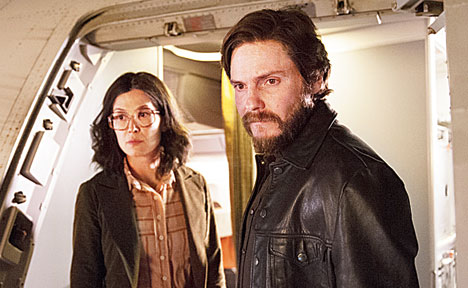
Oscar nominee Rosamund Pike was drawn to the role of German terrorist Brigitte Kuhlmann in part by the prospect of working with director Padilha. No stranger to playing characters that combine elements of good and evil, the actress found the film’s depiction of Kuhlmann impossible to resist. “The script really takes you inside the minds of the hijackers,” says the star of Gone Girl and Hostiles. “In most films, terrorists tend to be such unknown and personality-free figures. So it’s quite interesting to get to know what’s driving them in this story. If we get it right, you might, at certain moments, feel something for Brigitte and Bose.”
Though Padilha was thrilled with the idea of Pike playing the role, the issue of language was initially a concern. During Padilha’s first meeting with the actress, he asked her directly if she could speak German. “She suggested she could learn it phonetically,” recalls Padilha. “And I thought, really? I mean, how are you going to learn German phonetically?”
Ultimately, Pike performed all of the necessary dialogue in German. “We had a German language coach who worked with her extensively to make it as authentic as possible,” says Padilha.
To play German terrorist Wilfried Bose, the producers cast German-Spanish actor Daniel Bruhl. The complexities and psychological depth in Burke’s screenplay immediately piqued Bruhl’s interest in the project. “I was speechless and surprised when I first read the script,” says Bruhl. “I knew about Entebbe and I’d seen one of the earlier films on the subject, but reading this particular script made me aware of so many additional details that are absolutely fascinating. The script made it clear what drove each of the individual groups involved.”
Pike was thrilled at the decision to cast Bruhl. “I’d wanted to work with Daniel ever since I saw him in Good Bye, Lenin!,” says the actress. “And I thought he was just phenomenal as race car driver Niki Lauda in Rush.”
To prepare, Bruhl read several books about Germany’s radical Revolutionary Cells group and studied documentaries and films dealing with the time period in order to reacquaint himself with the way that people looked, spoke and moved. The actor also relied on the first-hand accounts of Ofer, the former soldier who participated in the raid.
“It was very impressive to have a real witness on the set with us,” says Bruhl. “He, of course, had an individual perspective on the event. Although it was fascinating to talk to him, I had to keep my distance in order to portray Bose successfully. I couldn’t fully agree with things he was telling me. It was quite freaky.”