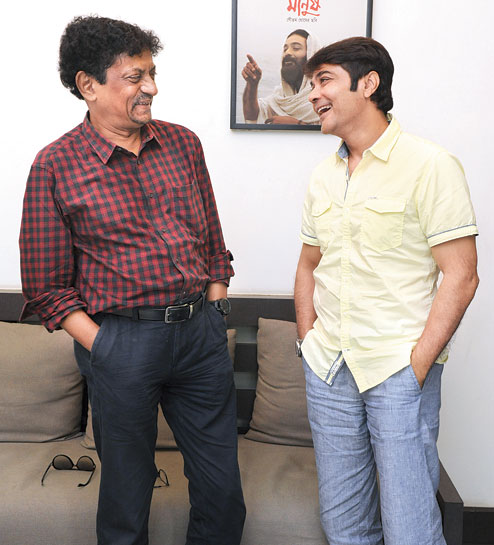

There’s a Moner Manush poster in Prosenjit’s Ballygunge home that sums up the bond between him and his Shankhachil director Goutam Ghose. A smiling Prosenjit, playing Lalon Fakir, is pointing at the distance as a mist engulfs him. Seeing the mist drawing in, on location for Moner Manush, Ghose had directed the unit to take up position. Prosenjit quickly slipped into Lalon’s robes and rushed in. A willingness to improvise and think on their feet are qualities they share. The only major difference? The filmmaker is yet to make his presence felt on social media, while the Tolly star has 364K Twitter followers! A t2 chat (spoiler alert)…
After Moner Manush, why did it take six years to make a film with Prosenjit?
Goutam: We have developed a nice chemistry since Moner Manush. Bumba (Prosenjit) is like a younger brother to me. I was looking for a character that would match up to the one he played in Moner Manush. Lalon was a legendary character. The film was successful and Bumba was accepted by the people here and in Bangladesh. So I was waiting for another role that would also be challenging for him. In 2014, I had incredible encounters with BSF and Bangladesh border guards. I heard some real stories from them, about human problems. It is such an artificial border.
The film is based on a real story. Badal (Prosenjit) crossed the border to save his daughter in the film. That happens on a daily basis there. It’s our dream that maybe one day people living along the border areas will get an on-spot medical visa.
After a national release, any other plans for Shankhachil?
Goutam: We have a huge Bengali population all over the world. Now we will take it out, to film festivals and release the film in the US, UK, Australia, everywhere.
Prosenjit: I have got requests on Twitter from Germany and other festivals to send the film.
Goutam: We got a fabulous response in Bangladesh too.
Prosenjit: A Goutam Ghose film is not a mass film but we are trying to market it in a new way. The film is running in almost 100 theatres across India (Delhi, Mumbai, Hyderabad, Bangalore, Pune) and Bangladesh.
After making so many films, what keeps you going?
Goutam: I am very adventurous. If cinema can give the audience a new experience, that’s good cinema. You have to give a new experience of time. One needs to experience time in cinema.
Prosenjit: I feel like I have done 10 films with Goutamda. In person he is very friendly. But once he gets hold of the camera, he is a different man. Anything can happen. We are always on our toes. He’ll tell you everything before the shoot, but on the set you have to match his rhythm.
Goutam: I am happy that my actors are always ready and willing to adjust.
The film’s cinematography is drawing a lot of praise. Tell us more about the cinematographer, your son Ishaan?
Goutam: Ishaan is a musician. He went to America to study music and got a scholarship. He came back. Then one day he went to the Kumbh Mela to take pictures. Once he returned he said, ‘Baba, this is such a fascinating country. I won’t go back to the US.’ This happened a few years ago, and I said, ‘Thank you very much son!’ He worked with me on documentaries later and this film marks his debut in cinema.
Are you on Facebook or Twitter?
Goutam: No, I’m not. I don’t know what to do online. I get to know things from my son and daughter (Anandi).
Prosenjit: It’s difficult to get through to him on the phone (laughs). We, in fact, call Boudi (Neelanjana) to get in touch with Goutamda.
Goutam: I’m a private person.

Bumbada, what was the most challenging scene for you in the film?
Prosenjit: My favourite is the scene where I tell the hospital’s receptionist that my daughter’s (Rupsha) body will not be cremated (revealing his character’s religious identity). I could have done it in an emotional manner, but I held back. I say the line in a calm, matter of fact way. And there is no bigger truth than death... when he loses his daughter, he comes clean. The father in Badal emerges when he meets the police and breaks down.
Goutam: The line is full of irony.
Why did you keep a tragic end, with the daughter dying?
Goutam: To me, it’s the symbolic death of Mother Bengal. It’s a metaphor. But there’s magic realism where the father imagines the girl saying, ‘Look, the shankhachil has come to our home.’ Rupsha is flying like a shankhachil. Maybe she is not there physically, but in Badal’s heart she is flying. There is no border… a kind of boundless boundary.
We see the doctor delivering the news of Rupsha’s death from a distance. The camera doesn’t intrude into the private moment.
Goutam: That is cinema. When you are saying something dramatic, you have to keep the space, and use it. The aesthetic choice is very important here — to stay back or not. Should I take multiple shots, or one shot is enough? I always work out the visual language when I am writing the script. And we did not compromise visually. After the Bombay screening, two important producers asked me about the budget of the film. When I told them, they almost fell down! They thought I was joking. We have always made films like this. Since we have budget limitations, we give our full effort to make films of an international standard. That’s what the best filmmakers like (Ingmar) Bergman have done. Making a film means shortening your life span a bit.
In the initial stages of the film, we see Rupsha peering into a magnifying glass and then later we see her peeping through a hole in the black border gate. There is a certain kind of playfulness in the cinematography…
Goutam: Very good observation. Certain things work as leitmotif in cinema. Cinema is very close to music, and elements come as a refrain, like in music. Since the beginning I have shot all my films. So I see the shots while writing a script. Of course, on visiting the locations you need to improvise certain things. And sound design adds another important dimension.
Right from the beginning, I have kept myself updated with the change in technology. I did the first magnetic mixing in Calcutta for Dakhal. I love taking on challenges. I did the first sponsored television serial. Kalbela was the first Bengali digital release. When I introduced Dolby Digital with Dekha, people questioned my choice. Now, all films are in Dolby Digital. Cinema’s technology is changing every day. Now, Shankhachil is being screened in Nandan in 4K resolution, so you get more detail.
Prosenjit: One interesting thing here is that the cinema-going audience is taking note of the way the film was shot or edited. And we have shot in real locations in Calcutta, guerrilla style, with a hand-held camera.
Goutam: Can you imagine shooting with Bumba at Ruby More at peak hour?! And it was not rigged, we did not block the streets.
Prosenjit: We conceived sequences keeping in mind the time it takes for the traffic light to go from red, yellow to green. Everyone was so tense.
Goutam: This is the challenge. My long documentary experience helps to take candid shots.
Once Badal gets his daughter admitted to the Calcutta hospital, there’s a scene where bikers are zipping down the streets, which is puzzling...
Goutam: Godard used to say something very interesting — ‘asynchronous’, which is putting in a few images that don’t sync with your film. People might understand the nuances 10 years down the line. These bikers are a symbol of Calcutta, its madness. In one scene we see a family suffering, and in another we see an image of a city’s madness.
Do you watch new Bengali films?
Goutam: Absolutely. I encourage young filmmakers. I liked Asha Jaoar Majhe. I found it original. Srijit (Mukherji), Kaushik (Ganguly) are really good, competent filmmakers.
We are carrying forward the mantel of the great filmmakers before us. And we have to give it to the next generation.
Overall, we are all recording collective memories. Manikda (Satyajit Ray), Mrinalda (Sen) encouraged us. Mrinalda came over to my place with a packet of sweets on hearing that I got a National Award. This is the kind of encouragement we got from them. It’s our responsibility to encourage the next generation. This exchange should always happen.
Will we see you acting in more Bengali films?
Goutam: (Laughs out loud) My job is to get people act for films. I’ll do it if I get the time.
What’s next?
Goutam: A tale of a courageous kid and his encounter with an Italian writer.
Arindam Chatterjee
What did you like/not like about Shankhachil? Tell t2@abp.in