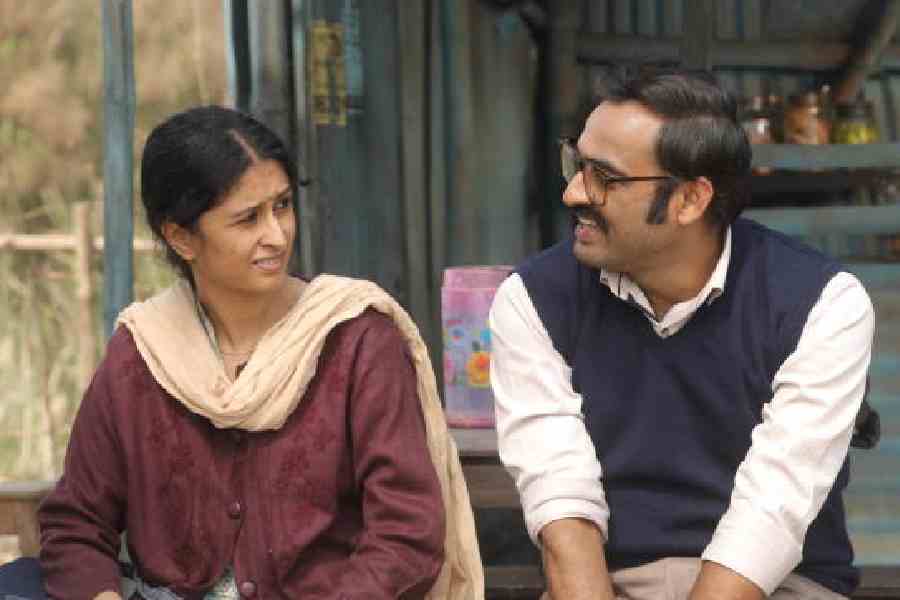
In Onek Din Por (Need to Belong), Saurav Palodhi, one of our few avowedly Leftist filmmakers, comes up with a Communist fairytale, set in a Never Never Land, mapped out in four distinct locations — a stately old mansion with stretching balconies, home for a commune of senior citizens, open to welcome more of the kind; a lone tea stall on a highway, maintained by a young man and his beloved who expresses herself in sign language that her lover cannot decipher but can still feel her messages; an STD booth in a small town, with a sensitive, caring boothkeeper, who leads another life in his house, sinking into alcoholism, finally detected with cancer of the liver!
As part of Palodhi’s scheme (represented and realised with remarkable craft by his art director Sanjay Pal), the ‘happy’ locations are characteristically theatre sets — the camera often settling on or crawling in leisurely pace across the surfaces of their walls to underline their fragile dreamscape insubstantiality; while Manik (a wide range of histrionics covered by Debesh Roy Chowdhury), the alcoholic STD boothkeeper’s home — a site of daily domestic battles — is ‘realised’ in terms of the lived space of a mofussil household, complete with the inner courtyard where the daughter can keep her bicycle.
There are rare glimpses of the big city, with its high-rises, the yellow cabs, the daily business of life, at one point in an extreme top shot from somewhere way up. But the distance between the commune and Manik’s house is covered by a bus and a bicycle — Mallika’s. Mallika commutes by bus and bicycle between the commune and her alcoholic father’s house, with stops at the tea shop.
The journey between the fantasy commune and the rugged mofussil ‘home’ is played out on yet another plane — the plane of romance, the slow process of a love affair, sly and delicate, with its own complications to be sorted out only in the larger sphere of the humane politics of the commune that seems to throw its spirit on to Tista (played with mischievous ease and humour by Doriyaa Das Palodhi), Mallika’s lover’s daughter who can, with her dreamscape sensitivity, come to terms with her parents breaking apart and bond with their new ‘special friends’.
Palodhi (and his collaborator on the story, Soumit Deb) bridges the roadway meetings of Mallika and Sayak and the uncertainties that loom over them to the commune that, as a collective, makes the journey in a car to ‘discover’ Mallika’s troubled ‘home’ to draw it into the commune’s generous universalist hospitality, climaxing in a rollicking musical happy ending.
It is left to Chitrangada Satarupa, a sensitive-quizzical presence, as Mallika, to weave the cords together in a consistently feeling performance, with familiar faces from the Bengali theatre scene filling in the rich scenario of characters embodying histories, each distinct in its own way.