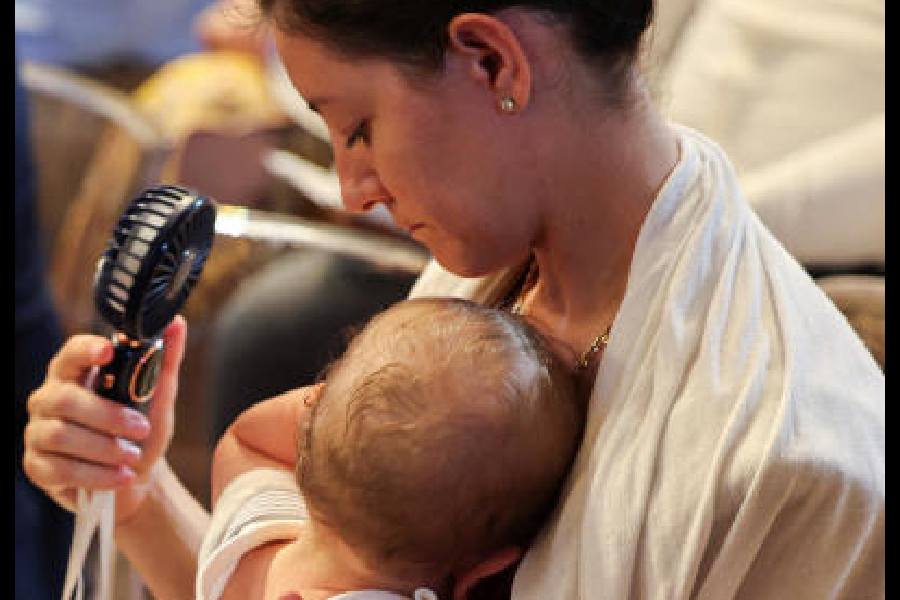
Europe is battling its worst heatwave on record amid research suggesting the human body may be less tolerant of extreme heat than previously believed, reinforcing warnings that runaway global warming could make parts of the planet, including India, too hot for human survival.
A study published in April had found that earlier deadly heatwaves in Australia, Pakistan, Saudi Arabia, Spain and the US had breached physiological heat-stress thresholds even though they had remained below the long-accepted 35°C wet-bulb
limit.
Wet-bulb temperature is the lowest temperature to which air can be cooled by the evaporation of water. If this temperature is too high, the body can no longer
cool itself.
The latest European heatwave has sent temperatures across parts of France, Germany, Italy, Spain and southern England between 5°C and 12°C above seasonal averages as hot air from North Africa combines with strong sunshine and clear skies to intensify heat.
The combination of heat and humidity has become especially dangerous, with 45 per cent of European cities analysed between June 18 and 29 exceeding indoor wet-bulb temperature thresholds, the World Weather Attribution, a multi-country research collective, has said.
Scientists say the European heatwave, like others elsewhere, bears the fingerprint of climate change — the rise in global temperatures since the industrial revolution, primarily driven by the burning of fossil fuels that releases Earth-warming carbon dioxide into the atmosphere.
The excess death toll from heat across Europe is expected to run into the thousands, with World Health Organisation director-general Tedros Adhanom Ghebreyesus saying more than 1,300 excess deaths linked to high temperatures had already been recorded since June 21.
“European homes, workplaces and schools were not built for these temperatures,” Ghebreyesus said in a post on X on Sunday, citing research describing Europe as “the fastest-warming continent on Earth, heating at twice the global average”.
The April study found that deadly heatwaves are already occurring at temperature and humidity levels once thought to remain within the limits of human survival, suggesting that earlier assessments may have underestimated the danger.
Scientists analysed six catastrophic heatwaves in Australia, Pakistan, Saudi Arabia, Spain, Thailand and the US between 2003 and 2024 and found that each crossed newly identified non-survivable physiological thresholds despite remaining below the 35°C wet-bulb benchmark.
“Non-survivable conditions are occurring during present-day heat events,” Sarah Perkins-Kirkpatrick, a professor of climate science at the Australian National University who led the study, said in a university media release.
Older people exposed directly to the sun repeatedly exceeded deadly physiological thresholds during every heatwave analysed, while pregnant women, young children, people with chronic illnesses and those unable to access cooling faced disproportionate risks.
The researchers said adaptation measures, including shade, cooling-oriented buildings, fans and interventions such as skin wetting, would become increasingly important as extreme heat becomes more frequent.
The findings suggest that regions projected to experience unsurvivable heat could be more extensive than earlier studies indicated because dangerous physiological limits appear to occur at lower heat-stress thresholds than the traditional 35°C wet-bulb benchmark.
A 2017 study led by researchers at the Massachusetts Institute of Technology projected that under unchecked global warming, combinations of heat and humidity could exceed the limits of human survivability across parts of South Asia, including the Chhotanagpur Plateau, eastern India and Bangladesh.
The researchers identified densely populated regions along the Ganga and Indus river systems among those facing the highest risks under high-emissions scenarios and warned that even lower levels of warming could expose vast populations to conditions considered extremely dangerous.
“A perfectly healthy adult” exposed to a wet-bulb temperature of 35°C for six hours or more has “very little chance of survival”, the study’s lead author, Elfatih Eltahir, said, adding that the threshold would probably be even lower for older people, young children and those already ill.
Stefan Rahmstorf, a physicist at the Potsdam Institute for Climate Impact Research in Germany, said that even with zero emissions, the effects of climate change cannot be reversed because carbon dioxide remains in the atmosphere for millennia, although further warming can still be limited.
“Our children and grandchildren will bitterly curse us... tipping points are drawing near,” Rahmstorf wrote on June 26 in a post on X.