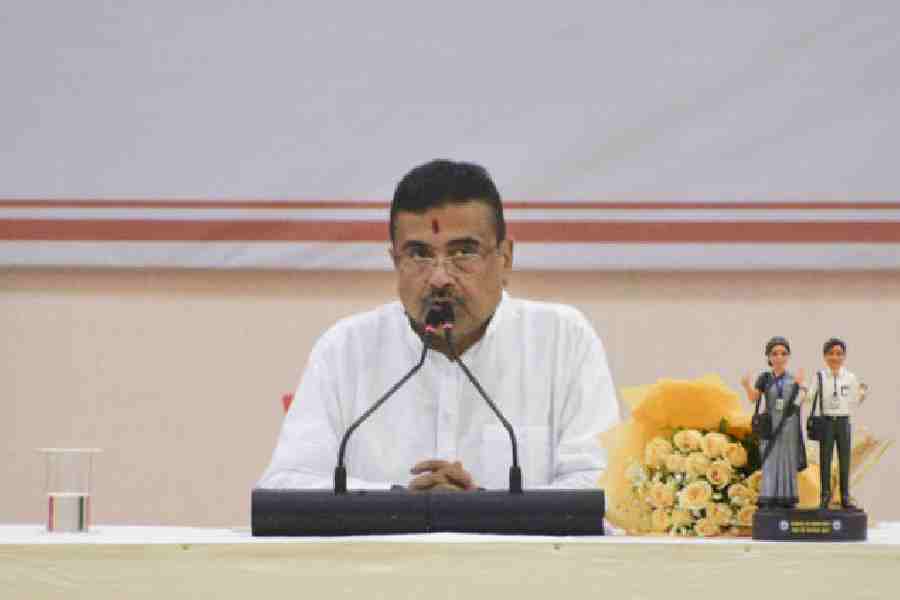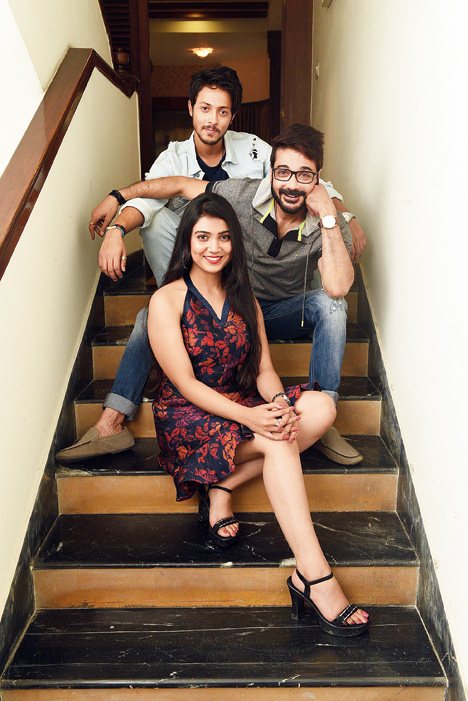

Picturesque locations, a film that stays on the road and four characters on a journey of self-discovery — Uronchandi, produced by Tolly star Prosenjit’s production company nIdeas, offers all. Directed by Abhishek Saha, it marks the debut of actress Indrani Dutta’s daughter Rajnandini and actress Chaiti Ghoshal’s son Amartya Ray. A t2 chat with Prosenjit, Rajnandini and Amartya...
Why did you pick this film to produce?
Prosenjit: I had heard the script in July last year. But I wasn’t really thinking of producing the film at that point of time. After the narration got over, I asked Abhishek about the way ahead. He said that he wanted to direct it. I told him to be patient. Then we started getting together the technical team. Then I got their feedback... I began to feel that they were falling in love with it. Seeing their excitement, I came on board. I wanted this film to happen.
And I’m very sure about the film. I was looking for fresh content. You won’t find a single indoor shot in this road movie. This is my way of giving back to Bengali cinema. The audience has faith in me... let me come up with something new.
How did you go about the casting process?
Prosenjit: We wanted to create characters first and not the names. There is a freshness to the cast. Of course, this film wouldn’t have worked without Sudipta (Chakraborty). She had to be a part of this. I have seen Rajnandini as a child. I have worked with her mother and I had told Indrani not to launch her in a hurry. She has qualities of a star. Ask any other established Calcutta director. She is also a wonderful singer and dancer. I knew she would be perfect for the role. Of course she also did Srijit Mukherji’s Ek Je Chhilo Raja... and I had asked her to go ahead so that she gets exposure there. For Uronchandi, she did an audition.

today; (below) Amartya and Rajnandini

Were you present at the audition?
Prosenjit: No.... Now, we come to Amartya’s role. I had also seen him as a kid. I had worked with his mother as well. But I had not seen him for a long time. His name came up when we were looking for a fresh face. He also sings well and plays the guitar. We took three months to block the cast before the shoot. I feel this new generation of artistes will create a revolution of sorts in Bengali cinema. And I interact with them closely. They see and read cinema in a new way; their understanding and perspective towards cinema is different.
Tell me something... why are the kids below 18 not watching Bengali cinema here? We need to think about it. Because we don’t speak their language, because we cannot connect with them.
The change in the cinematic language has somehow not been captured. The new generation is super talented. They only need proper guidance. They are straight-forward and spontaneous, and not pretentious.
What was Amartya’s biggest challenge?
Prosenjit: In the film, he had to drive a truck. I told him to drive my (make-up) van whenever he would come down to Calcutta. That’s how he learnt how to drive a heavy vehicle. That’s how he got his confidence.
Amartya: I would drive it at 5.30am, in December, through the fog.
Prosenjit: They worked hard. I didn’t get any complaints bout them. In the middle, Rajnandini had put on some weight. But then she worked it off. And she did workshops with Sudipta. And Sudipta is like a teacher, and the film is also about their journey… so it came off really well on screen. Their bond developed through the workshops.
Did you drop by the set during the shoot?
Prosenjit: No. They would just update me after the day’s pack-up. Only one day Rajnandini fell ill... she fainted after having tea and grapes.
Rajnandini: I didn’t tell my mom out of fear! She would have come to the sets.
How was Abhishek as a director?
Prosenjit: He is a nice guy, and very sorted. A director shouldn’t give everything in his first film. Keep something for the second and third films. The great thing about Uronchandi is that the film doesn’t have any indoor shot.
Amartya, before the shoot Rajnandini and you learnt that both of you live in the same para (Golf Garden)…
Amartya: Yes! I still remember the first day of audition. For me, it has been a learning experience, very exciting.
But you are also learning direction now. So will you pursue that?
Amartya: I didn’t plan on joining FTII, Pune, in direction. I got through. I want to learn the craft. I like telling stories. And I write my songs. So if I can tell the story through a character or a song I’ll be happy. Right now, I think of myself as a performer.
Rajnandini, did you have ambitions of becoming an actress since childhood?
Rajnandini: No, not really. Two years ago I thought I could take it seriously enough. I felt I could work hard enough, or have the discipline to become an actor. People had told my mother to let me act in telefilms. But she had always told them that I would join films when I felt it was the right time. I took singing more seriously. Uronchandi is special. Every debutante doesn’t get a platform like this.
How did you deal with your first shots?
Rajnandini: I was not tense. I was just running along the railway tracks. But I did develop cold feet before a few shots. Of course I was intimidated sharing screen space with Sudipta Chakraborty. I dedicate every ounce of compliment that I have got till now to Abhishekda and Tumpadi (Sudipta). They really worked hard on my acting skills.
To brush up on my language, I would learn Sukumar Ray’s rhymes. I had to run wearing a Benarasi sari; they made sure I was comfortable doing that.
Amartya: The first shot I gave was also my first shot in the film.
Prosenjit: The scheduling was done is such a way that shots were taken in the way the story progresses. The two characters meet on the road for the first time, and that’s how their friendship develops. It’ll make it easy for them.
You have seen the film. What did you think?
Prosenjit: I am really proud of this one... the way the story is told. There is a journey in the story. And finally, it’s a story about the progression of women. It’s a story about women being independent, about gathering courage to break free of their circumstances.