 |
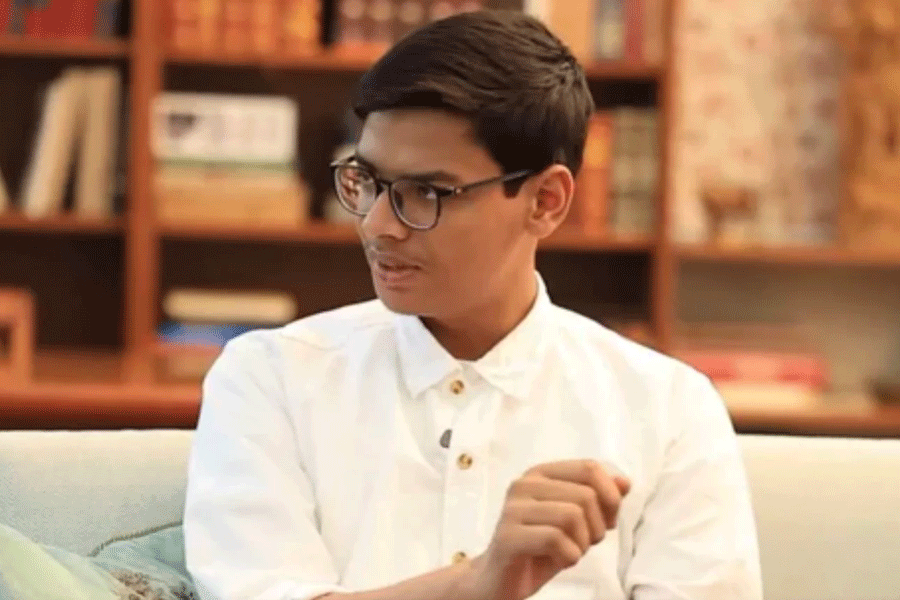
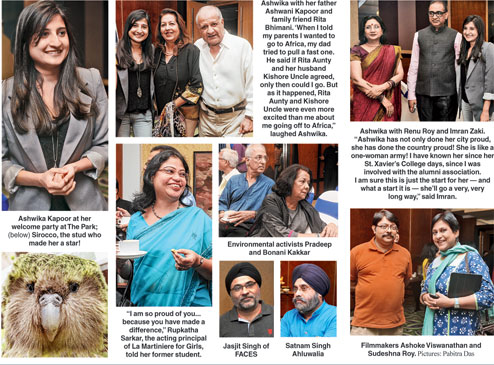
Ashwika Kapoor, the 26-year-old Calcuttan who won a Green Oscar last month, was welcomed home by her family, friends, former teachers and well-wishers at The Park on November 6. The alumnus of La Martiniere for Girls and St. Xavier’s College is the recipient of the Wildscreen Panda Award (also known as Green Oscar) in the Best Newcomer category, the youngest and first woman from India to do so.
Ashwika’s entry was titled Sirocco — How a Dud Became a Stud, a short film on the Kakapo, an endangered flightless bird native to New Zealand. She made Sirocco as part of her graduating project for a course in natural history filmmaking in Dunedin, New Zealand. At The Park programme, co-hosted by Spandan, FACES and CenturyPly, Ashwika sat in conversation with Renu Roy and then took some questions from the audience. Excerpts.
A zoo in my home
When I was three or four years old, I wanted a dog. Mom said ‘No’. I said, ‘Okay, duck’. For some reason, Mom said, ‘Yes’. So I got home a duck. All my friends used to take their dogs for a walk to CC&FC, I used to take my duck for a walk on a leash to CC&FC.
After that I got a couple of rabbits. Very soon that became 20. Then about 20 guinea pigs, then pigeons, mice… all kinds of things.
Off to Africa
I grew up as a child actor, so I used to prance around in these commercials and I did some telefilms as well, with some big names, like Aparna Sen, Rituparno Ghosh and Aniruddha Roy Chowdhury. And I think my learning in films started very early because when I was on set, I learnt so much just by observation.
So, when the time came to decide what I wanted to do, I put together my two favourite things — animals and films — and decided that I would leave for Africa.
I chose this training programme in South Africa because it was giving me an opportunity to actually live in the wild. To stay for two months in the middle of the forest in Africa and learn how to use a camera in the wild.
And then I fell in love...
This training programme didn’t focus so much on camerawork, editing or scripting but why I did it was because it taught the discipline of wildlife filmmaking. I realised that it was going to be a very difficult career choice. A lot of well-wishers were saying, ‘Be careful, it’s really challenging, no jobs available, it’s going to be really hard… plus, you’re a girl.’ And these were people within the industry, giving me honest advice.
I managed to get myself a project in Kenya, in Masai Mara, filming vultures and then I was in Nairobi for a while. Very close to that place there’s an animal orphanage. That’s where I fell in love. I met this young cheetah, her name was Mazeema. I made friends with the caretaker and convinced him to let me into the enclosure and once he finally agreed, Mazeema did a long feline drama. She took about a day or two to warm to me but by the second or third day, she used to come running straight at me. Once she became friends with me, suddenly all that wise advice coming from grown-ups just went out of the window!
A formal degree
Right after Africa, with a three-minute small little film I had made, I managed to get more assignments. The more I learnt, the more experience I gathered in the field — I even made a film for WWF — the more I realised how much more I had to learn. Slowly, the thought of studying this formally was becoming more and more attractive. The second reason was when I told people I was a wildlife filmmaker, they would never believe me!
When I started out, I knew it was a tough career but the driving force behind it was the fact that I felt strongly about conservation. The biggest lesson that this course taught me, ironically, was that to make good films, I had to beat the conservationist out of me. I had to stop thinking like a conservationist and start honing my storytelling skills. I had to start packaging conservation films in a way that was digestible and accessible to people who weren’t conservationists. Because otherwise it’s preaching to the choir.
My discovery of Sirocco
When I was looking for story ideas in New Zealand, I was consciously trying to avoid gloom-doom stories. I wanted to make something that would entertain as well as educate. While there is a message in my film — it is definitely about Kakapo conservation, and how difficult it has been — I didn’t want it to be a sad conservation story. I wanted it to be a celebration.
I suddenly came across this newspaper which said a Kakapo parrot was coming to Dunedin, where I was. I read up a bit more and realised that there are only 125 Kakapo parrots and all of them live on an isolated island in the middle of the Pacific Ocean. There are so few that all of them have been individually named. They are all wild but they’ve been all named at birth. And one among them is convinced that he’s a human being — Sirocco.
I realised that there was something really odd going on about this particular parrot. He had a very, very strange life story and so I decided to go ahead and make this film. It’s a rags-to-riches story about the world’s only bird with a government job!
My next step
I’m working with an international television channel which is allowing me to film something cross-country India. And I am very happy about it because my experience in India is limited so far. One is spoilt for choice in this country. But it’s also very difficult to film in India, lots of permissions need to be taken, there are many conditions put forth by the forest department, like you can’t get off the car, then there are very high fees… so lots of challenges but there’s so much to do here. I’ve been dying to film red pandas. A lot of people don’t even know they exist! And they are right up here in Darjeeling.
An average day in the wild
Well, nothing later than 4am is when you wake up. Because dawn and dusk are the most active times for any kind of wildlife and also the light is the best, for photography. Of course, when you are doing filmmaking, you come back after sunset and after that you have to back up all your footage, clean all your gear, pack for the next day, have dinner, clean yourself up and then go to bed. So you’re really sleeping very few hours.
But the biggest challenge is what lies in between! I can really say with full confidence that I have spent most of my career so far staring at grass. Nothing happens in the wild. But when it happens, it happens in a flash. So, not only are you staring at grass, you’re staring at grass very alertly!
Animals as ambassadors
As far as I am concerned, animals make the best ambassadors for conservation. Animals, just by who they are and what they are, are so much more effective than a bunch of us standing there and saying that ‘this is cute, it’s endangered, it should be saved’. If you tell their story and tell it honestly and in a nice and engaging manner and you bring them to the forefront, and let them unfold the magic for you, animals make the best conservationists... so long as nothing gets plucked out of the wild.
A promise to the audience
I come from a humanities background. The rest of my class [in New Zealand] all came from zoology and different kinds of sciences. The most important thing about a documentary is that you are making a promise to the audience that you are saying the truth. So research is right up there. We have to go through papers and papers and papers... and proper scientific journals, full of jargon. I used to be googling every third word!
At the beginning, not having science meant it was very difficult for me, but in a way that turned out to be almost an advantage. A lot of the science students were bringing in language that was part of their natural vocabulary but wasn’t necessarily a part of the audience’s natural vocabulary. But because I didn’t come from a science background, I was naturally replacing those with digestible film script words. So every challenge sort of has a silver lining.