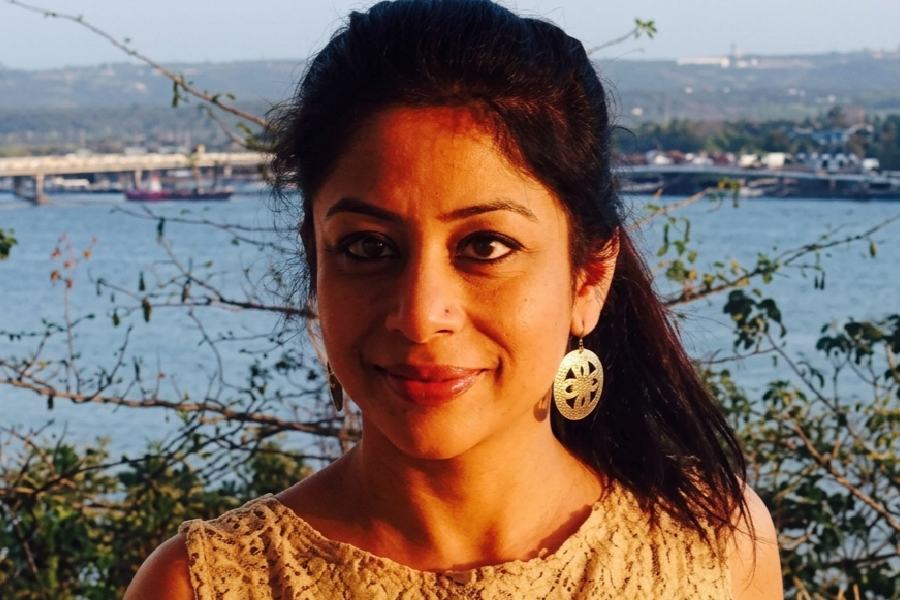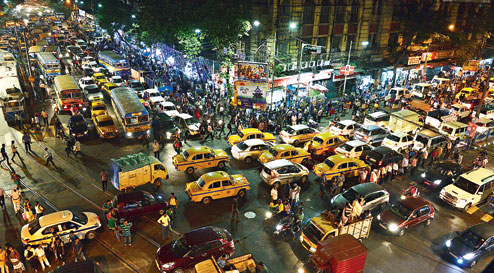

Kushanava Choudhury, who grew up in Calcutta and the US, has poured his relationship of love and discord with his hometown into his debut book, The Epic City: The World on the Streets of Calcutta (Bloomsbury India, Rs 499). t2 caught up with the Kochi-based 39-year-old.
The book is a diary that reads like a lover’s letter to Calcutta — both an ode and a complaint....
Love letter, diary, travelogue, ramya rachana, ode, complaint register, joke book — you can read it in any of those ways as long as it draws you into the book.
I want to bring as many people to the text as possible, so I worked to make the writing simple and entertaining. In this regard, I learnt a lot about technique by studying the writing of Syed Mujtaba Ali, who could write about German philology or Afghan history and still be funny and appeal to a wide general audience. I think anyone who reads Anuja Chauhan or Amish or similar authors today can find something that they like in The Epic City.
Take us through the germination of the idea for the book.
No one in my family is a writer. In fact, until I went to college I didn’t know any writers at all. The first writer I ever met was John McPhee (Pulitzer Prize-winning writer of non-fiction), whose “Literature of Fact” seminar I took as an undergraduate at Princeton University.
After graduating, I moved to Calcutta to become a reporter at The Statesman. I kept in touch with McPhee. Whenever I went back to New Jersey, he would take me out to lunch at the Annex, a basement bar and cafe in downtown Princeton. One year I was telling him about my work at The Statesman and he said, why don’t you write a book about Calcutta? That conversation took place 14 years ago! But it’s how I got the idea to write The Epic City and more importantly the courage to pursue the writing life.
What about this city made you want to write your first book on it?
I left, but the city never let me go. It followed me wherever I went; I could not move on. It haunted every world I lived in. When that happens, you can either destroy your life, as many artists have done, or you can try to confront the ghosts inside you. You have to give them their due and then let them go. Ghaare bhoot chaaple, some people perform exorcisms. Writing the book was the only way I knew how to do something similar. I don’t think that art can save you, or redeem you, but it can sometimes give you some peace.
Calcutta’s passion for politics is well-known, but The Epic City has somewhat avoided this subject...
I was born a year after the Left Front came to power (in 1977) and the time I describe in the book ends in 2010, a year before the end of the Left rule. I write about trade unions and refugee colony politics, how the Left grew in Bengal after Partition, why it splintered into CPI, CPM and Naxalites, the ghosts of the failed Naxalite revolution and the graveyard peace that followed. I think The Epic City can be read as an account of Calcutta under Left Front rule.
What you won’t find in the book is me bashing the CPM or the TMC or Jyoti Basu or Mamata Banerjee. That kind of superficial analysis belongs in a newspaper, because it dates quickly. Calcutta is shaped by its deep political culture, and you miss that depth if you focus only on the surfaces. For instance, Left Front rule in West Bengal was embedded in the tea shops and the para clubs and party offices and CITU auto stands. It was a phenomenon without precedent anywhere in the world in terms of producing a political culture that held the society together for a generation, which even virulent anti-Communists can’t deny.
With all of Calcutta’s inadequacies that you write about, why did you think the word ‘epic’ would do justice to your book?
People have been pronouncing Calcutta dead for my whole lifetime! I would only quote what Mark Twain had once said, when a newspaper mistakenly published his obituary: “The reports of my death are greatly exaggerated.”
Calcutta is one of the world’s greatest cities, and will remain so regardless of what I or anyone else writes about it. A city as complex and fascinating as Calcutta deserves to have hundreds of books written about it, not just one or two.
There is a certain propaganda about Calcutta that it’s a city where nothing happens, about which there’s nothing to say, nothing worth writing about, because it has not marched dutifully to the drumbeat of economic liberalisation. Do these people think that in the coming decades great novels will be written about shopping malls and office cubicles? In the US we have had malls and call centres for 70 years without producing a Hemingway or a Fitzgerald, so I’m not optimistic.
I accept that life in the city is very difficult at many levels. But the book isn’t called ‘The Perfect City’, or ‘Neat and Clean City’ or ‘Covered Drain City’. There are many good reasons to not want to live in Calcutta, but its epic scope is hard to deny for anyone who knows the city in her bones.
What impact has the city’s culture and literature had on you?
A fish doesn’t know that it’s wet. The city’s culture and literature was the water in which I lived; it was who I was. Only when I migrated and became a fish out of water did I realise this. Perhaps returning to the city and later writing the book was a way of getting back into the water.
Is this book also a product of your work as a journalist?
Everything in the book is real. This is non-fiction. All the people are real, though a couple of names have been changed, for obvious reasons. When I quote someone, it’s what they actually said. In this kind of writing, you have to maintain the same standards as in print journalism, even though I have tried to place it in a narrative that reads like a novel.
When we were growing up, we were taught not to talk to strangers, not to look at people living on the footpaths, not to ask too many questions about the politics of the street. Fish curry-eating boys and girls of my generation in Calcutta were raised by parents who were shell-shocked by the Naxalite mayhem. We were taught to drink Horlicks, mug up, take exams and get out of Calcutta. Newspaper reporting, in contrast, teaches you to leave your AC room and go outside and talk to strangers. No other profession gives you that kind of leeway to enter countless little worlds that are contained in the city. Once you have that exposure, you can never go back and write bloodless novellas about drawing rooms. In that sense, I think reporting is indispensable training for any writer.
If you had to name one thing that still brings you back to the city, family apart, what would it be?
The language. I don’t mean the language of Tagore; I mean the everyday language of the streets, the sounds of hawkers that Radha Prasad Gupta wrote about, the gossip of housewives oiling their hair before the afternoon bath, the arguments of children playing football on the street in the late afternoon, the taunts hurled by passengers at bus drivers for driving badly, the jokes that people make at tea shops about the news of the day.
And I don’t just mean Bengali. In Calcutta I love hearing the Bhojpuri-infused Hindi-Urdu, the unique idiom that is called ‘Kalkatiya zabaan’, plus, the Hindi that’s spoken by Bengalis, the Bangla that’s spoken by Biharis, not to mention the insults hurled during street fights, by nearly everyone, in English. I go to Calcutta just to feed my ears, and of course my stomach.
Anannya Sarkar