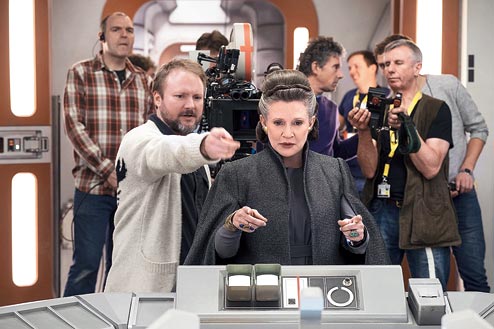

Rian Johnson — the man behind critically-acclaimed films like Brick and Looper — steps into the Star Wars universe to direct The Last Jedi, that hits screens worldwide today. A chat with the man who’s also directed a few episodes of our favourite badass TV show Breaking Bad...
Tell us how you got involved in Star Wars: The Last Jedi…
I had a couple of general meetings with Kathy Kennedy (producer) after she stepped in and started running Lucasfilm. But they were very general meetings, and I didn’t think that I was actually in the running for anything. And then, at some point, I came in for what I thought was another just how-you-been, what-are-you-working-on meeting, and she felt out whether I would be interested in doing this. My jaw hit the floor! And I took some time to think about it. It was a big decision, actually. On one hand, it was something that I felt was a dream offer. On the other hand, it was a big life-changing deal. I wanted to make sure it was something that was going to be a good experience, and it really has been.
How do you even tackle the responsibility of following up on The Force Awakens?
If I had let myself zoom back and look at the enormity of the task, and the responsibility of it, I would have just been paralysed and just spent the last few years curled up in the foetal position. So, we just had to dive in, and so I first read the script for The Force Awakens. They were shooting it when I started writing, and so I was able to watch dailies, and I just started from square one.
I looked at where The Force Awakens left off, and I wrote down the names of each one of the characters, and I started asking myself what I knew about each of these characters. What do I think they want? Where can I see them going? And what would be the hardest thing for each of them to come up against? And once I got to a place where I had something for each one of them that made sense, I started drawing it out into a story.
How is The Last Jedi going to build on what has been done?
I knew that the bigness and the epic sense and all of that would sort itself out because once we started playing with these toys, we came up with cool battles and cool stuff. What I needed to really work on were the characters and the story. That was really the starting point of the whole thing. Because it’s the middle chapter of a trilogy, this is the one where we have to slow down a little and dig into everybody a little bit more.
.jpg)
Tell us about some of what personal challenges the characters are going through.
Rey (played by Daisy Ridley), at the end of The Force Awakens, has been thrown into this big adventure and been sent on a mission to find Luke (Skywalker, played by Mark Hamill). She has a desire for connection to her past and some notion that there are answers there that she can get. I think she probably expects there are some answers about who she is, and that’s really what she is on a quest to find out. Not just who her parents are or where she comes from, but what’s her place in all of this.
Kylo Ren (Adam Driver) was the character I was most excited about writing. In the first Star Wars films, Darth Vader was a great villain, but he was never someone that you identified with. Vader was the monster… the scary father, and then he was the father you had to reconcile with. With Kylo, it’s almost like Rey and Kylo are two halves of the protagonist. Rey is the light, and Kylo is the dark. Kylo is that anger of adolescence, and wanting to reject your parents, and wanting to break away, which, to some extent, all of us can identify with as much as we can identify with the hopeful Rey looking up at the stars from her planet. And that is thrilling to me. My favourite kind of bad guys are the ones that you identify with.
Tell us about the importance of strong female characters in the Star Wars universe.
One of the first things that Kathy told me when she asked me if I’d be interested in doing this was that the lead character was a girl named Rey. I was instantly into that… it just felt right. Leia (played by Carrie Fisher) was the first female figure that girls and women could look up to, and seeing how much it meant to them, Carrie Fisher was very conscious of that and held that with her. She felt a responsibility to make Leia great. Now, in addition to Leia and Rey, we have the characters of Rose (Kelly Marie Tran) and Admiral Holdo (Laura Dern). In this movie, there are a lot of really interesting strong and powerful, weak and conflicted, good and bad female characters.
What are some of the new worlds that we’re going to see in this movie?
There are two new planets that we see. One is the planet Cantonica that the city, Canto Bight, is on. And this is kind of the Monte Carlo of the Star Wars universe. It’s where the galaxy’s one per cent hang out. We’ve seen luxury before, in the prequels, and that design, so there’s some precedent for it, but it was a fun challenge trying to figure out what it was going to look like.
And then the other big new world is Crait, which is a mineral planet. I had a really specific visual idea for Crait from the very start, which was that it would be white, a thin white layer of salt actually, but like a top soil. And then, under that, would be this ruby red sort of crystal foundation. I liked the whole notion of what a battle on a planet like that would look like. It just felt like it gave incredible possibilities in terms of graphic design for an environment that we hadn’t seen before.
How many sets did you build?
It’s an insane amount of sets. We shot for like 100 days. We shot at Pinewood Studios (in London), which was great. But the entirety of Pinewood was just us, every single stage. And even with that, there was a huge amount of shuffling around. It was like a big Tetris game in terms of, okay, you’re done shooting with this set, so we instantly tear it down and build another while you’re shooting here. We only had a limited amount of stages, even though we were using all of them. It was this big shell game of finding space for everything. But it’s really worth it. When you watch the film, it gives that sense of everything being grounded in the real world.
How important is it to you to physically create as much as you can?
A big part of what defines this world is the feeling that you could reach out and touch anything. You combine the tactile real sets that we’re building with the magic that Ben Morris, our ILM Supervisor, and his whole team can do, and that’s when it really starts feeling special.
Can you tell us what locations that you shot in?
The big location was Ireland. A big chunk of the movie takes place on Luke’s island, which is Skellig Michael, an uninhabited, tiny island off the southwest coast of Ireland. it’s a bird sanctuary, and a UNESCO Heritage Site. It is quite inaccessible. We could only get there for two days, so we had to really pick our battles in terms of what we could actually shoot on Skellig.
The vast majority of the scenes set on the island were shot on the southwest coast of Ireland, County Kerry, and up the coast a little bit, which was great because it very naturally shared a lot of the same feel and look of Skellig, but was more accessible for the crew. We were weirdly blessed in terms of weather when we were there. There were days when we were literally sitting there in Ireland waiting for clouds!
Our Irish crew was amazing. They built the set that Luke is living in. We actually built it cantilevered out over a massive cliff, just outside of Dingle. They even had to build a temporary road for everyone to get up to it. It was a massive, massive project. But then you’re up there, and you’re sitting there and you’re looking out at the ocean, and you’re just there. And the actors are just there, so you just point, turn the camera on, and you’re in the scene. Technically, we could have just set up a green screen and built a set, but when you watch it, you can tell it is actually real. It was incredible.
Dubrovnik in Croatia was the perfect place to shoot the city streets of Canto Bight. But we didn’t go there with any actors. We went there with a second unit. It was another one of these surreal things where we were in Dubrovnik with a whole crew taking over the street and smashing speeders. In Bolivia, we were up on the salt flats of this very high elevation to get elements for the battle on Crait.