Satyajit Ray, who framed Kashi as the Bengali’s second home in films like Aparajito and Joy Baba Felunath, could hardly have imagined that years later Prime Minister Narendra Modi, the MP from Varanasi (erstwhile Kashi), would attempt to turn Bengal into a political second home, complete with jhalmuri stop, bringing food to the centre of this Assembly election.
What appears anecdotal is a study in political signalling and cultural semiotics, a layered communication strategy aimed at negotiating identity, familiarity, and political legitimacy. The way to a Bengali’s heart is through the stomach, and the BJP has long been fighting the bohiragoto (outsider) tag.
In his novel The Stranger aka The Outsider, Albert Camus exposed the political risks of emotional and cultural detachment. In Bengal’s electoral context, “outsider” is not just geographical but sensory and cultural — what one eats, how one speaks, and how one performs belonging.
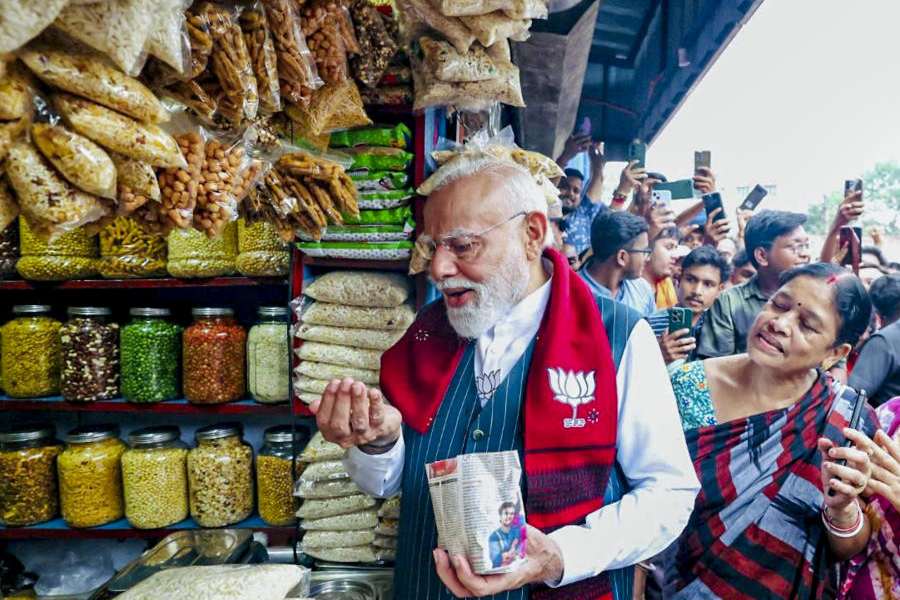
In this image posted on April 19, 2026, Prime Minister Narendra Modi tries ‘jhalmuri’, street snack made of puffed rice, on the sidelines of public meetings ahead of the West Bengal Assembly elections, in Jhargram. (PTI)
The Trinamool, not typically associated with high literary framing, successfully operationalised the outsider label in 2021.
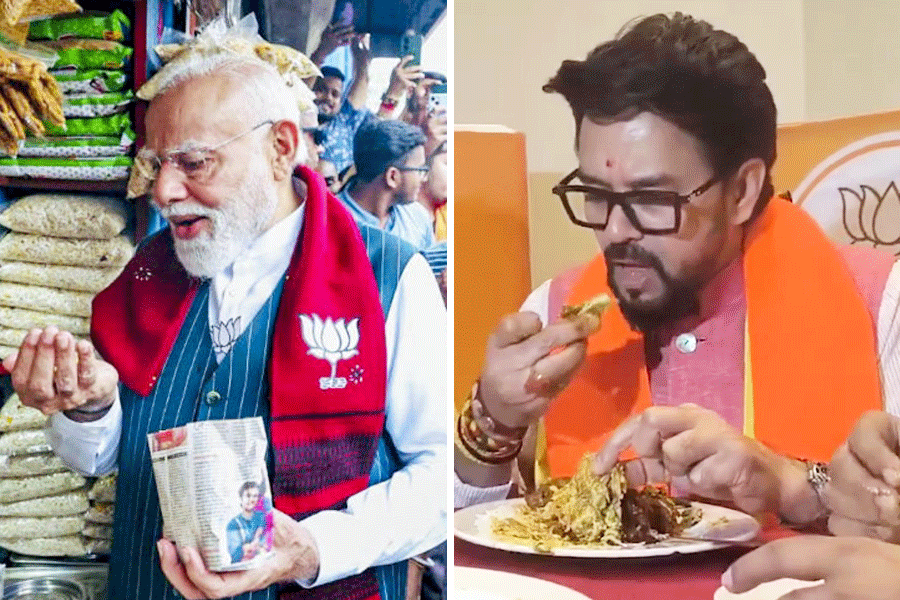
Hence, in this election cycle, Modi is having jhalmuri in Jhargram; Anurag Thakur is seen eating fish; and BJP candidates like Koustav Bagchi (Barrackpore), Rudranil Ghosh (Shibpur), and Sharadwat Majumdar (Bidhannagar) are campaigning with fish in hand.
Modi was not seen eating litti chokha in Bihar or consuming idli-vadai in Tamil Nadu, pointed out Pushpesh Pant, food critic and historian.
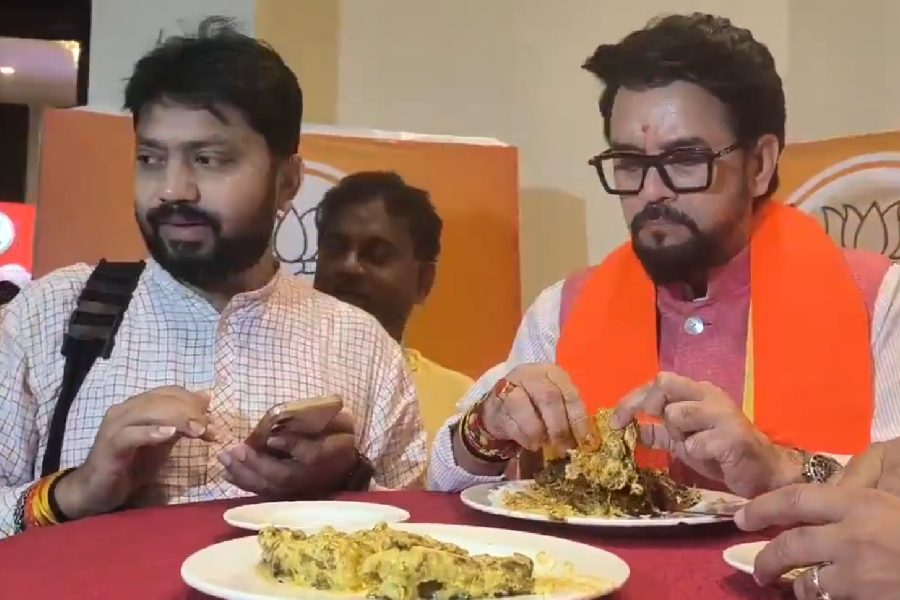
BJP MP Anurag Thakur eating fish in Kolkata on April 21, 2026. (Videograb)
There seems to be no visual of Modi eating in Kerala, a state known for many culinary delights, either.
Across party lines, documenting what candidates eat during campaign breaks has become a common feature. Whether from the TMC or the BJP, the recurring meal is machher jhol bhaat, fish curry and rice.
From a functional standpoint, the choice is also pragmatic. A light fish curry suits the summer campaign trail; cooling, filling, and logistically simple.
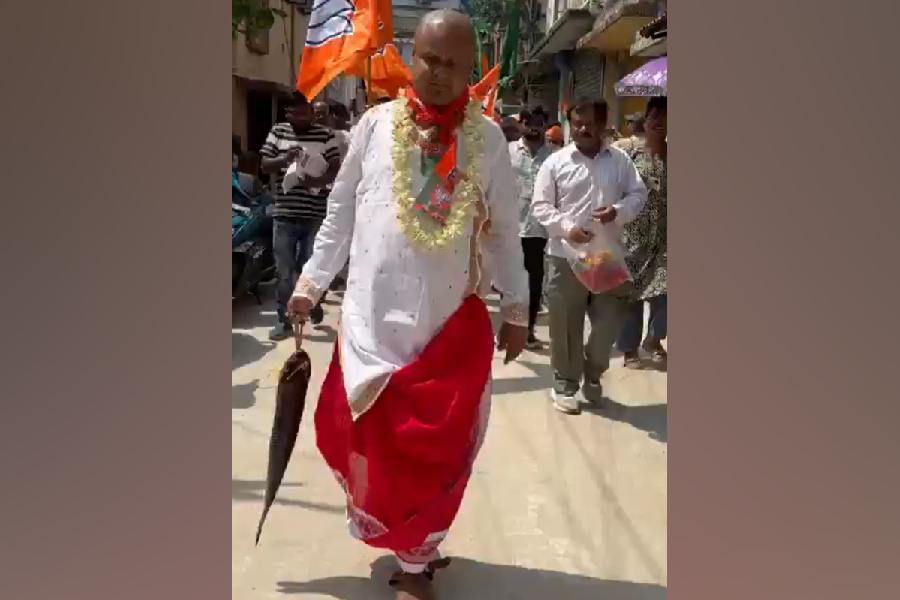
Barrackpore BJP candidate Koustav Bagchi campaigns with fish.
The hordes of media personnel who have come from outside Bengal are also part of this food-politics loop. Where to eat and what to eat is as much part of getting to know as where to go and who to speak to.
A national television channel hosted an election show from a prominent south Kolkata eatery, staging a discussion that evoked a Last Supper tableau.
Participants — anchor, owner, chef and journalists — debated politics while digging into a curated Bengali meal.
“If Modi wanted to shed the bohiragoto tag, he could have had fish,” said Pant. “But he will not eat fish because he is vegetarian. But he could’ve had a niramish [vegetarian] meal at some slum, which had chholar dal, chochhori, and ghonto,”
What Modi had, therefore, was calibrated; kosher and safe, according to Pant.
“The issue is not if Bengalis are bhadralok [genteel] or mastaan [rowdy]. Bengalis have a distinct self-identity,” said Pant.
Bengal’s cuisine, shaped by Islamic, Dutch, and English influences, as well as the ghoti-bangal (the latter being those from what is now Bangladesh) divide, offers multiple entry points for cultural identification.
Jhalmuri is a strategically neutral choice. It is ubiquitous, inexpensive, neutral. It also aligns with the known preferences of Bengal chief minister Mamata Banerjee, who is known to like heer muri (puffed rice).
“If one wants to culturally identify with Bengal one needs to speak the language a little better and not call a woman chief minister ‘aye didi, o didi’,” argued Pant, who is also a retired professor of international relations from JNU.
In comparison, Union home minister Amit Shah, who has previously been known for highly publicised meals at Dalit and tribal homes across India, has not had a comparable, camera-facing food moment in Bengal this election.
“Shah doesn’t like the camera in front. He will not step out and play like Modi, Yogi,” said Pant.
Pant also felt that publicised meals during election time are used to show one is not casteist. “The BJP has a caste problem,” he said.
So are these gestures merely optics or do they signal cultural assimilation?
Sumanto Chattopadhyay, an international award-winning ad maven, said that in Bengal, machh may win over manifesto because food is identity.
“When a politician eats jhalmuri, he is trying to say: ‘I belong here.’ Strictly as communication, it is an attempt at assimilation. Modi eating jhalmuri and Anurag Thakur eating fish are designed to answer the bohiragoto charge visually: ‘Look, we understand Bengal’,” Chattopadhyay said.
“When you have to prove you ‘belong’ by staging yourself with the local snack, you may also be reminding people that you are a political tourist,” he said.
This tension is compounded by policy contradictions. In a few BJP-ruled states, eggs have been removed from school meals citing vegetarian or religious sentiment, despite recommendations from the National Institute of Nutrition.
Such decisions complicate the party’s attempt to align itself with Bengal’s food culture, where fish and eggs are dietary staples.
It’s not just the politicians, though.
“A roadside snack stop becomes a prime-time segment. Reporters report from restaurants. The act of eating is replayed, analysed, turned into a beggars’ banquet. It is no longer a moment, it is a narrative,” Chattopadhyay said.
Pant agreed: “Murshidabad can be ground zero election coverage, a south Kolkata restaurant can’t be ground zero.”
When elections start to look like a tasting menu, jhalmuri and machh over jobs and migration, the risk is that real issues get reduced to garnish, said Chattopadhyay.