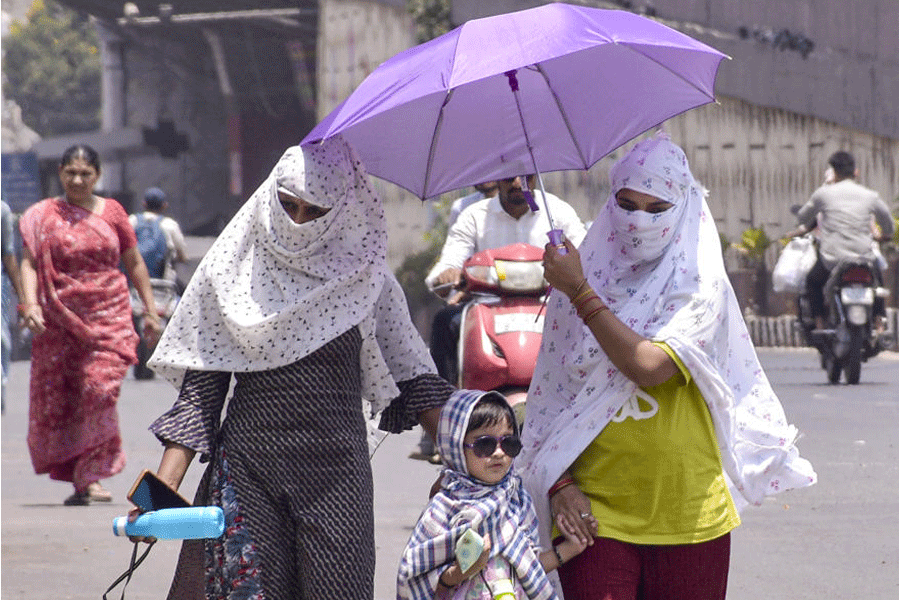
With temperatures climbing sharply across several parts of the country, the India Meteorological Department (IMD) on Saturday issued detailed heatwave advisories and warned of worsening conditions in multiple regions over the coming days.
The guidelines include avoiding prolonged exposure to direct sunlight, especially during peak afternoon hours, staying adequately hydrated, wearing light and breathable clothing, and avoiding strenuous outdoor activities during high-temperature periods.
The IMD advised special care for vulnerable groups such as children, the elderly, and individuals with pre-existing health conditions. "The department emphasised that early awareness and preventive action are critical in reducing heat-related illnesses such as heat exhaustion and heat stroke," an official said.
In its latest assessment, the IMD said maximum temperatures in many parts of northwest, central, and peninsular India currently range between 40 degrees Celsius and 44 degrees Celsius, with the highest temperature of 44.5 degrees Celsius recorded at Sri Ganganagar in Rajasthan.
In several regions, temperatures have been markedly above normal by five degrees Celsius or more, indicating a developing heat stress scenario across parts of the country.
"The IMD indicated that heatwave conditions are very likely to develop in isolated pockets of Jammu and Kashmir, Himachal Pradesh, Punjab, Haryana, Chandigarh and Delhi, Uttar Pradesh, Rajasthan, and central India over the coming days," the official said.
Hot and humid conditions are expected over coastal and eastern regions, while warm night conditions are likely in parts of north India.
"The department further projected no significant change in maximum temperatures over northwest India till April 27, followed by a gradual fall, while central and other regions may witness a gradual rise and subsequent decline in temperatures during the forecast period," the official said.
Meanwhile, India's peak power demand hit a record high of 252.07 GW on Friday following an intensifying heat wave, which pushed up the use of cooling devices like air conditioners and desert coolers, according to the latest power ministry data. The previous record high of 250 GW peak power demand was recorded in May 2024.
On Saturday, Delhi recorded its highest maximum temperature of the year so far at 42.8 degrees Celsius, marking the highest maximum temperature in the city since 2022, when it reached 43.5 degrees Celsius on April 28.
While the IMD had initially classified Friday as the season's first isolated heat wave, the MeT department later clarified on Saturday that it had been the third consecutive day of a heatwave.
IMD classifies a heatwave when at least two stations have met the required criteria. An IMD official clarified that while Delhi had fulfilled the heatwave condition only in one station on Thursday, the two-step criteria are actually for the entire subdivision of Haryana-Chandigarh-Delhi.
"On Thursday, one station, Rohtak to be specific, of Haryana and Ridge of Delhi, had satisfied heatwave criteria, thus making it the first day. Saturday was the third consecutive day of heat waves," an IMD official said.
Uttar Pradesh was left reeling from soaring temperatures as Banda logged a scorching 47.4 degrees Celsius. This was followed by Prayagraj at 45.5 degrees Celsius and Varanasi at 45 degrees Celsius.
Similar blistering conditions were witnessed in Haryana and Punjab on Saturday, with Rohtak and Faridkot baking under the sizzling conditions. Both states recorded above-normal maximum temperatures by up to six degrees. In Punjab, Faridkot recorded a day temperature of 45.2 degrees Celsius. In Haryana's Rohtak, the mercury settled at 44.6 degrees Celsius, according to the MeT.
In Rajasthan, Barmer recorded the highest temperature on Saturday, reaching 45.7 degrees Celsius, as temperatures hit sweltering levels in the state.
Although Himachal Pradesh is also enduring above-normal temperatures and heatwaves, the Shimla Meteorological Office predicted a wet spell for the state from April 27 to April 30, which is expected to provide some relief.
Intermittent rains in Kashmir on Saturday brought a respite from heatwave conditions, with light snowfall reported at Zojila Pass. Following the rainfall and overcast skies, temperatures dropped to 21.2 degrees Celsius-approximately seven degrees lower than the previous day. However, Jammu remained hot, with the city recording a high of 39.5 degrees Celsius, which is 5.1 degrees above normal, officials noted.
The full impact of the heat has not yet hit Uttarakhand, where maximum and minimum temperatures hover around 39 degrees Celsius and 22 degrees Celsius, respectively. However, Pantnagar recorded a high of 40.4 degrees Celsius.
High UV radiation levels persist across Kerala
High levels of ultraviolet (UV) radiation continued to be recorded across Kerala on Saturday, prompting the Kerala State Disaster Management Authority (KSDMA) to issue alerts and health advisories for residents.
According to data shared by the authority, UV levels above eight — warranting an orange alert — were reported at Konni in Pathanamthitta, Chengannur in Alappuzha, Changanassery in Kottayam and Munnar in Idukki.
Additionally, UV levels between six and seven, corresponding to a yellow alert, were recorded at 10 locations across the state.
Similar UV radiation levels were recorded on Friday as well, the KSDMA said.
The authority noted that high UV levels are generally recorded between 10 am and 3 pm and advised people to avoid direct sunlight during these hours, as prolonged exposure can cause sunburn, skin ailments, eye diseases and other health issues.
People working outdoors, fishermen, water transport workers, tourists, those with skin diseases, persons with albinism, cancer patients and other low-immunity groups have been urged to exercise caution.
The KSDMA said UV radiation levels are usually higher in high-altitude and tropical regions and can remain elevated even on clear, cloudless days.
It also warned that surfaces such as water bodies and sand can reflect UV rays, increasing overall exposure.
The authority recommended using hats, umbrellas and sunglasses, along with wearing cotton clothes that cover the entire body while stepping out during the day.
Drinking plenty of water, taking adequate rest and consuming food that does not cause dehydration were among the other precautions suggested.
The KSDMA also advised residents to provide water, food and shade to domesticated animals, stray animals and livestock.