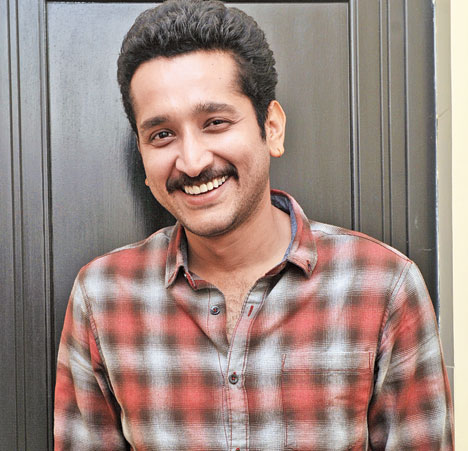

An elderly woman who lives alone in an old house. A son whose relationship with his mother has turned bitter. And a seven-year-old guest who arrives at the house one fine day. Directed by Parambrata Chattopadhyay, the Bengali film, Shonar Pahar, starring Tanuja, Jisshu Sengupta, Parambrata and Shrijato Banerjee, is about the dynamics between all these characters and much more.
A t2 chat with Param...
The film Shonar Pahar is about the growing distance between a mother (Tanuja) and son (Jisshu Sengupta)…
And the 70-year-old woman makes a friend in a seven-year-old kid. The story deals with the increasing isolation of this woman, Upama, and how she finds a new friend of a weird age. Upama is erratic, wants to dominate people but does not always manage to do so. The film has its own pace. It is a mood-based, subtle film. The lensing, the way the camera movements are chosen, are very soothing.
The music of the film has a Gustavo Santaolalla (composer) feel…
I am a mad fan of Santaolalla. His music is very minimal. Of course, a Star Trek or Avengers cannot have that kind of music. This film plays on minimal, next-door emotions. There is nothing heroic in the film. Shonar Pahar deals with regular day-to-day crisis. So I wanted minimal music for it. It is very organic. We wanted it to let it grow. The sensibility is less is more. The moment the kid comes in the film’s pace picks up.
It’s a very personal film. Which is why I didn’t have to think much on how I want to frame it or cut it. I had a very clear idea of what I wanted to shoot.
Is it an autobiographical film?
Not quite. See those of us who grew up in the 1980s and 1990s have a strange crisis. We have grown up seeing joint families. And then nuclear families came around. The nature of the crisis changed along with our lives. Nobody’s at fault here. At times it becomes difficult to balance between parents and the life one wants to now lead. I have seen people stay very close to their families till marriage… and then they drift apart. And there is a crisis at both ends. And hurt.
In my case, there have been phases when I have stayed apart from my family. All these things have filtered into the film. I shared a very special relationship with my mother (Sunetra Ghatak). We were more comrades than mother and son.
Getting your bond severed from your parents means you are losing a portion of your childhood. Now that my parents are no more, I don’t have anyone to tell me about my childhood. And I feel we want to keep going back to our childhood in every step of our lives. What we are today is shaped by our childhood. I was seeing this crisis around me.

What prompted you to direct Shonar Pahar?
The perspective from which kids see things. And the helplessness of the older generation. It’s been a really interesting personal journey. It’s a coming together of a personal feeling and a strong sense of social contribution. I’ve tried to blend these two things.... My childhood, my relationship with my mother, the sense of social responsibility... everything came together.
One afternoon, a year after my mother passed away, I was going through the proof of a collection of short stories written by her (that was reprinted). My mother had a keen interest on how kids view the adult world.
I couldn’t control myself and started howling. Uncontrollably. I felt I had to do something with these stories. How can I keep the spirit of these stories and make something that is a befitting tribute to her? I wanted to recreate the world that my mother had in her head, about kids and how kids look at the world, and how kids become instrumental in solving a lot of mature issues.
And then you met Kallol Ghosh (founder-director of OFFER, an NGO)...
Yes. And then I got to know about this programme that involves the elderly people.
Saanjhbaati is an effort to bridge the two most helpless people in the world — kids and the elderly. What if two such people get together? What does it bring to the people around them? What effect does it have on the son who stays away from his mother? How does it alter the dynamics between the mother and the son?
And then I thought how nice it would be if a kid spent time at an elderly person’s home. When the kid first comes, there’s a lot of conflict in the film. He is from a destitute background. The woman’s sense of education is high. There is bound to be a conflict.
The name of the film is a metaphor…
My parents made it a point that I realised the struggle they were putting in to raise me. I was very close to my mother and we shared all our problems. My mom taught me a little rhyme that would take away my fears. It’s a nonsense poem. I actually believed in it.
We create this make-believe world and feel that all our problems will be solved once we go there. That is Shonar Pahar. I play Kallol Ghosh in the film. I have also followed his dress code. Kallolda wears nice shirts, co-ordinated trousers, jackets.
How was it like directing the kid, Shrijato Banerjee?
Before I started shooting, I didn’t think he would be this good. He has a super-fast brain. He remembers hundreds of poems by heart.
Did you ever think of playing the son’s character that is played by Jisshu?
Initially, yes. But then I realised playing that character would be too close to me. I won’t be able to be objective about it. So Jisshu played him. Now, Jisshu and I share the ill-fortune of losing our mothers early in life. Jisshu was really moved by the experience.
.jpg)
Why did you think of Tanuja as Upama?
I thought that casting somebody we haven’t seen for a long time might be nice. I found her (Tanuja) to be really feisty. She was always a little different from the actresses of her time. She was very spontaneous, fast-talking… she had a different style altogether. I also felt she is somebody who has remained unexplored as an actress for a very long time. In recent Hindi films, we have seen her in character roles. Shonar Pahar is about her and the kid. The beautiful thing is how these two people got along in real life as well.
There are traces of my mom in Upama, but not just my mom. There are thousands of moms like her. Upama is a contradictory character, and the crisis comes from loneliness and a sense of neglect. There is a tremendous sense of betrayal. I am not saying they are great human beings. They have their share of faults, shortcomings. But at the end of the day they are our parents. And you cannot take away the helplessness that comes with age. Nobody in this world should be alone at this age.