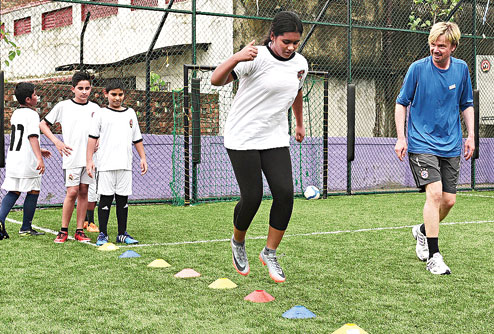
The men who’ve produced the likes of Thomas Mueller, Bastian Schweinsteiger and Philipp Lahm through the Bayern Munich ranks were recently busy training kids in Calcutta. Bayern youth team coaches Matthias Nowak and Peter Wenninger trained boys and girls aged between 6 and 17 for German Football Academy (GFA), at the iLead Sports Complex in Topsia. The Academy has been co-founded by Matthias and Germinati Sportz, a sports development company run by Krish Roy and Chetan Chavan. While GFA has a full-fledged coaching team, they are looking to get German coaches down here on a quarterly basis. The academy has been functioning in Calcutta and Pune since April. t2 kicked along in one of their training sessions at their Calcutta centre on Monday.


Utsabh Banerjee, 10, was having a ball. “Matthias taught me some really nice samba skills! It was great fun,” smiled the La Martiniere for Boys student, who idolises Lionel Messi.


TEAM DINNER AT NOVOTEL


“We started GFA to develop grass-root football in India and put India on the world map of football,” smiled Krish Roy, director, GFA.

You’ve been here in India for a couple of days now, what has it been like?
Matthias Nowak: I’m surprised by everything. I didn’t really have enough experience about Indian football. The kids here have a wonderful attitude. I was just thinking that it’s the most basic thing. If you don’t have the right attitude, even the best of coaches won’t be able to help.
Peter Wenninger: The level isn’t very high, but with the right talent and good training, things will change. You have to go big with many kids and then find the top players out of them. It’s not easy, takes a lot of time. You won’t get a world-class player tomorrow, but there’s so many kids here… if you can find them and give them the right training… you’ll have Indian players playing in Europe.

Shaji, do you think academies such as these are the way forward for Indian football?
Shaji Prabhakaran (former FIFA regional development officer for South and Central Asia): Absolutely. There’s a huge gap when the knowledge base is concerned in India. It’s very important to have the right coaches, the right structure, right environment, which is there in academies such as these. But it’s just the beginning. You have to strengthen the foundation. The academy alone cannot produce a player, it’s the system. But it’s a great initiative and we need to keep working hard on this and get more children in the game. One day I’m sure we’ll see results.
You’ve seen Indian football from close, what does our system lack?
Shaji: Look, Indian football truly started its development four years back, when we appointed a Technical Director. To produce a player, to create the right structure, it takes 15-20 years minimum. This is just the infancy stage of our development. The results will come in 10-15 years time. But the important thing is that we are taking the initiative, there is a mindset change. People are understanding that we need to invest in development. That wasn’t the case before even though we were Asian champions in the 1960s, but that was purely due to talent. Once the other Asian countries started working, we lagged behind and never focused on our development. I’m hopeful that some day one of our players will play in one of the top European leagues and that will change a lot of things. In 10 years maybe. That will change the whole ecosystem much quicker.
Peter: I agree to that 100 per cent. We had that problem in Germany in the 1990s and then people pushed for more investment on the youth. It costs money, and it takes time.
So when can we see an Indian player in the Bundesliga?
Shaji: I see in seven-eight years for sure. Could be even before!
Peter: Yeah, there are so many Asian players from countries like Japan! Ten years ago there were barely any. Now there are so many.
Shaji: Japan exports around 130 players annually to foreign leagues and India too could become a talent hub.
Matthias: Yes, you must. There are so many kids in India!
Bayern Munich has produced the likes of Philipp Lahm, Bastian Schweinsteiger, Thomas Mueller to name a few. What’s the secret?
Peter: When I know the secret… I’ll be a multi-multi-millionaire! (Laughs) I guess it’s just hard work. In Germany, every kid grows up playing soccer… they all want to grow up and play soccer, it’s their dream. They start playing on the streets with their friends and when they are five-six they join a club. And when they’re really good, they get picked up by big clubs.
Bayern’s new academy is also opening in August...
Peter: Yeah, but what is more important is the coaches and the kids. (David) Alaba, (Bastian) Schweinsteiger, (Holger) Badstuber, (Thomas) Mueller all came through the previous academy. So having the talents and coaches is the most important and then comes the facility.
Peter, Indians often lack in physicality against big sides. Being a sports nutritionist, any tips for them?
Peter: I don’t think it’s that important. The technique is much more important. Tactic, technique and team play are the most important and then comes the physicality.
Will the FIFA U-17 World Cup generate more interest in football here?
Shaji: Yeah, absolutely. Indians will be able to see the best of youngsters here. But it also depends on how India perform. If they perform well… like even if we draw a match against one of the best teams in the world, that’ll be big. If we qualify for the second round, that would give a massive boost to our country because we’ll start believing in our future. But if it’s lopsided, and we lose 5-0 or 6-0 then people will think ‘hey, maybe we should keep playing cricket.’
One tip for our U-17 Cup team?
Peter: If you lose one match, don’t give up. Show the Indian population that soccer is a wonderful sport. And most importantly, learn from the others.
Shaji: Be confident, enjoy the game and don’t take any pressure because what is very important is that they are the first batch to play in any football World Cup, so they’ll be real role models.
Matthias: Don’t be afraid and have fun.
Text: Rwitoban Deb
Pictures: B. Halder