A decade after redefining the zombie thriller genre with Train to Busan, director Yeon Sang-ho returns to the genre that made him an international name. Expectations surrounding Colony were understandably high. Not only is it Yeon's first major zombie thriller since the underwhelming Peninsula, but it also arrives at a time when the genre itself feels exhausted.
Colony doesn't completely reinvent the wheel. But it does manage to bolt a few intriguing new parts onto it.
Set largely inside a sprawling highrise that houses the headquarters of a biotechnology firm and a shopping mall, the film begins with a bioterror attack orchestrated by a disgruntled scientist, Seo Young-cheol (Koo Kyo-hwan). During a corporate event hosted by biotech giant Chains Bio, Young-cheol unleashes an experimental virus that rapidly transforms people into savage, hyper-aggressive creatures.
The twist? Before triggering the outbreak, he injects himself with the antidote, making him the only living source of a potential cure.
Trapped inside the quarantined building are biochemist Kwon Se-jeong (Jun Ji-hyun), her ex-husband Han Kyo-seong (Go Soo), security officer Choi Hyun-seok (Ji Chang-wook), and a collection of increasingly desperate survivors trying to find a way out before the infection consumes everyone.
The virus spreads through bites. The infected move with terrifying speed. Characters sprint through corridors, barricade doors and make impossible choices under pressure.
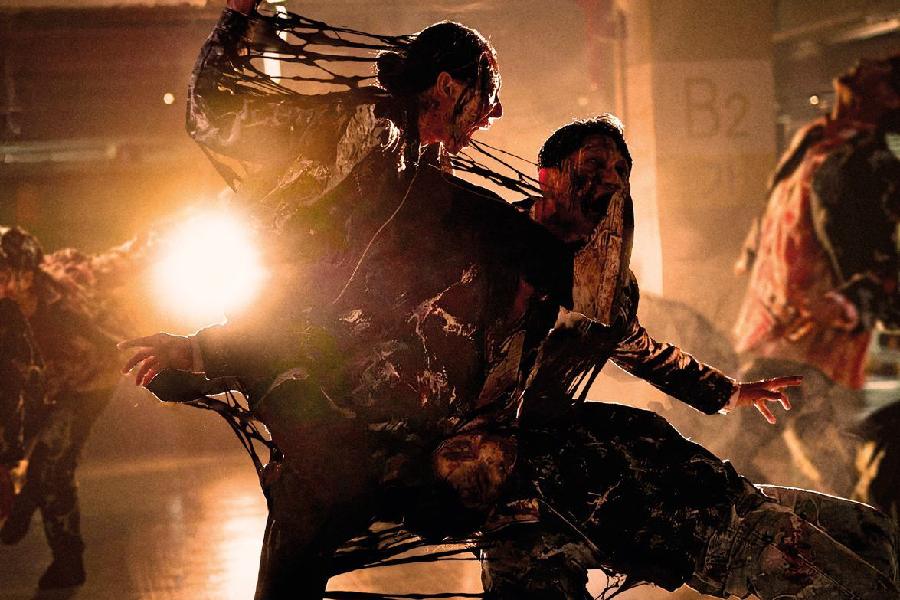
The infected themselves are a major highlight. Performed by an impressive ensemble of dancers and physical performers, they twist, contort and sprint with unnerving fluidity. Their transformations remain as grotesquely fascinating as anything Yeon has previously put on screen. Every snapped limb, spasming movement and bone-crunching attack carries an impact.
But Colony distinguishes itself through a clever evolutionary twist. These zombies don't merely hunt. They learn.
The virus has been engineered to create a kind of hive intelligence, allowing the infected to share information collectively. When one zombie discovers a weakness in a survivor's strategy, that knowledge spreads through the entire group. The result is a constantly evolving threat that becomes more dangerous with every encounter.
This concept generates some of the film's strongest moments. Early on, survivors exploit the infected's inability to distinguish between humans and mannequins or advertising displays. Later, the zombies adapt. Tactics that worked minutes earlier suddenly become useless.
The shifting dynamic creates a genuine sense of unpredictability. It's a smart idea and arguably the film's most significant contribution to zombie mythology in years.
Yeon also makes excellent use of the setting. The sterile corporate interiors gradually deteriorate into a nightmare landscape of blood-soaked hallways, abandoned laboratories and flickering surveillance rooms. The building itself becomes a character, its maze-like design constantly trapping both survivors and predators in increasingly dangerous situations.
Several set pieces are superbly executed. A tense sequence involving separated groups attempting to reunite across a zombie-infested zone demonstrates Yeon's continued mastery of spatial storytelling.
Yet for all its inventive ideas, Colony struggles with the same problem that affects many large-scale genre spectacles: the humans simply aren't as interesting.
One of Train to Busan's greatest strengths was its emotional core. The relationship between father and daughter gave the film its appeal. Colony lacks a similarly compelling anchor. Characters are introduced rapidly and often remain defined by broad archetypes rather than fully developed personalities.
Jun Ji-hyun delivers a commanding performance as Se-jeong, bringing intelligence and grit to a role that could easily have become generic. Koo Kyo-hwan is equally impressive, injecting the villainous Young-cheol with a mix of charisma, menace and unpredictability.
Unfortunately, the screenplay rarely affords the rest of the ensemble comparable depth.
The pacing also becomes increasingly uneven during the second half. Yeon introduces a steady stream of new ideas, mutations and revelations, some of which are genuinely intriguing. But the narrative occasionally feels overloaded, as though the film is trying to explore every possibility generated by its premise without fully developing any single one.