What if the artworks from around the country that made it to the CIMA Awards Show could travel out and find their spot in some of the most popular art spaces around the globe? Writer and filmmaker Ruchir Joshi imagines a world where nothing is impossible and pins some of his favourite paintings, sculptures and installations to creative nerve centres, far and wide.
“These artworks bring me back to a novel that I am writing now. It’s set in the last moment where Calcutta is actually a great international city, the 1940s, and I suddenly remember that in the 19th and early 20th centuries, Calcutta was in fact the centre of the universe in many important ways. All of London, as we read from many historical writers, was built from the spoils from Bengal and the spoils from India, and Calcutta was the nodal point from where all this was going out. The biggest colonial empire on earth was being run from Calcutta. Today, I see these pieces as travelling out too, but from a place which has its own self-respect and is exciting on its own terms. Not as supplicant offerings from the provinces to the great world market but with their heads held high, to engage with the world,” explained Ruchir who has a degree in art and photography from Goddard College, US.

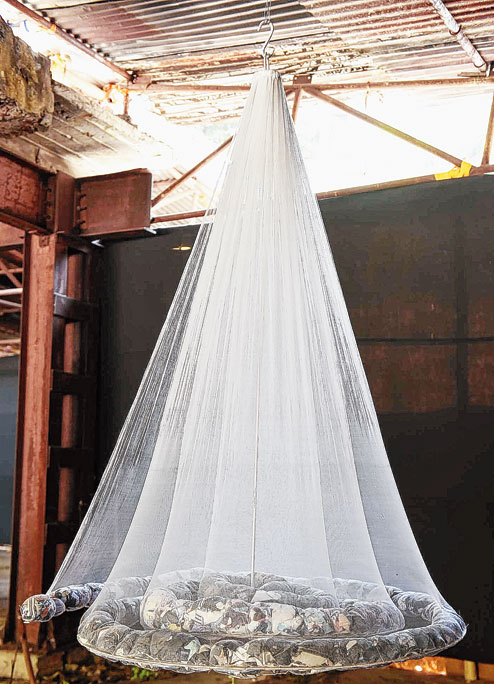
What: Reptile II (new media installation made of fabric, net, iron and frame)
By: Nilanta Das
In: Ramdulari Park
Where I see it: Hanging in an industrial space in Berlin or in repossessed houses where people are doing a guerrilla art attack.
Why: I see it contrasting with the hard concrete and steel girders. I look for actual skill in an old-fashioned way — something that involves aesthetic pleasure and some manual work as well. I see this piece as a simple form, of a snake trapped in a mosquito net. It’s got the element of danger, of a snake in bed. It’s erotic and at the same time funny, because the Eros, or danger, is trapped in a spiral inside a classic mosquito net, in which I find a resonance of India, or our culture.

What: A Settlement to Deepen the Land (serigraphy and image transfer on iron sheet)
By: Sangita Maity
In: CIMA
Where I see it: In Tate Modern, London.
Why: Tate Modern has huge spaces but they do show tiny works in conjunction with very large works. Also, Tate Modern tends to look at modern art in terms of originality, practice, history and how modern art is refracted, and this piece is a very good example of that. At one level it’s a photograph that’s been painted over to create a grungy Indian urban landscape, on the other hand it’s the subtlety and the business of painting with gold, which makes it very Indian.

What: Great Artist and Old Master (A diptych sculpture made with synthetic nylon, aluminium, wood, glass and fabric)
By: Prithwiraj Mali
In: Ramdulari Park
Where I see it: A small gallery in Paris showing contemporary work.
Why: Marcel Duchamp was working in Paris and he made fun of the idea of the ‘masterpiece’ and the ‘great artist’. This play on words and the laughing at art is appropriate for a small gallery in Paris. I like the use of text and image. I find the boxes witty and funny. I think the artist has taken the idea of the great artist and the old master and put that idea into a museum box. It’s a one-line joke but the brushes extended like beards work like a diptych or a pair. This is a work that could be done by someone from any nationality.

What: Gossiping (mixed media painting)
By: Snehendu Pal
In: Studio 21
Where I see it: A small gallery in Paris showing works from the ’50s to now.
Why: It refers to older work but it’s not actually from the ’50s. I like classic old-fashioned painting and sculpture, and I don’t think that’s ever going to go out of fashion and die out. This is a simple and beautifully painted form of two — not young, not thin — women sitting naked but gossiping, maybe at a bathing ghat. It’s a form that is a salute to artists like Picasso, Henry Moore and Matisse, but also a beautiful piece of work by itself.

What: Discarded Memories (New media installation work with abandoned electric switches, plyboard electric board, lamp and buzzer)
By: Krupa Srichand Makhija
In: CIMA
Where I see it: Museum of Modern Art in New York.
Why: If you look at how the business of pop art has spread and you trace the works of Duchamp to Warhol, Rauschenberg, Johns and Oldenburg, you can see those light switches in a dialogue with their constructions. It’s a funny piece, which is very contemporary, international yet Indian. At the same time it also evokes all the grime and repetition of our lives… short circuit, overload, us cleaning our switches. It works very well as an idea and in execution despite not having much ‘manual artistic skill’. But in this case that’s not a problem.

What: Synthesis (mixed media sculpture)
By: Amit Debnath
In: Ramdulari Park
Where I see it: In a small gallery in SoHo or Tribeca in New York.
Why: Because it is a take off on the kind of artwork that was developed in New York. Cooking or kitchen utensils have become quite widespread now in contemporary Indian art, but the whole thing stems from the work of an American artist called Claes Oldenburg who in the ’60s started to take everyday objects such as a light switch or a plug and enlarge them. First into beautiful drawings, and then sculptures. It’s the change in scale that makes you think of these objects in our everyday life, their shape and what they mean to us. What this chopped-up pressure cooker does is add layer upon layer, it gives you a sense of rhythm and kinesis contrary to the way you usually see things layered inside a pressure cooker which is horizontally. It’s funny yet it’s quintessentially Indian and connects me with our middle class and working class culture. Looking at this, American pop artist Jasper Johns’ axiom comes to mind: ‘Take something, do something to it, and then do something else to it.’
Pictures: Rashbehari Das
CIMA Awards Show will be on from March 14 to April 12 l CIMA Gallery: Sunny Towers, 43 Ashutosh Chowdhury Avenue l Studio 21: 17L Dover Terrace l Academy of Fine Arts: 2 Cathedral Road l Ramdulari Park: 13/1 Ballygunge Park Road