
Frank Sinatra reportedly said that a true artiste gave away a little bit of himself/herself with every performance… I was toying with the idea of staging Brecht’s The Good Person of Szechwan. But somehow the lack of sheer energy or dynamism of the theatre scenario around me, was discouraging. I had been practising theatre since the age of 21 since 1976, producing works of Sartre, Genet, Weiss, Brecht, Kroetz, Buchner, Dorst or Mueller with the support of Goethe Institute or Alliance Francaise. They were extremely unorthodox productions and did not attract huge audience or media attention. Yet there was a certain space and a group of people who bothered to treat us as an alternative. Gave us courage. Yet having professionally produced Brecht’s Galileo in 2012 or Threepenny Opera, directed by Chanda Dutt, in 2015, much more successfully, the gnawing feeling that the alternative space in my city has dwindled, cannot be avoided. That Calcutta can no longer boast of its alternative intellectual /cultural space is as evident as dirty drainage.
RE-READING AMADEUS
Dynamic live art thrives on this space. Be it Badal Sircar’s street theatre at Esplanade, Dizzy Gillespie at DI, Peter Brook’s workshop at Nandan or my concerts at Kala Mandir… the space for the dynamic alternative was once far more in my city than any other in this country. The reasons for this rise of utter mediocrity are manifold and I do not wish to get into them. But the fact that my surrounding is not very conducive to the pains taken and funds spent was becoming too apparent and I decided to quit theatre. Had movies and music not been my bread and butter I’d have quit them too.
Then Peter Shaffer suddenly died on June 6 and overnight I re-read his Amadeus. It suddenly became clear what I needed to do today, perhaps for the last time ever. In a strange way Amadeus addressed a very basic crises of us entertainers. The question: Are we simply talented or do we make a difference? Why do you go to the theatre? Why do you watch live art? To be merely entertained or to witness or hear something beyond?
MOZART VS SALIERI
Here is where the outrageously insolent, subversive Wolfgang Amadeus Mozart and the suave, shrewd, orthodox Antonio Salieri fit in. Both extremely capable musicians but one far more “gifted” than the other. One a genius, the other plain mediocre. Peter Shaffer does not churn out a biopic and much of his material is based on rumours. There are rumours that Salieri murdered Mozart, but in reality none of that happened. Nothing can be proved. Shaffer’s Amadeus is not at all interested in proving anything but exposing the crises of “great” entertainment.
THE ORIGINAL HIPPIE
So, inspired by this great material, I decided to produce my own interpretation. To go back to the music that inspired my generation which is rock ‘n’ roll, and rebel against the order. To try and seek that connection which Mozart perhaps has with Jim Morrison or Jimi Hendrix. To seek the fact where Mozart was more ahead of his time, was the original hippie. To adapt it and write my own material in Bengali: Medha.
WE ARE MOSTLY SERVING OUR TIME
At the age of 61, in the final leg of my career, I no longer wish to produce a timeless material as it is but to recreate something relevant to us today inspired by Shaffer. I could have done a version of it in Bengali. But, having already done that a numerous times with Brecht, Weiss, Sartre or Shakespeare… I did not want to repeat that same process.
Any and everybody can produce theatre. Like any and everybody with a descent understanding of chord structure can make a Bangla band. Or any and everybody with some connection to surplus money can make a movie. That’s democracy and digitalisation. We have to respect that. And I do sincerely. But we all know that our work will be forgotten after 30-odd years. My songs have survived 23. One or two of my films will perhaps survive maximum five more years…. But Mrinal Sen or Buddhadeb Dasgupta’s films will survive much more than we all can ever imagine. Morrison, Hendrix or Ravi Shankar will be heard for generations. You don’t need to understand rocket science to guess why.
We are mostly serving our time. And in the process we are defined by our time. Defined by our market. We are defined by the pressures around us. How many of us can actually challenge that market demand and produce for the sake of art? For the sake of one’s own belief. How many producers actually care for that dynamics?

OVERWHELMING GROWTH OF MEDIOCRITY
Here, readers, is where we confront the basic question defining our local space of arts and entertainment. The overwhelming growth of mediocrity in our city. I am certain there are those young or old among you striving to break new grounds in various fields. But do you feel encouraged by your environment? Or do you fear to fade away unnoticed? Or will you finally give it all up and take up a job in Bangalore or Boston?
TRULY RELEVANT FOR BOTH THE PERFORMERS AND THE AUDIENCE
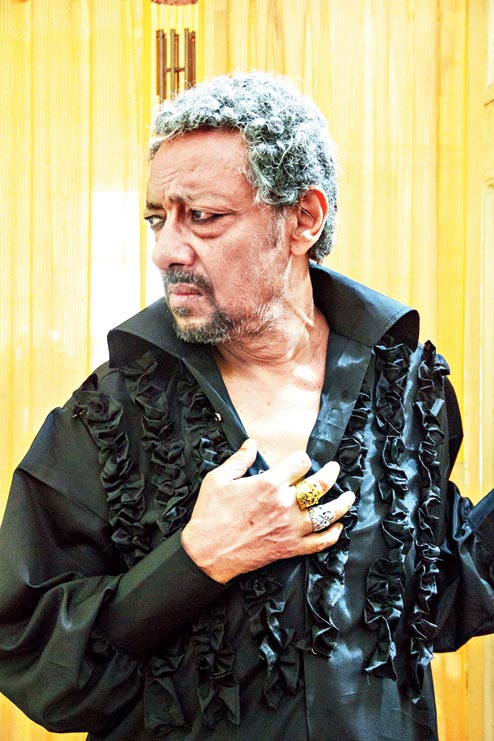
I play Salieri in Medha. A very young, aspiring talent called Subhra Sourav Das plays Mozart. Remember Makaranda of Byomkesh Phire Elo? Yuri of Hemanta and Panugopal of the currently running Byomkesh O Chiriakhana? We both, together with Neel Dutt, Amyt Datta and a small bunch of rather talented actors and musicians, have come together to produce our own interpretation of Amadeus called Medha. The production Medha, through the fictional murder mystery of Mozart, tries to understand and illustrate the rise of mediocrity and what it entails. It tries to answer questions that many of us artistes or entertainers in our city face, if we do face them at all. That makes Medha truly relevant for both the performers and the audience in my city. How many of you as a certain section of our audience actually demand artistic work that is ahead of its time? That which is unorthodox and dynamic? Or do you want to be satisfied with what you are comfortable with and choose not to see beyond?
Why does the onus to break grounds lie only with the artiste and not with the audience at large also? How can an artiste get away by creating the new if the audience is not there to uphold him or her?
Theatre or any live act for that matter thrives on its temporal quality and not posterity. It’s then and there that both parties push the boundaries. Our city was once famous for harbouring the discerning, the radical, the sensitive, the intelligent, those who loved the dynamic and scorned the formula. Those who actually hated cheap gloss and sensationalism. Now, where has all that audience gone?
I still travel around this city a lot. From the backstreets or coffee houses of the North to the New Gen cafes and bars and malls of the Central and South… I meet a lot of young folks who want to take selfies with me but hardly know where I am coming from. They have a certain raw energy and joyfulness which I admire and enjoy, but they lack political insight or a certain radical ideologue which comes from depth of knowledge.They would most probably hear my Bela Bose and watch my Byomkesh and not demand any theatre from me at all.
MORRISON INSTEAD OF MAGIC FLUTE
Medha deals with the conflict between two giant music composers of the 18th century Europe. A 60-year-old Salieri and a 28-year-old Mozart. But neither do we attempt a costume drama, nor do we actually play any classical composition. Our setting is the late 1960s rock ’n’ roll scenario when the entire cultural and social attitude underwent a revolution through music. The transposition makes the text much more contemporary and relevant to our situation today, when we perhaps need another one. Therefore instead of The Magic Flute or The Marriage of Figaro… it is numbers from Morrison, Hendrix, The Rolling Stones…. Here is where Neel Dutt, Amyt Datta and their music become relevant. They have re-arranged some of the classic rock numbers to go with the scenes and situations. The costumes and set-up is a mixed bag of rock and classical idiom.
A FIRST ATTEMPT
Medha tries to do what I have never done before. It tries to actually deconstruct Peter Shaffer’s text. As a farewell gesture from the scenario as a theatre director, this is my first attempt at interpretation in the true sense of the term. So readers, if you have cared for my work, it ought to be an interesting experience for both of us to confront each other honestly. For the first and perhaps the last time. I have lost a little of my life with each work I have given you, for better or worse. Since the age of 21.
This time at Gyan Manch on November 4.
Anjan the singer-songwriter, actor, filmmaker,
theatre director or t2 columnist — who do you value the most? Tell t2@abp.in