 |
Manju 1980: Effervescent and friendly to the point of being over familiar, she will dole out unsolicited advice, but will be the first to hold out a hand to yank you out of a tricky situation. She eats without washing her hands (“moonh dhuli hui hai, Auntyji”), laughs loud enough to put a laughter club to shame, speaks in rhymes and believes that rules and regulations need to be bent and broken at times.
Manju 2014: Is now Mili. A zesty physiotherapist whose personality is as colourful as her outfits. Always ready with an opinion and with no “filter” to cap her thoughts, life for Mili is one big party — she gulps down wine like water, is forever on the lookout for a background good enough to click a selfie and makes sure she breaks some rules along the way. And yes, her mom — as quirky and dysfunctional as her — is called Manju!
Hrishikesh Mukherjee’s 1980 film starring Rekha as the vivacious Manju, who overturns the lives of the Gupta parivaar and makes its disciplined matriarch have a change of heart, was a fun family film that married message with mirth. Khoobsurat 2014 — its official remake — is predominantly a fuzzy love story, merging the magic realism of a Disney film (Khoobsurat is Disney’s first tryst with Bollywood film production) with the romance of a typical Mills & Boon novel.
But the love story — the best bit of Khoobsurat 2014 — kicks in much later. Before that, we have Mili Chakravarty (Sonam Kapoor), physiotherapist to the likes of Dhoni, Sehwag and Team KKR (!) who fills in for an associate on assignment — to get Shekhar Singh Rathore (Aamir Raza Hussain), the wheelchair-bound ruling patriarch of the Rajasthani town of Sambhalgarh back on his feet. So off goes Mili, but runs straight into Nirmala Devi (Ratna Pathak Shah), the strict disciplinarian of the family, who won’t allow anyone to break the rules set by her — no laughing out loud, no touching the priceless antiques in her palace, giving up on dinner if you arrive at the dining table a minute later than 8pm, and not allowing her children to follow their hearts.
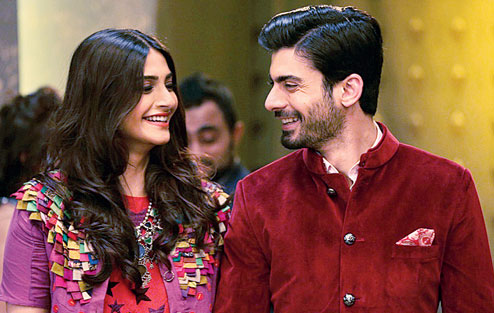
Mili’s outrageous ways — she can’t walk straight without knocking something (or someone) down and uses her colourful scarves to change the curtains of her room in the palace — find no favour with Nirmala Devi. Mili also starts off on the wrong note with her son Vikram (Fawad Khan), a man who enters an engagement as dispassionately as he brokers his business deals, his cocky tone and crisp suits reeking of arrogance and betraying little emotion. She calls him “khadoos maindak” (frog = prince, get?); he thinks of her as nothing more than an “aafat”.
 |
But Mili’s feel-good personality is infectious — she forms a bond with Vikram’s kid sister Divya, has beer parties with the palace help in the kitchen and gradually wins over Shekhar Singh, making sure he does his exercises diligently sitting in his wheelchair even as she raids his vintage wine collection.
And true to a Mills & Boon romance, it’s not long before the blue-blooded Vikram falls prey to Mili’s spontaneity and zest for life. “Hum bilkul alag hain,” he keeps reminding himself, but can’t stop himself from stealing glances at her from above his ledger books, waking up at the crack of dawn so that he can see her walk on the palace grounds and waiting for her to crack him up with a PJ. Their romance — unspoken, but passionate — finds its high point on a moonlit night when they lock lips for the first time, hesitating at first and then more passionate and needy. Every time they meet after that, their chemistry hits a new high, their heads and hearts giving off conflicting emotions. Theirs is the kind of romance that makes your heart soar even as you root for them.
Unfortunately, you can’t root for the rest of Khoobsurat. Director Shashanka Ghosh’s plot is wafer-thin — a kidnapping subplot feels a little too forced — and the film soon degenerates into just another romance. It doesn’t help that Sonam overplays her Mili. Though she seems more comfortable on screen than she’s ever been, Sonam manages to make her Mili more annoying than adorable. Kirron Kher — playing Mili’s mom Manju — knows the overbearing Punjabi mother like the back of her hand, but save for a few fun moments, her performance has too much of a deja-vu feel. Theatre veteran Aamir Raza Hussain sparkles in his role, but Ratna Pathak Shah — stepping into the role that her mother Dina Pathak made so memorable in the original — is, unfortunately, saddled with a half-baked part... her quick transition from no-nonsense matriarch to loving mother and doting wife coming off as too abrupt. The silly and soppy climax is also a big let-down, making Khoobsurat a film you forget the moment you exit the theatre.
But if you want to hold hands with your partner and feel warm and fuzzy this weekend, then Khoobsurat should figure on your date list. That one glimpse of Vikram looking at Mili with puppy eyes... love will never be the same again.
PS: And then there is Fawad (see box)!
Five Fawad faves (Spoiler alert!)
His introduction shot: The blue pocket square. The black necktie. The stubble. The eyes. Then, the baritone.
What’s better than Fawad in a bandhgala? A bare-bodied Fawad. And yes, he even makes chest hair look sexy.
The way his Vikram looks at Sonam’s Mili after that first kiss… almost as if he’s discovering a whole new world as he lets go of his inhibitions. Sigh!
Hopelessly in love with Mili, he tries to convince himself that she isn’t the one for him. “Let’s remain friends,” he tells her, even as his inner voice begs: “Please kiss me.”
His proposal in the middle of a paintball match… he goes down on his knees and tells her he needs her and wants to grow old with her. What’s not to love?
Rekha vs Sonam
Rekha’s Manju was far more mature then Sonam’s Mili, evident in the manner in which she handles a crisis situation — Dwarkanath’s (Ashok Kumar) heart attack. Rekha’s effervescence was never over-the-top, but Sonam, in her
enthusiasm to make Mili quirky and fun, grates.
Ashok Kumar vs Aamir Raza Hussain
Aamir Raza Hussain does his bit, but is no match for Ashok Kumar’s Dwarkanath — the seemingly hen-pecked husband who gives his wife an earful towards the end and makes Rekha his “girlfriend” and eventually, his “bahu.”
Dina Pathak vs Ratna Pathak Shah
As Nirmala Devi, Dina Pathak was far more convincing. Pathak Sr lends layers to her strict mother and wife role, her emotions often peeking out from beneath her disciplinarian garb. Pathak Jr scoffs and frets, but fails to rise above her uni-dimensional role.
Rakesh Roshan vs Fawad Khan
Roshan’s Inder was largely a side player. Fawad has more screen time and a better fleshed-out role and his Vikram’s proposal to Mili — on his knees and looking into her eyes — is far more romantic than Inder’s to Manju — leaving a rose in a glass on her dressing table. And when it comes to looks, we all know who wins hands down
An uncooked love story on dowry and dreams
 |
The chef is so enamoured of his own “novel” recipe that he throws in all the right ingredients but finally forgets to cook the dish. That, in 140 characters, is Daawat-e-Ishq.
Gulrez “Gullu” Qadir of Hyderabad is the quintessential modern Indian girl, one who doesn’t let her dad feel “ke tum beti ho ya beta”. She’s a school topper, zips around in a scooter, works as a shoe salesgirl and studies commerce. But there’s one thing that reminds her and her court clerk dad again and again that she is in fact a girl — the incessant and unashamed dowry demands from the families of prospective grooms.
After one insult too many, and this time from the family of a boy who said he loved her and held her hand but sat like a silent lump when his parents demanded Rs 80 lakh as “help” for his American MBA education, Gullu decides that marriage is not for her. She hatches a plan to “fake marry” one of the greedy grooms, slap a dowry harassment case against the family and fleece them to fund her own American dream — studying fashion designing in New York and opening her own shoe label.
So daddy in tow, Gullu lands up in Lucknow in search of a husband to con. What she doesn’t account for is meeting Taaru, short for Tariq, the man with the Midas touch in the kitchen. If you have watched any rom com, you can guess the rest of the story.
But sadly, Daawat-e-Ishq is no rom com. There’s very little romance and zero comedy. Writer-director Habib Faisal is so busy with Gullu’s plans and predicaments that he forgets to factor in love, save for the hummable Mannat and the cute Holi sequence. Maybe because while Parineeti Chopra as the spunky Gullu and Aditya Roy Kapoor as good guy Taaru are individually nice and bright, put them together and the scene fizzles out like a cold plate of kebabs. Parineeti’s boring wardrobe is an added damper and that military close crop sits very uneasy on a big guy like Aditya. Given that he runs a famous eatery, lives in a big house and loves his parents, the mawaali look is a mystery.
 |
The missing LOL moments in the script is a bigger mystery. One feels disappointed, especially if one looks at the films Faisal has been associated with before, from the fresh Band Baaja Baaraat and the hilarious Ladies vs Ricky Bahl to the passionate Ishaqzaade.
Anupam Kher as Gullu’s timid dad could have sleepwalked through the role. And he does. Karan Wahi (of Nach Baliye fame) makes his big screen debut as Gullu’s spineless boyfriend. He’s not required to do much except look good and smile pretty. He manages to do both.
The greatest missed opportunity for Daawat-e-Ishq is the camera’s failure to romance the food. From tunde ke kebabs to biryani, and shahi tukda to jalebi, this could have been a mouth-watering ode to Lucknow’s gastronomic treasures, one that the khaate-peete Indian audience would have wolfed down with pleasure.
What somewhat redeems Daawat-e-Ishq is the theme. Even a few years back, one couldn’t have imagined a big banner (YRF) Bollywood film being made with A-list actors based on something as real-life as Section 498A of the Indian Penal Code. And if the film is successful in shaming or scaring even a handful of young men and their families into not looting the girl’s side in the name of “gifts” and “help”, well, that alone would be worth something.