India has snapped up 30 million barrels of Russian crude after the United States gave it a temporary green light, as the war in the Middle East disrupts crucial energy supplies.
The buying spree follows Washington’s decision to allow Indian firms to purchase Russian oil that had been loaded onto ships before March 5. There are thought to totally be around 138 million barrels of Russian crude on the high seas. But India will face competition from other countries like China for these cargoes.
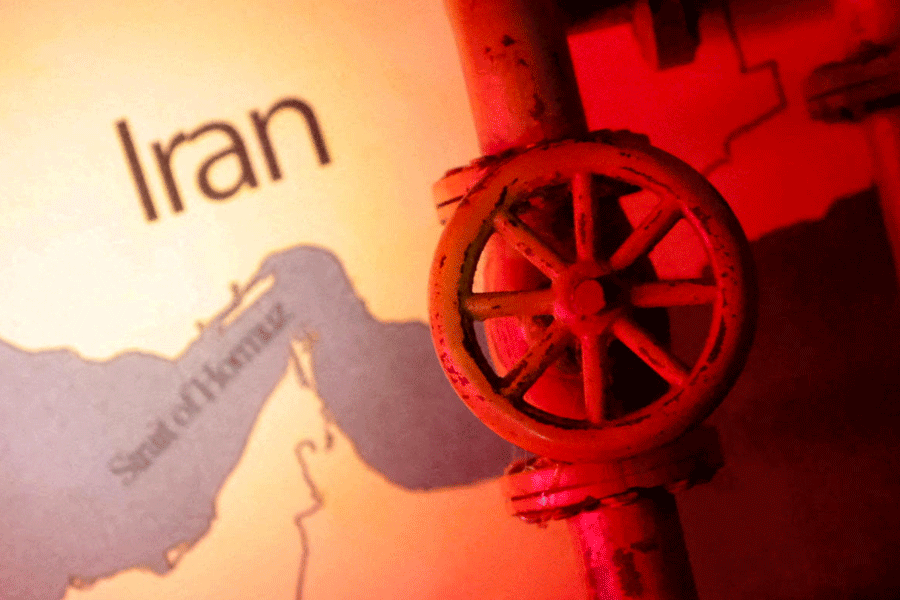
The Washington oil waiver is intended to offset the impact of the conflict between the US, Israel and Iran, which has effectively shut the Strait of Hormuz, the key waterway through which 20 per cent of the world's oil and gas normally flows to India and other markets.
The pivot back to Moscow for fuel comes amid uncertainty about how long the conflict may last. At one level US President Donald Trump indicated that the war was close to an end but then he qualified his remarks. That resulted in international crude oil prices falling steeply on the Brent Index from a peak of $119 on Monday to around $88.
But with tankers unable to move through the Strait of Hormuz, India has scrambled to replace the barrels it normally buys from producers such as Saudi Arabia and Iraq in order to keep the economy running.
Refiners including Indian Oil Corp and Reliance Industries have purchased Russian cargoes in the spot market, according to data intelligence firm Kpler. Roughly 10 million barrels were bought by state-run Indian Oil, while Reliance acquired at least as much.
Instead of the discounts at which Russian oil was previously sold, buyers are now paying premiums of between $2 and $8 a barrel to the Brent crude benchmark.
Some tankers have reversed course to head towards Indian ports to take advantage of the US waiver after initially signalling Singapore as their destination.
India had been cutting back its purchases of Russian crude under pressure from Washington after ramping up imports following Russia’s invasion of Ukraine in 2022. Taking advantage of discounted supplies, India was buying more than 2 million barrels a day in mid-2024, but volumes had slipped to about 1.06 million barrels a day last month, according to Kpler.
The scramble for crude oil is only one part of a much broader energy shortage unfolding across the country.
The government has invoked the Essential Commodities Act of 1955, giving it sweeping powers to control how natural gas is distributed across the economy. Under a new order called the Natural Gas (Supply Regulation) Order, 2026, New Delhi has created a priority system for gas supplies, deciding who receives fuel first and who must accept reduced deliveries.
At the top of the list are households and essential services. These sectors will continue to receive their full normal supply, based on their average use over the past six months. This includes piped natural gas to homes, compressed natural gas used by buses, taxis and other vehicles, gas used to produce cooking fuel such as LPG, and the fuel required to keep the country’s pipeline network operating.
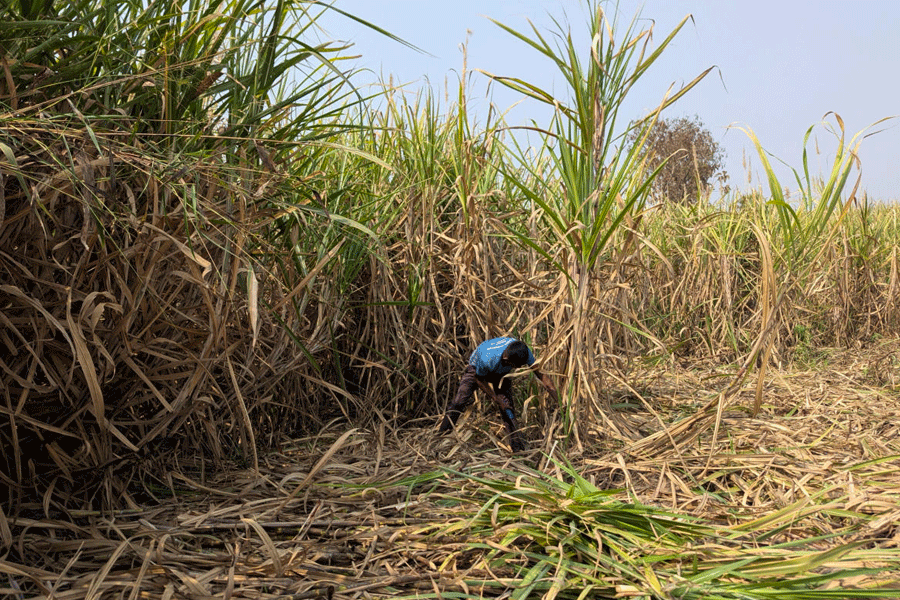
Fertiliser plants will receive about 70 per cent of their usual gas supply. The government says protecting fertiliser production is essential to ensure farmers have the nutrients they need for crops, particularly with the kharif planting season approaching.
Industrial users connected to the national gas grid, including manufacturing and the tea industry, will receive about 80 per cent of their usual supply. Commercial customers supplied through city gas networks, such as restaurants, hotels and small businesses, will also receive 80 per cent of their typical allocation.
Oil refineries are expected to absorb part of the shock by cutting their gas use to about 65 per cent of their recent average consumption. To free up enough fuel for higher-priority sectors, the government said supplies would first be curtailed to petrochemical plants, heavy industrial users and some power stations.
At the same time, authorities have ordered refiners to boost domestic LPG production and build emergency stockpiles. Reliance announced late on Tuesday that “ensuring uninterrupted access to essential fuels for Indian households remains a national priority”.
It said it would “maximise LPG production” from its refining and petrochemical complexes at Jamnagar, the world’s largest integrated refining hub.
India sources more than 90 per cent of its LPG imports from the Middle East, much of it transported through the Strait of Hormuz.
Natural gas supplies are also under pressure, with major supplier Qatar halting production following an Iranian drone strike. Reliance said that to offset the reduction in supplies it would divert natural gas produced from its KG-D6 basin to support priority sectors.
The LNG shortages could become especially painful in the coming months as India heads into what weather forecasters say may be an unusually hot summer. Gas-fired power plants supply only a small share of electricity but play a critical role in meeting evening demand when solar generation falls away but temperatures remain high.
Experts warn that if LNG supplies remain constrained, only a fraction of the gas-fired capacity needed to meet peak evening demand may be available. Power consumption could surge past 270 gigawatts this summer, potentially breaking records as millions of households rely on fans and air conditioning to cope with soaring temperatures.