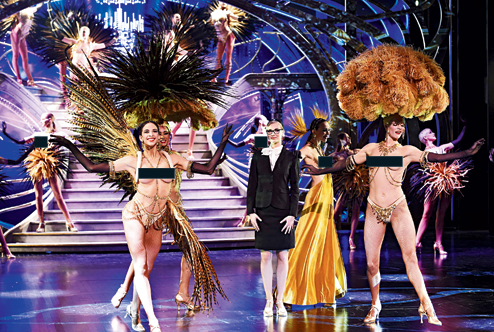

The bus took a cautious turn into Champs-Elysees minutes after seven on a March evening only to make an equally cautious stop before a granite-covered facade hidden by an oversized billboard befitting the grand scale of Parisian nightlife.
With the word “Lido” on my lips and “Welcome monsieur” in my ears, the walk past the rose bouquet sellers took me right to the heart of the naughty-but-nice culture of the city — cabaret, drowning all street side cafe talk of the far-right surge that has gripped Europe.
First, let’s brush an important question off the table: Was I seated among dodgy businessmen with busty blondes or among twinkly-eyed pervs? Neither. I was just another tourist among hundreds of tourists — mainly Asians and Americans — who were wondering if Paris is still kicking as much as it did in the better half of the twentieth century. The answer presented itself not just in the kicks of the five-feet ten-inch-tall girls — that’s the average height! — (some) draped in designer wear and swathed in feather, but also in the storyline of the dozen-odd scenes that were presented over one-and-a-half hours.
Le Lido is to the city’s nightlife what a Versace or Gucci is to style. Ever since 1946 when it opened doors shortly after the end of World War II and the liberation of Paris, Le Lido has been brilliantly blending taste and tack while at the same time fighting competition from the other famous addresses — the Moulin Rouge (if cancan is what you are looking for, this is the place but if some tourist guides are to believed, it’s not the same dance routine as that of the early 1900s) and Crazy Horse (the hall is much more intimate than Le Lido). There is also the Paradis Latin but the name didn’t come up while planning the visit to the Champs-Elysees address.
LE LIDO IN FIGURES
2 MILLION CRYSTALS
45 MUSICAL INSTRUMENTS FORM THE ORCHESTRA
200 KILOS OF FEATHER
300 LIGHT PROJECTORS
40000 HANGING BEADS FROM A CHANDELIER
300000 BOTTLES OF CHAMPAGNE EVERY YEAR
500000 VISITORS PER YEAR
Tutus to g-strings
Back to Le Lido, here the tradition of cabaret is honoured and continues to be perfected long after its famous director of dancers, Margaret Kelly (better known as Miss Bluebell), passed away at age 94 in 2004. She was known for getting the best out of classically trained dancers willing to exchange tutus for G-strings. And she didn’t take the philosophy to her grave.
“I wanted them tall, with long necks to show off the costumes with their big feathers, cloaks and trains. I wanted long legs because they show up better and I wanted the girls to look as though they were enjoying themselves. The ballet training is essential because it produces good posture and an elegant look. I’ve made my reputation on elegance and class,” she had told Los Angeles Times in 1986.
Before the long necks and big feathers took centre stage, it’s the atmosphere inside the auditorium that won me over. A 50-something man sporting a salt-and-pepper look walked me down to a red semi-circular-shaped sofa, immediately transporting me to the setting of Elvis: That’s The Way It Is, the 1970 concert film.
But after two glasses of wine, the mental picture of Elvis was replaced by a coy woman in a black jacket-skirt combination, standing on a stage fitted with giant screens. Paris Merveilles (Paris Wonders), created and produced by Franco Dragone (also the artistic director of Celine Dion’s Las Vegas dos and he was a part of several prestigious Cirque du Soleil shows), had started. And like King Presley had once sung, she was followed by a bevy of long-legged girls with short dresses on.


The coy woman has arrived in Paris and to a cabaret show, like the one before me. The jazz numbers are in full swing and a silhouette of the Eiffel Tower can be seen in the background. She is soon hooked to the show and wants to become a part of it.
That’s when the topless women arrive to make the central character of the show lose her inhibitions. She agrees. She disagrees. She ponders. She gives in to all that jazz.
Good plot for a cheesy B-grade Bolly film? I didn’t think that way and neither did the crowd. While the man seated at the table near me repeated the words “ballet” and “cancan” several times, the crowd appreciated every twirl, every move Miss Bluebell’s students did. And not once did the men attending to the crowd have to raise their voice or shout: “Stop that.”
And it’s not just about long legs. There are daring gymnastic acts and an ice-skating routine. Sewing the acts together are a Fred Astaire-style dancer, a mime and the vocal magic of Manon, the 2014 semi-finalist of the reality TV show The Voice: La plus belle voix, who makes one fall in love with French songs.

Let’s go Paris
So did I sit through the wolf calls at a strip show? Nope. Time to quote Pierre Rambert, Miss Bluebell’s successor as artistic director at Le Lido: “There was never any confusion between being a Bluebell Girl and a stripper or a lap dancer. This was a celebration of the female body, and she was very vigilant that the show should not stray beyond that.” In fact, much of what’s presented here is the stuff that inspires music videos and stage acts, like the daring rope act of singer Pink or ‘dare to bare while being fashionable’ stage acts of Madonna.
Of course, no longer does an Edith Piaf linger around any of the cabaret addresses in town but there is something about the cabaret show at Le Lido that makes one sing under the breath Let’s Go Paris weeks after the one-and-a-half-hour show ends.
PS: According to Le Lido’s official website, children over four years of age are allowed to attend the show, though none was present when t2oS attended Paris Merveilles.
— Mathures Paul
Pictures: Getty Images
Cabaret on your Paris itinerary? Book in advance (prices don’t include meals):
Le Lido — upwards of Euro 75; Moulin Rouge — upwards of Euro 87;
Crazy Horse — upwards of Euro 105; and Paradis Latin — upwards of Euro 65