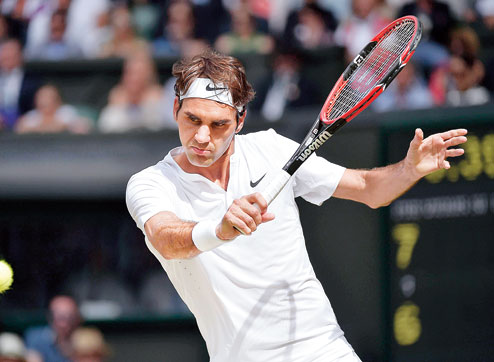

When the imperious Roger Federer lost to the indomitable Novak Djokovic on the Centre Court in Wimbledon, it confirmed the ascending march of the power-packed double-fisted backhand over the guile, variety and grace of the single-handed backhand.
And the grass courts of the “Championships” is, tenuously but still, the last preserve of what must be the most difficult and spectacular shot in tennis. The backhand topspin drive, swerving beyond the outstretched racquet of the opponent, of the kind Federer unleashed midway through the second set, or even better, the one down the line, which was once the King’s hallmark, now being appropriated by his countryman Stan Wawrinka.
Ever since the summer of 1985, when Boris Becker dove into the tennis sphere like a flaming angel and daubed himself with green glory, I have had a thing for grass and single-handed backhands. Sure, there was John McEnroe, but a notch past his prime, but more importantly, Doordarshan hadn’t quite woken up to the brave new world of live telecast of major sporting events till the World Championship of Cricket Benson & Hedges Cup in 1985.
Single vs Double
That fetish for the single-handed backhand meant that I had a reasonably open field to choose my tennis icons from in my teens. Stefan Edberg, Yannick Noah, Pat Cash, Henri Leconte, the aforesaid McEnroe –– all of them purveyors of devious sliced serves, single-handed backhands and silken volleys. But the true pre-cursor of the steely Federer backhand was Ivan Lendl.
All this while on the women’s side, Martina Navratilova, single-handedly carted all the prime silver away till she was challenged by one Ms Steffi Graf, another svelte single-hander who broke my brother’s heart in ways that cannot be recounted here. Suffice it to say that it involved an issue of the Sportsworld, that venerable publication from the ABP stable that kept our small-town sporting dreams alight, which carried a delish photofeature on Mrs Agassi,
nee Graf.
Stacked up against the finesse of these cool snipers (some like Cash and Noah were, and are, literally rock stars), were the double-barrelled shotgun brigade of Bjorn Borg, Jimmy Connors and Mats Wilander. In 1989, the diminutive Michael Chang heralded a new era with his oversized racquet, aggressively loopy, top-spinning double-handers, struck from well within the baseline, derailing Edberg’s best bid to win a French Open in 1989. Andre Agassi would soon take this trick of striking the ball early to an entirely new level, and against all predictions, win the Wimbledon title, his first Grand Slam, in 1992. His phoenix-like ability to resurrect his career somehow trumps over his ungainly backhand and makes him the double-hander I have egged on to victory.
And then along came Sampras –– Pistol Pete to many for the way he cocked his racquet –– to tilt the balance firmly in favour of the single-handed backhand, especially at Wimbledon. Not only are Sampras and Federer tied on the number of Wimbledon singles titles they have won (seven apiece), tennis cognoscenti are still abuzz about whose backhand packed more fizz and the service more piquant. I personally think if Federer was able to hit the ball any harder or find angles even more impossible, then he might as well have walked on water.
The new Mad Max
If Federer and Sampras are tied for the spot of the best single-handed backhand, male, then to Justine Henin-Hardenne and Amelie Mauresmo must go the award for the best single-handed backhand, female, award. Of course, in the Nineties, a subset of the classic tussle between Sabatini and Graf was their contrasting single-handed backhands, with the Argentine’s elegant top-spun ones having a slight edge over the German’s skiddy slices that at Wimbledon threatened to mow the turf at the point of impact. For a while in the Nineties, Monica Seles was Graf’s prime rival, with a curious double-handed forehand as well as a backhand. It was one of the greatest sporting tragedies of our time that her genre-defying playing style was cut short by Gunter Parche’s manic stab, also, incidentally, a single-handed stroke.
The current Mad Max of the single-handed backhand in men’s tennis is Stan Wawrinka, as famous for tattooing a Samuel Beckett quotation on his left forearm as for his pink chequered boxers. He seems to have invented a new shot, the inside-out backhand, where he almost runs around a forehand on the deuce court and fires at the opposite left-hand corner. He caught Djokovic unawares repeatedly with this shot in the French Open final. Watching the Wimbledon semi-final between Wawrinka and Richard Gasquet was every single-handed backhand fetishist’s wet dream as the two Europeans launched relentless trebuchet-like backhands, long in preparation, and the execution sweet to behold.
However, no one at this year’s Championships matched the versatility of Dustin Brown, who unsheathed killer backhands, single-handed as well as double-handed, as he overwhelmed Rafael Nadal with a combination of power and deft touch. And that was, for me, the match of the tournament. Suddenly tennis became real, no longer merely a metaphor for a sparring, gladiatorial sport, but bare-knuckled in all its physicality. A sublimely talented tyro went for broke against a seasoned pro, who stretched and tried to reach for an entirely different level. That seemed to work for a while, with Rafa clawing his way back in the second set. One could then almost hear Nadal’s fingernails scraping against a rocky precipice. But it was Dustin’s day. He prised open Rafa’s grip with nonchalance and let him go. Such was the beauty of this violence that I failed to notice whether Brown used both hands to do that or just one. By then it had ceased to matter.

Debanjan Chakrabarti
The writer is a tennis fanatic whose passion for the game far outstrips his ability to play it
Who had/ has the best backhand in the game? Tell t2@abp.in