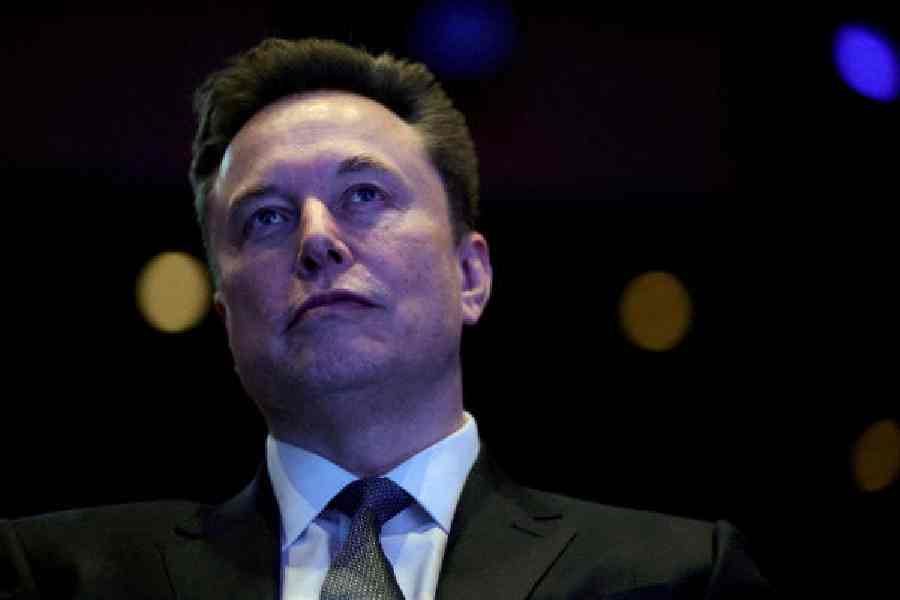
Tesla shareholders continue to bet big on chief executive Elon Musk to drive up stock prices, and on his proximity to US President Donald Trump, even as the 54-year-old announced an end to production of two of the company’s popular models, the S and X, and plans to convert its Fremont factory into a manufacturing hub for its Optimus robots.
“It’s time to basically bring the Model S and X programmes to an end with an honourable discharge,” Musk said on the company’s latest earnings call.
Fourth-quarter revenues fell 3 per cent to $24.9 billion, Tesla said, beating analysts’ estimates of $24.79 billion.
Tesla continues to face stiff competition from BYD in one of Musk’s biggest markets, China. The Chinese carmaker recently became the world’s largest manufacturer of electric vehicles.
In Europe, Volkswagen is selling more electric vehicles than Tesla. The slide in car sales has taken a toll on Tesla’s net profit, which stood at $3.8 billion for the year, down from $7.1 billion in 2024.
Musk is increasingly focusing Tesla’s future on the self-driving Cybercab and AI-enabled humanoid robots. The group has, in fact, begun referring to itself as a “physical AI company”. Tesla’s chief financial officer, Vaibhav Taneja, said the company will spend more than $20 billion this year to expand factory capacity and invest in AI infrastructure.
The biggest surprise has been the decision to scrap two of the company’s long-running car models. The Model S sedan, which went on sale in 2012, helped position Tesla as a serious automaker. The Model X was first teased the same year and reached customers three years later, arriving with distinctive ‘Falcon Wing’ rear doors that folded upwards.
The Cybercab, which had initial launches in San Francisco and Austin, is set to roll out in seven more US cities by the summer. Musk has claimed the company is likely to obtain regulatory approval for its "full self-driving" (FSD) software in Europe and China next month. Despite its name, FSD still requires a human to sit in the driver’s seat and pay full attention.
The future, Musk argues, belongs to self-driving taxis and humanoid robots. In 2024, he said Optimus could be the catalyst for lifting Tesla’s market capitalisation to $25 trillion one day.
To take home a record-breaking $1 trillion pay package, Musk needs to raise Tesla’s valuation to $8.5 trillion — from $1.4 trillion in November 2025 — and sell millions of robots and autonomous-driving subscriptions.