 |
New Delhi, March 22: The government today issued norms for setting up National Investment and Manufacturing Zones (NIMZs) with a slew of incentives, which include exemption from capital gains tax, time-bound clearance and soft loans.
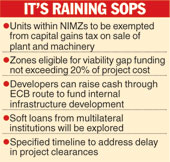
A unit located within an NIMZ will be exempted from capital gains tax on the sale of plant and machinery, the guidelines issued by the department of industrial policy and promotion (DIPP) said.
The tax break will be granted in case of re-investment of the sale consideration within three years for the purchase of new plant and machinery in any other unit located within the same NIMZ or another zone. Besides, NIMZs will be eligible for viability gap funding, which cannot exceed 20 per cent of the project cost.
The developers of NIMZs will be allowed to raise funds through external commercial borrowings (ECBs) to develop internal infrastructure. Soft loans from multilateral institutions will be explored to fund infrastructure development in NIMZ, the guidelines said.
Assistance will be offered for negotiating non-sovereign multilateral loans.
The norms have also addressed the issue of delay in project clearances.
“Timelines will be defined in respect of all clearances. In case the decision is not taken in the specified timeline, the clearance will be ‘deemed’ to have been given on expiry of the timeline,” the guidelines said.
NIMZs are conceptualised as integrated industrial townships of at least 50 sq km (5,000 hectares). At least 30 per cent of the total land area will be devoted to manufacturing units.
In March 2010, the DIPP had proposed to establish NIMZs to increase the share of manufacturing in the gross domestic product from 16 per cent to 25 per cent within 10 years and create 100 million jobs.
The policy proposed to liberalise labour and environmental laws to facilitate faster project clearance. However, the cabinet decision had to be deferred because of opposition by the ministries of labour and environment.
Later, a group of ministers under agriculture minister Sharad Pawar was able to reach a consensus on the contentious issues, following which the cabinet cleared the proposal in October 2011.