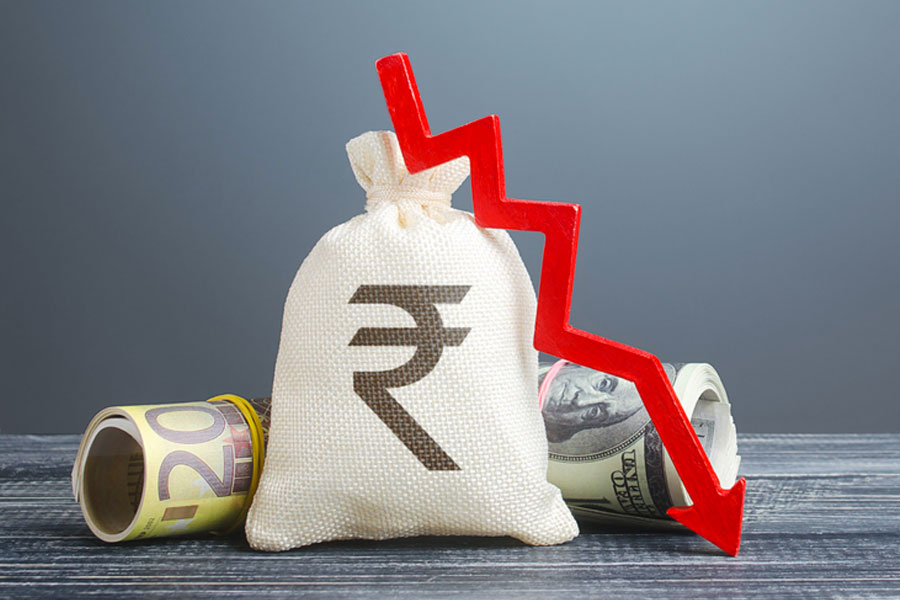
The Indian rupee tumbled to a record low on Wednesday, underscoring mounting external vulnerabilities as surging oil prices and persistent foreign capital outflows triggered by the ongoing West Asian conflict intensified pressure on the currency, even as the central bank stepped in intermittently to contain volatility.
The rupee weakened to 92.63 against the US dollar, extending losses in what has become a challenging phase marked by elevated crude prices and risk-off sentiment among global investors. According to Santanu Sengupta, the chief economist at Goldman Sachs India, the currency could depreciate further to 95 over the next year amid widening macroeconomic imbalances.
The local unit has fallen more than 1.5 per cent since the outbreak of the conflict, alongside nearly $8 billion in foreign portfolio outflows from domestic equities. Market participants said frequent interventions by the Reserve Bank of India, including on Wednesday, have helped prevent sharper declines.
Global crude benchmarks continue to be a key overhang. Brent futures rose 5.5 per cent to $109.13 per barrel by late evening trade and have surged about 40 per cent since hostilities began.
A sustained rally in oil prices could significantly widen India’s current account deficit and stoke inflationary pressures, leaving the rupee more vulnerable than many of its emerging market peers.
India, which imports over 80 per cent of its energy requirements, faces additional risks from potential disruptions to remittances and exports to the region. Analysts warn that as long as crude prices hover around the $100 mark, pressure on the rupee is unlikely to abate.
Dhiraj Nim, economist and FX strategist at ANZ, noted that while the central bank can curb speculative pressures, it may not aggressively defend the currency if elevated oil prices weaken the balance of payments.
Technical indicators suggest near-term resistance for the USD/INR pair at 92.85 and support at 92.40, according to Dilip Parmar of HDFC Securities.
Sengupta said that although inflation remains contained for now, a prolonged phase of high oil prices combined with currency weakness could eventually feed into consumer prices, potentially prompting the RBI to tighten monetary policy at a later stage.
Reflecting these risks, Goldman Sachs recently trimmed India’s growth forecast for the year to 6.5 per cent from 7 per cent and raised its inflation estimate by 30 basis points to 4.2 per cent. The investment bank also expects India’s current account deficit to widen by 0.8 percentage points to 1.2 per cent of GDP.
Despite currency pressures, domestic equities showed resilience. The BSE Sensex rose 633.29 points, or 0.83 per cent, to close at 76704.13, while the Nifty 50 advanced 196.65 points, or 0.83 per cent, to 23777.80.
Foreign institutional investors remained net sellers, offloading equities worth ₹4,741.22 crore on Tuesday, according to exchange data.