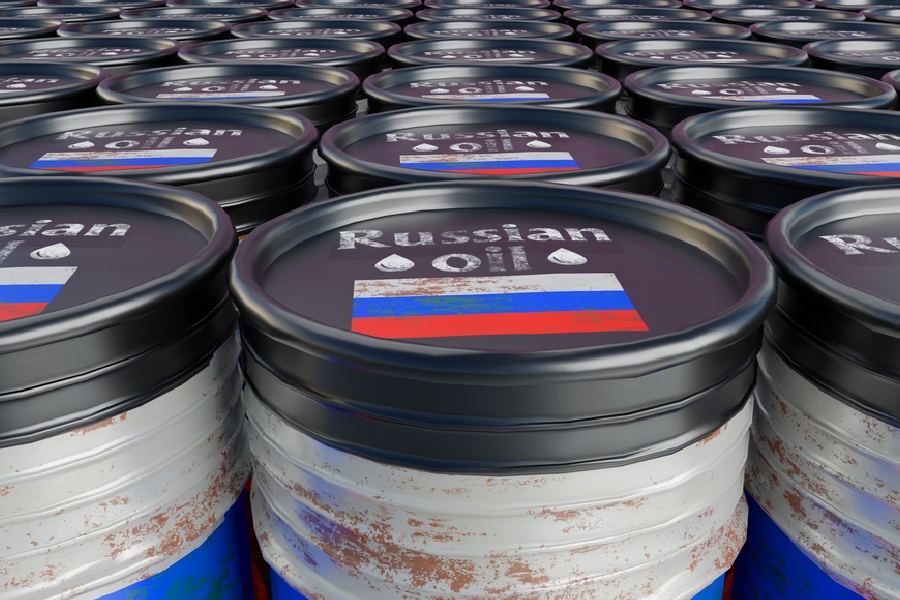
India is set to restrict crude oil purchases from Russia as part of an agreement with the United States that links energy imports to trade concessions, PTI said quoting sources.
The move is part of a broader bilateral arrangement under which Washington has agreed to lower tariffs on Indian exports.
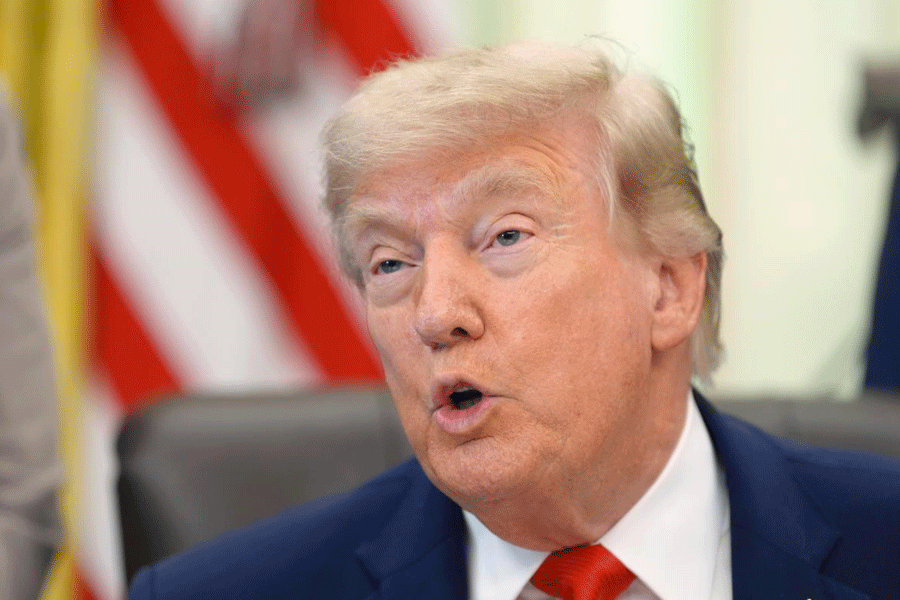
US President Donald Trump announced overnight that the United States will reduce the reciprocal tariff on Indian goods to 18 per cent from 25 per cent.

The announcement, made under what he described as a wider bilateral deal, followed India’s commitments on trade and energy.
According to Trump, the tariff cut came after India agreed to stop buying Russian oil, lower its tariff and non-tariff barriers against the US, and commit to purchasing an additional USD 500 billion worth of US energy, technology, agricultural products, coal and other goods over time.
The agreement removes the additional 25 per cent punitive tariff that had been imposed earlier, effectively bringing down the applied US tariff on Indian exports to 18 per cent from 50 per cent. This is expected to ease pressure on Indian exporters.
Sources said Indian refiners will continue to honour crude purchase commitments made before the announcement but will not place fresh orders thereafter.
“Imports will continue for now by refiners such as Nayara Energy, which have no other alternative source,” one source said to PTI.
Indian refiners emerged as the world’s second-largest buyers of Russian oil after Moscow’s invasion of Ukraine in February 2022, when supplies became available at a discount.
However, purchases have gradually declined since the US imposed sanctions on key Russian exporters.
State-run firms such as Hindustan Petroleum Corporation Ltd (HPCL), Mangalore Refinery and Petrochemicals Ltd (MRPL) and HPCL-Mittal Energy Ltd (HMEL) had already stopped buying Russian crude soon after the sanctions.
Others, including Indian Oil Corporation (IOC) and Bharat Petroleum Corporation Ltd (BPCL), are expected to wind down their purchases.
Reliance Industries Ltd, India’s biggest buyer of Russian oil, had paused imports late last year after sanctions on Rosneft and Lukoil. Sources said it is also likely to stop purchases once its resumption cargo of 100,000–150,000 barrels is delivered.
An exception is likely in the case of Nayara Energy. The refinery was first sanctioned by the European Union and later by the UK because of its Russian links, with Rosneft holding a 49.13 per cent stake.
Due to these sanctions, other major suppliers are unwilling to engage in commercial transactions with Nayara, leaving it dependent on Russian oil sourced from non-sanctioned entities.
“Nayara is likely to continue purchases of Russian oil from non-sanctioned entities in the near future,” sources said.
They added that the refinery’s position was explained to US trade officials during talks in December, and that Nayara may require an exemption from the no-Russian-oil policy or a special dispensation.
Trump also said India’s reciprocal tariff rate of 18 per cent would be marginally lower than the 19 per cent imposed on most ASEAN economies, except Singapore, and the 20 per cent levied on Bangladesh.
The additional 25 per cent tariff linked to Russian oil purchases will be removed following India’s reported commitment to halt such imports. India has also agreed to import USD 500 billion worth of US goods over a five-year period.
In 2025, India exported USD 92 billion worth of goods to the US, accounting for 20 per cent of its total exports, and imported USD 50 billion worth of US goods, or 7 per cent of its total imports.
India’s total oil import bill stood at USD 180 billion, with 30–35 per cent sourced from Russia, 20–30 per cent from Iraq, 15 per cent from Saudi Arabia, 10 per cent from the UAE and 5–10 per cent from the US.
Sources said Russian oil imports have already been falling. In December 2025, India imported an average of 1.2 million barrels per day from Russia, down from a peak of 2.1–2.2 million barrels.
In January, this fell further to about 1 million barrels per day, and was expected to drop below that level in the coming months. Under the new arrangement with the US, imports could halve soon.
However, analysts said the impact may not be immediate. According to Sumit Ritolia, Lead Research Analyst, Refining and Modeling at Kpler, the trade deal is unlikely to lead to a sharp near-term drop.
“Russian volumes remain largely locked in for the next 8-10 weeks and continue to be economically critical for India's complex refining system, supported by deep discounts on Urals relative to Brent. Imports are expected to stay broadly stable in the 1.1-1.3 million barrels a day range through Q1 and early Q2,” he said. “Despite a recent moderation in purchases, India is unlikely to fully disengage in the near term.”
Prashant Vasisht of ICRA said the deal includes India stepping up purchases of US crude oil and potentially beginning imports from Venezuela.
“For the Indian refining sector, there are ample avenues including the US, to purchase crude as Russian crude accounted for less than 2 per cent of Indian crude imports prior to FY2023,” he said.
He added that discounts on Russian crude were limited before sanctions were announced in October 2025, and replacing Russian supplies with market-priced crude would raise India’s import bill by less than 2 per cent.
Venezuelan crude, which is heavy and sour and therefore cheaper, could also attract Indian refiners capable of processing such grades.