India is charting a “middle-path” approach to regulating artificial intelligence, balancing the imperatives of innovation with the need for safeguards.
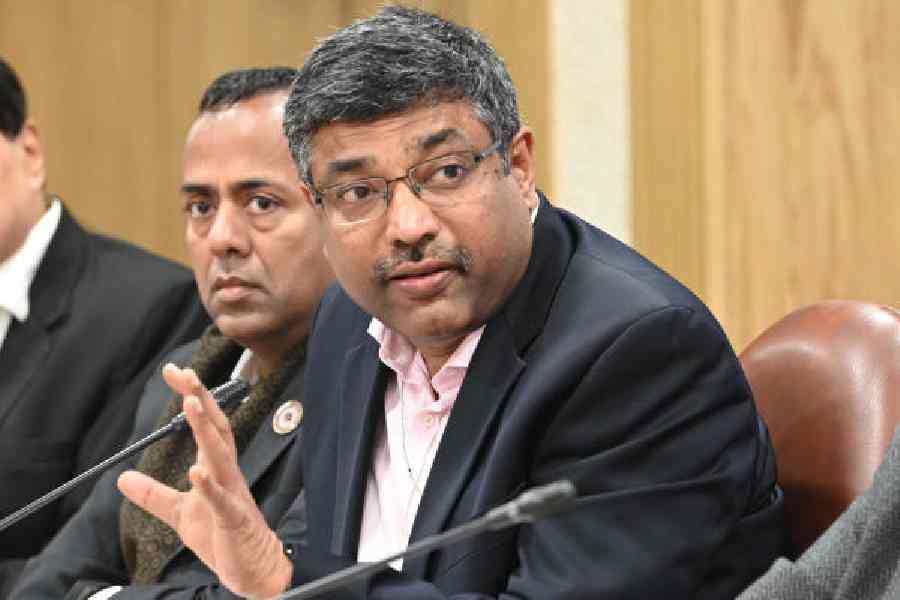
Addressing concerns over future governance challenges in AI, S. Krishnan, secretary, ministry of electronics and information technology, said that countries have adopted contrasting regulatory models globally.
The European Union, he said, legislated early “even before AI had started”, while the United States has followed an almost “laissez-faire” regime driven largely by private contracts and subsequent court interpretation. “We are taking a middle path,” he said at a Merchants Chamber of Commerce organised event in Calcutta on Saturday.
Innovation, Krishnan stressed, must take “the front seat”. India already has laws in place that can address some of the problematic aspects of AI, including deepfakes, misrepresentation, and related harms. He added that the government stands ready to intervene with targeted measures whenever necessary.
Citing the recent rule on synthetically generated information, which is expected to be notified shortly, Krishnan said such focused interventions would continue.
“We stand ready to regulate on certain specific aspects, but we do not want regulation to come in too early and throttle innovation, because AI is still in a phase of innovation,” he said.
Krishnan also pointed to strong domestic momentum in the sector. He said the Prime Minister had recently met with 12 Indian AI start-ups, along with representatives from academic institutions that are developing the country’s first foundational models, some of which are expected to be launched soon, underscoring the government’s confidence in India’s AI ecosystem.
Ahead of the India AI Impact Summit 2026 to be held in India next month, 12 Indian AI start-ups that have qualified under the Foundation Model Pillar in the Summit attended a roundtable with Prime Minister Narendra Modi on January 8 and presented their ideas and work.
These start-ups are working in a diverse set of areas, including Indian language foundation models, multilingual LLMs, speech-to-text, text-to-audio and text-to-video; 3D content using generative AI for e-commerce, marketing, and personalised content creation; engineering simulations, material research and advanced analytics for data-driven decision-making across industries; healthcare diagnostics and medical research, among others.
Krishnan also said that with Bengal’s potential in subjects like pure science and mathematics, the state could play a crucial role in developing the country’s AI ecosystem.