
New Delhi: E-way bills or electronic invoices will be required to move goods between states from February 1, the GST Council decided on Saturday.
The council, which met through video-conferencing, had earlier said that electronic invoices would be required for inter-state transfers from April 1. However, they decided to bring forward the date after some pointed out that a shortfall in GST revenues could be because inter-state movements were not being captured.
"This will bring uniformity and allow seamless inter-state transfer of goods," a statement issued after the meeting said.
"Till such time as a national e-way bill is ready, states were authorised to continue their own separate e-way bill systems. However, it was represented by the trade and transporters that this is causing undue hardship in inter-state movement of goods and, therefore, bringing in an early all India system of e-way bill has become a necessity," the statement said.
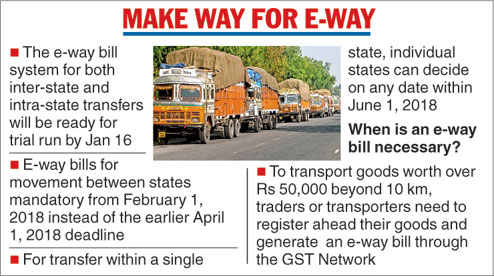
Officials said that nationwide the e-way bill system will be ready for a rollout on a trial basis by January 16. Traders and transporters would use it voluntarily during the first fortnight more as a test.
"The immediate call of the GST Council meeting to bring forward the implementation of the e-way bill reflects that serious gaps in the system have been noticed. The shortfall in revenue could be the reason for the early implementation of an e-way bill," said Ansh Bhargava, head (growth and strategy), Taxmann.
According to the GST act, to transport goods worth over Rs 50,000 beyond 10 km, traders or transporters need to register ahead their goods and generate an e-way bill through the GST Network which will be used to track goods movement within and between states.
"While the system for both inter-state and intra-state e-way bill generation will be ready by January 16, the states may choose their own timings for the implementation of e-way bills for intra-state movement of goods on any date before June 1, 2018," the statement said.
There are certain states which already have a system of e-way bill for intra-state as well as inter-state movement and some of those states can be early adopters of the national e-way bill system for intra-state movement also, it noted.
"But in any case, the uniform system of e-way bill for inter-state as well as intra-state movement will be implemented across the country by June 1, 2018," it said.
"The intra-state e-way bill will be counter productive for smooth transactions of goods and services. In local sales, goods are moved many times for sample purposes or even returned because of quality issues or as surplus. How will intra-state e-way bill be generated in such cases...some other mechanism is needed for this issue," the Confederation of All India Traders said.
While the GST was rolled out on July 1 this year, the GST Council had decided to defer the e-way bill implementation to March 31 next year.
Pratik Jain, leader (indirect tax), PwC India, said it was important to ensure that all states have common e-way bills and that suggestions from industry for simplification are taken into consideration.
"If the implementation is not done properly, it could lead to significant supply chain bottlenecks and somewhat dilute the objective of 'one nation, one tax'," said Jain.
"The fair balance for mandatory inter-state e-way bill compliance from February 1 will have to be maintained. This compliance will reduce tax evasions but may pose some problems for movement of goods. The government should check the system thoroughly so that there is no disruption in movement of goods," said Abhishek A Rastogi, partner, Khaitan & Co.
The shortfall in revenues to target was about Rs 39,111 crore for the period July-October 2017. The GST revenue for October stood at Rs 83,346 crore, the lowest in four months since the new indirect tax regime was implemented.