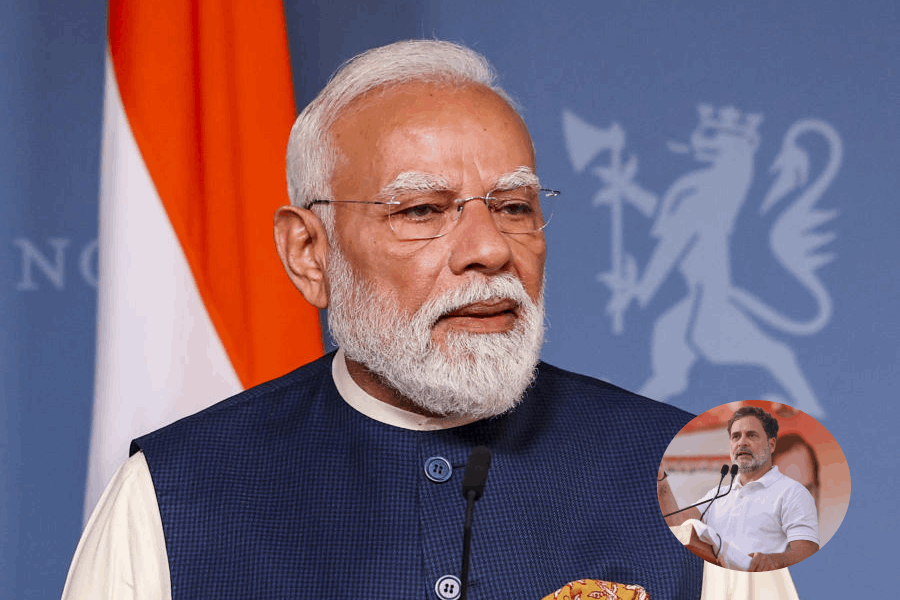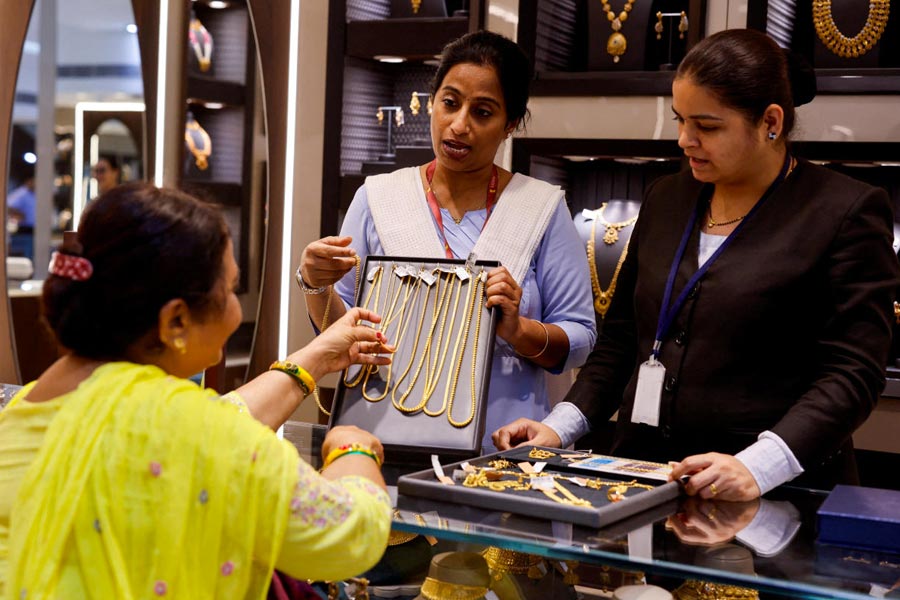
Jewellery associations are reportedly scheduled to meet officials from the Prime Minister’s Office (PMO) on Tuesday after Prime Minister Narendra Modi appealed to citizens to refrain from buying gold for a year.
Shares of jewellery makers such as Titan, Senco Gold and Kalyan Jewellers fell between 6 per cent and 9 per cent on Monday, the day after Modi urged people to cut down on unnecessary consumption to help protect foreign exchange reserves.
It fuelled concerns of higher import tariffs on gold, sending shares of Indian jewellery retailers lower.
"There are concerns that the government might sharply increase import duty on gold for a year to discourage imports," Surendra Mehta, national secretary at the India Bullion and Jewellers Association, told Reuters. "Duties could be raised even higher than levels seen in recent years."
In a letter to Commerce Minister Piyush Goyal, The All India Jewellers & Goldsmith Federation (AIJGF) national President Pankaj Arora said while the government's concerns over foreign exchange reserves and a swelling import bill were understandable, a broad public appeal discouraging gold purchases without a structural alternative risked devastating the jewellery ecosystem.
"While the intention of protecting India's foreign exchange reserves is understandable, the solution should not be demand destruction. The solution should be domestic gold mobilisation, recycling and productive circulation of India's idle gold stocks," Arora told PTI.
The federation warned that a sudden negative shift in consumer sentiment could reduce footfalls, slow manufacturing orders, and hit the incomes of small jewellers and artisans - the most vulnerable workers in the supply chain.
"This is not merely a gold trade issue. This is a livelihood issue."
The Iran war has sent oil prices surging and that in turn has resulted in mounting pressure on India's balance of payments and the rupee. India is the world's third-largest oil importer and consumer, meeting more than 90 per cent of its crude oil needs and about half of its natural gas demand through imports.
India faces mounting pressure on its forex reserves due to elevated global commodity prices and increasing uncertainty in international supply chains. India’s forex reserves fell by $7.794 billion to $690.693 billion in the week ended May 1.
Modi's remarks about gold on Sunday came along with a range of other measures he urged, including fuel conservation, increasing working from home and limits on travel and imports.
Gold is in high demand in India, particularly for weddings where gold jewellery is seen as a crucial part of a bride's attire and is a popular gift from family and friends. While it is the world's second-largest gold consumer, India relies on imports to meet nearly all of its demand.
The country is among the world’s largest consumers of gold, using around 700-800 tonnes annually while domestic production remains limited to just 1-2 tonnes. As a result, more than 90 per cent of India’s gold demand is met through imports.
In 2012 and 2013, New Delhi hiked tariffs on gold imports to stabilise a rapidly depreciating rupee. Now, jewellers fear that duty cuts made in 2024 to 6 per cent from 15 per cent to curb smuggling could soon be reversed.
A government source, however, told Reuters on Monday that India has no plans to raise duties on gold and silver imports.
India's balance of payments is expected to deteriorate sharply this April-March fiscal year to a deficit of about $66 billion to $70 billion, compared with an estimated $26 billion to $28 billion in 2025-26.
Pressure on the rupee has prompted the central bank to sell the dollar and limit the size of trading positions that banks can take. It has also clamped down on arbitrage trades.
The Indian rupee closed at a record low of 95.31 to the dollar on Monday.
Senior government officials said on Monday India has sufficient gasoline and diesel supplies.
But fuel retailers incur losses of about Rs 100 per litre on diesel and 20 rupees per litre on petrol by selling the fuels below market rates.
State retailers have not raised petrol and diesel prices since April 2022.