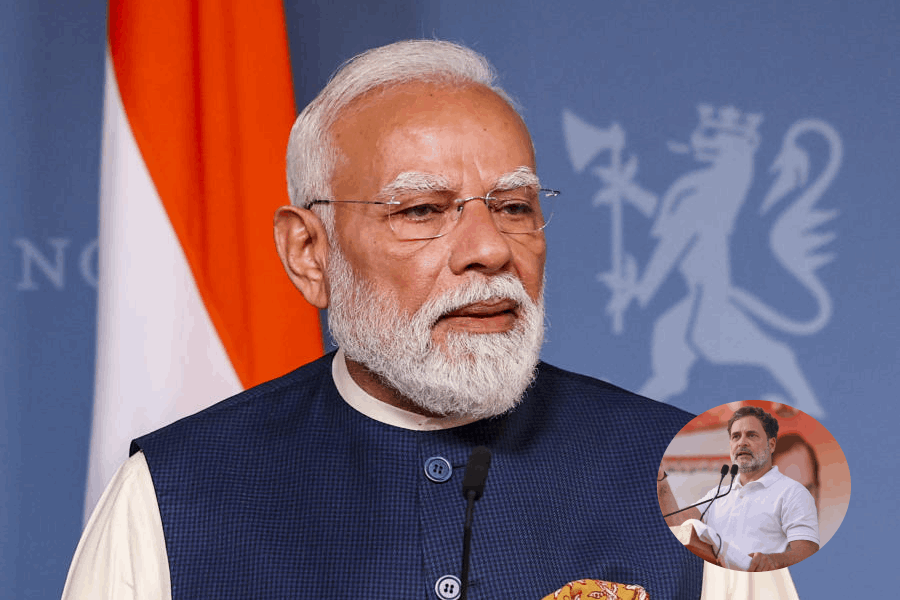
A day after Prime Minister Narendra Modi urged citizens to defer gold purchases for a year to help conserve foreign exchange amid the ongoing West Asia crisis, India’s gems and jewellery industry voiced unease over the prospect of a fresh hike in import duty on the precious metal.
While acknowledging the pressure on external balances, industry players said policy efforts should focus more on unlocking the country’s vast stock of idle household gold. They have called for a comprehensive framework to mobilise these holdings, which could help reduce import dependence and ease strain on foreign exchange reserves.
Data from the commerce ministry shows that value-wise, India’s gold import grew 24.09 per cent in FY26 at $71.97 billion compared with $58 billion in FY25.
Industry executives said the sharp reduction in customs duty to 6 per cent in 2024—from 15 per cent earlier—may be reversed amid strains on foreign exchange reserves due to the ongoing West Asia conflict. A Reuters report quoting a government official, however, said that there is no plan to raise duties on gold and silver imports.
“There are concerns that the government might sharply increase import duty on gold for a year to discourage imports,” said Surendra Mehta, national secretary at the India Bullion and Jewellers Association.
Suvankar Sen, managing director and chief executive of Senco Gold and Diamonds, echoed similar concerns while calling for a collaborative approach between policymakers and industry players to mobilise idle gold assets. “With nearly 20,000 tonnes of gold lying idle in the Indian economy, there is a strong need for the government and industry stakeholders to work together to mobilise the dormant asset,” he said.
Sen added that the industry is already adapting through lightweight and lower-carat jewellery to maintain affordability. If such trends persist, India’s annual gold imports could decline to around 550 tonnes, compared with the historical average of about 700 tonnes. The World Gold Council has estimated India’s gold demand in 2026 to be in the range of 650-750 tonnes.
Jewellers also highlighted the role of recycling old ornaments. “Indian households hold a huge amount of old gold, which can be utilised to exchange new hallmarked jewellery, and by melting the used gold, jewellers can easily meet the demand of existing clients. This can help the country save precious foreign exchange,” said Annargha Uuttiya Chowdhuury, partner at Anjali Jewellers.
Kirit Bhansali, chairman of the Gem and Jewellery Export Promotion Council (GJEPC), said the industry remains resilient and is engaging with stakeholders to find balanced solutions.
“Be it the Gold Control Act, the 80:20 rule or other challenging phases in the past, the industry has worked together and successfully adapted to changing circumstances. We are currently consulting with industry stakeholders and will collectively work towards finding balanced and practical solutions for the way forward, while continuing to support the national interest,” he said.
Pankaj Parekh, eastern regional chairman of GJEPC, cautioned that any steep hike in import duty could have unintended consequences in the form of a rise in smuggling.
All India Gem and Jewellery Domestic Council chairman Rajesh Rokde said that the industry, which provides direct and indirect jobs to over a crore people, could come under stress if gold purchases are postponed.