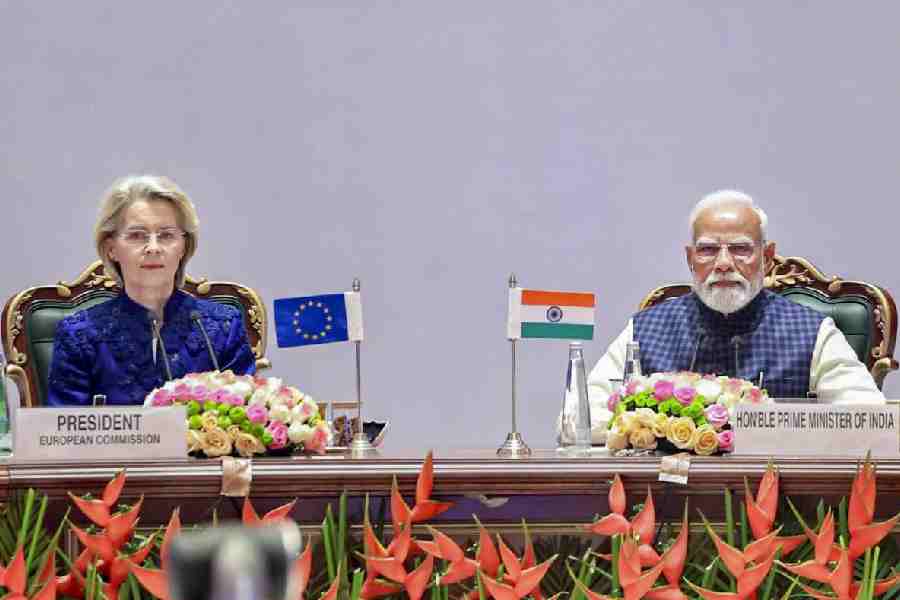
“We did it. We delivered the mother of all deals,” European Commission president Ursula von der Leyen said on Tuesday as India and the EU brought two decades of negotiations to fruition and clinched a free trade agreement against the backdrop of US President Donald Trump’s punishing tariffs.
The agreement, which will make Europe’s celebrated wines, spirits, beer, chocolates and cars cheaper for Indian consumers and allow greater market access in the EU for the domestic textile, marine and leather sectors, is likely to be operational by the end of the year. Both sides have agreed to sweeping tariff cuts while protecting the politically sensitive farm and dairy sectors.
“India will grant the EU tariff reductions that none of its other trading partners have received,” the European Commission said.
The deal comes days after the EU signed a pivotal pact with the South American bloc Mercosur, following deals last year with Indonesia, Mexico and Switzerland.
During the same period, New Delhi finalised pacts with Britain, New Zealand
and Oman.
The spate of deals underscores global efforts to hedge against trade with the US as Trump’s bid to take over Greenland and economic coercion of European countries test longstanding alliances among western nations.
An India-US trade deal collapsed last year after a breakdown in communications.
Talks between India and the EU were relaunched in 2022 after a nine-year lull, and gathered pace after Trump imposed steep tariffs on several trading partners, including a 50 per cent levy on goods from India.
Apart from the free trade agreement (FTA), India and the EU also inked pacts on defence and security collaboration and mobility for Indian talent in Europe.
Prime Minister Narendra Modi hailed the agreement as “a new blueprint for shared prosperity” as the FTA is going to impact two billion people by bringing the second and fourth-largest economies together.
The announcement of the FTA is expected to give a fillip to India’s $75-billion exports to the EU’s 27 partner nations and create greater market access for labour-intensive sectors, which are cumulatively worth $33 billion. This is the largest trade deal signed by India, Modi said. Bilateral trade of goods and services between India and the EU stood at $215 billion (180 billion euros) in 2024-25.
Von der Leyen, who is on a four-day visit to India, said the FTA was “a strong message that co-operation is the best answer to global challenges”.
By combining India’s skill, service and scale with Europe’s technology, capital and innovation, the two sides will create levels of growth that neither side could have achieved alone, she observed. “And by combining these strengths, we reduce strategic dependencies at a time when trade is increasingly weaponised,” Von der Leyen said with Modi and European Council president Antonio Costa by her side.
Win some, lose some
While the EU will cut or eliminate tariffs on 98 per cent of Indian goods, the country will gain most in labour-intensive sectors such as garments and footwear, where duties were significantly higher than in other segments, according to Ajay Srivastava, founder of the trade think tank GTRI.
India has agreed to open up some of the most protected sectors, such as automobiles and liquor. The country has decided to cut or eliminate tariffs on about 97 per cent of EU exports, with reductions spread over 7-10 years, giving sufficient time to Indian industry to adjust to the increased competition from European manufacturers.
“An early, ambitious agreement will provide certainty to businesses, expand market access both for sunrise and labour sectors of exports and 144 tradable services, and significantly strengthen the India-EU trade partnership,” Ajay Sahai, director-general of the Federation of Indian Export Organisations, said.
However, the deal left India’s most sensitive structural concern — the EU’s carbon tax — unresolved.
“The agreement’s impact is constrained by what it leaves unresolved. The EU’s Carbon Border Adjustment Mechanism (CBAM) remains outside the deal, creating a structural imbalance in which EU exports could enter India duty-free while Indian exporters continue to face carbon taxes in Europe — an asymmetry that could steadily erode tariff gains as CBAM expands beyond steel and aluminium,” he said.
Asked if India has secured a carveout, commerce secretary Rajesh Agarwal pointed out that this is a horizontal regulation which is applicable to all partner countries across the globe, adding that a technical dialogue will be initiated to find ways for Indian industries to access the market despite CBAM regulations.