Book: THE SOCIAL LIFE OF INDIAN TRAINS: A JOURNEY
Author: Amitava Kumar
Published by: Aleph
Price: Rs 399
Amitava Kumar’s book announces its intentions as a prelude even before the first chapter begins. The epigraph, borrowed from Franz Kafka’s travel diary — “Irresponsible to travel, even to live without taking notes” — prefigures the book’s tenet; that travel, especially in India, demands attentiveness and annotation. Kumar positions himself not as a romantic flâneur aboard the railway carriage but as an archivist of motion, alert to the ramifications of journeys that are at once personal, historical and infrastructural. Anecdote yields space to argument and the personal recedes to make room for the political. But the writing never lapses into abstraction.
It’s tough to bracket this book into a genre. Kumar maps the railway through intimate vignettes. It dismantles the familiar, forcing readers to confront the egregious silences and the stories of lives in motion. To read this book is to enter a polyphonic train of thought. Spanning 130 pages and divided into five chapters, The Social Life of Indian Trains runs like a Bakhtinian chronotope, keeping the reader suspended in the interstices of time, space and social life.
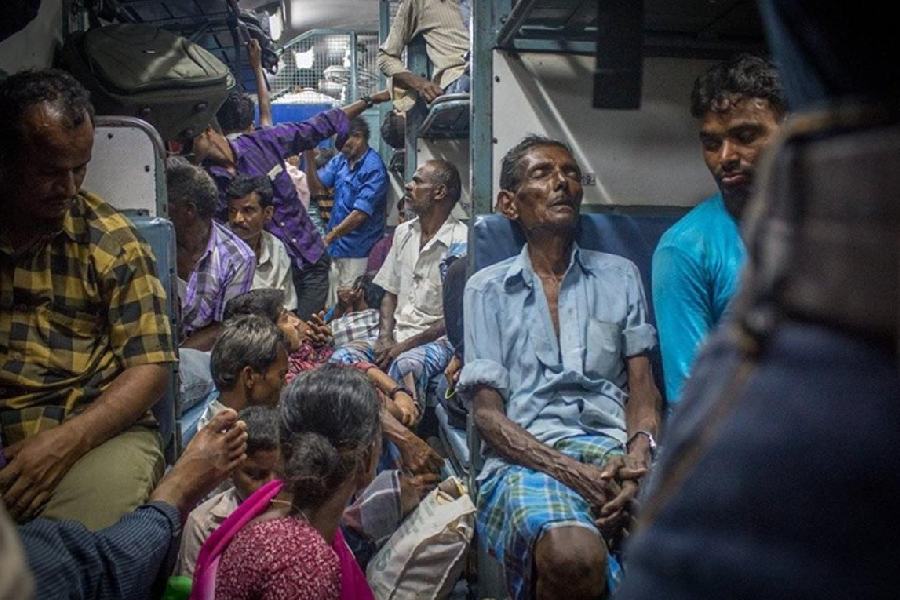
The opening chapter itself establishes one of the book’s key undercurrents: the gradual erosion of rail travel’s primacy among India’s affluent classes. Kumar notes, without rancour, how trains have ceded cultural prestige to cars and airplanes. Nevertheless, this decline in elite regard is precisely what renders the railways socially consequential. Kumar argues that the train’s diminished glamour has intensified its democratic density. The railway becomes a space where India persists in its most unfiltered form — a proliferation of bodies, languages, aspirations — even as the bourgeoisie glides overhead, sealed off from the country below.
It is in this context that Kumar invokes V.S. Naipaul’s albeit grudging yet admiring description of the Indian Railways in An Area of Darkness as a “stupendous organization”. The railway system is perhaps not heroic per se but its survival, notwithstanding bureaucratic entropy and infrastructural strain, underpins a stubborn faith in collective coordination.
A plethora of intertextual train-sequence references, from Ray’s Pather Panchali to Mani Ratnam’s Dil Se.., is cited and peppered throughout the book at intervals; however, what distinguishes Kumar’s work is how these strands coalesce sans hoodwinking. In the latter chapters, Kumar cursorily historicises the Indian Railways and binds the link between trains and Partition Literature. Memories are conjured, rendered in the chiaroscuro of desire and displacement.
The language employed is lucid and the pages slip through fingers. The words appear dipped in the cadences of motion, strung together on the thread of journeys and set up to dry against the backdrop of berths, stations and passing landscapes.
The book is populated with the shards of shifting selves and glimpses of grinding lives. A noteworthy character that Kumar introduces is Rajwar, a proletarian labourer, identifiable as much by his “colourful cotton gamchha” as by the dignity with which he inhabits the crowded train.
The book finds its apogee in the concluding reflection aboard the Himalayan toy train in Darjeeling. Kumar disavows the stance of the tourist with its appetite for the consumable and the clean. A sense of disillusionment and disenchantment thus prevails. Ending the book here is perhaps a considered choice. It is here, at the book’s end, that the author, almost like an epilogue, articulates the line that retroactively pre-empts his standpoint, “I don’t want to be a tourist in the arid zone of endless luxury, the desert of the unreal. The world is dirty, and life is difficult. Why should the railway sanitize your existence?”
Much like the watercolour-drenched cover illustration, where a plume-blurred train emerges indistinctly against a cerulean wash, the book privileges approach over arrival, evoking drift rather than destination.