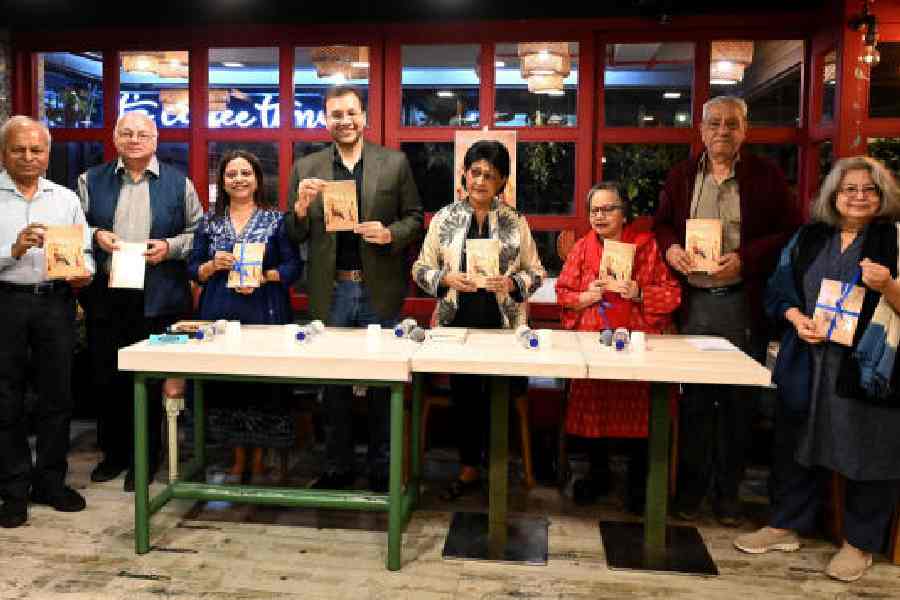
Calcutta is a city born of scattered villages, shaped by empire, and sustained by stories. A panel session that took place at ICanFlyy Tea Kafi near Maddox Square on February 7, courtesy AHAVA Communications and the AHAVA Readers’ and Writers’ Club, unpacked exactly this truth, wherein a newly translated book was discussed by translator Anita Kar, alongside state convenor of INTACH G. M. Kapur, author Aritra Sarkar, and owner and founder of FunOnStreets Navpreet Arora, all while in conversation with Oindrilla Dutt.
The book, simply entitled Sripantha’s Kolkata, is an English translation of essays by the Bengali journalist and chronicler Nikhil Sarkar (popularly Sripantha), best known for his long-running columns on Calcutta in Anandabazar Patrika. These essays, painstakingly researched yet written in a conversational, accessible style, revisit the streets, communities, institutions, and forgotten corners of this city we all call home, and build a vibrant, multi-layered portrait of colonial and early modern Calcutta.
Opening the discussion, Dutt sketched the historical arc that Sripantha was so fascinated by: a cluster of villages that grew into what was once the second city of the British Empire, the capital of British India, a “city of palaces”, as Robert Clive called it, with grand mansions, broad boulevards and the Hooghly flowing through it. It was also a city that was often chaotic and unplanned, yet irresistibly alive. Sripantha’s weekly essays, eagerly awaited by readers, were the result of extensive fieldwork: visits to museums and libraries, reading old manuscripts, and pursuing details with almost archival devotion.
For Kar, the journey to translating the book began on the personal front. She said she had first picked up the Bengali volume and found herself “enthralled” by the writing. Each essay, she recalled, moved easily between people, incidents, social change and history – especially the ferment of the 19th-century Bengal Renaissance – without the stiffness of academic prose. “It was riveting,” she said, adding that the ease of reading was part of its great strength.
Kar began translating the essays simply for pleasure. Life, eventually, took her to England, where she attended a translation workshop at St Anne’s College, Oxford. There, she was encouraged to shape the work into a formal project and submit a proposal to publishers. The process that followed stretched over seven years, much of it spent researching at the Bodleian Library, checking dates, cross-verifying facts, and ensuring historical accuracy. Ratna Books eventually published the compilation after multiple years of long-distance coordination, pandemic delays, and repeated revisions.
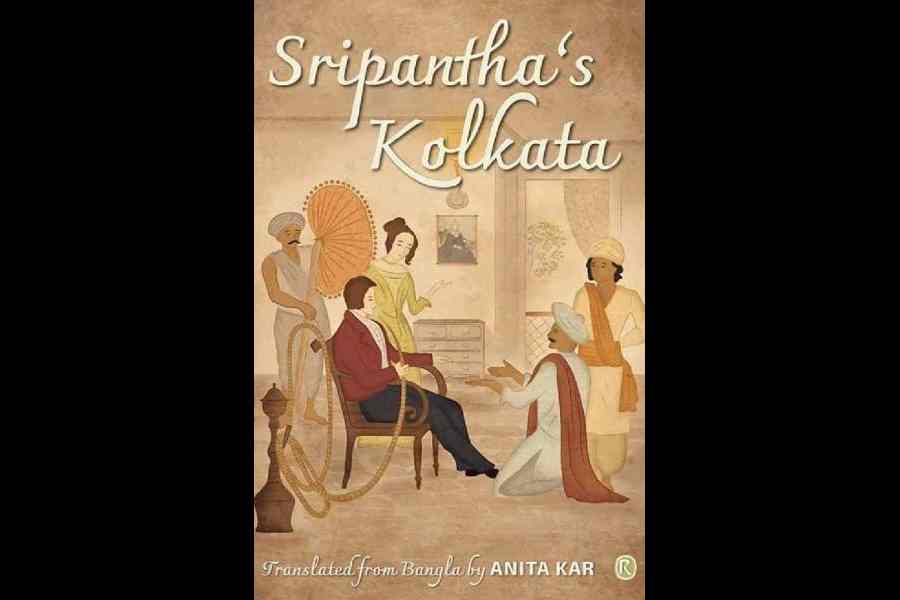
“It was absolutely riveting. Each essay was interesting and so well-written, but in a conversational style. There was no historical or academic rigour. I just started translating the essays into English on my own, for pleasure. Fate took me to England, where I got to attend a translation workshop at St. Anne’s College, Oxford. I was asked to submit a proposal to a publisher, and within a year, I heard from them. The book was accepted, and we started working on it... and it was really a long seven-year stint. But we’ve done it, and I’m so happy that I’ve done something for Calcutta. This is a city I love, and I’m overwhelmed by the interest people have shown,” Kar said at the panel.
Kar described the book as her tribute to her favourite city, even though she was born and brought up in Burma. While Sripantha’s original work was already quite researched, she added that the translation process required her to verify almost every reference. In one striking admission, she noted that a chapter on road names was missing from her copy of the Bengali book, prompting her to research and draft it herself before later synchronising it with the original.
Aritra Sarkar, whose own book Soulful Cal! also explores the city, spoke about the craft of Sripantha’s writing. He resisted any direct comparison between the two works, calling Sripantha’s writing “a different level altogether.” What impressed him most was the balance between storytelling and historiography; the way narrative drive and archival depth coexist on the page. “It’s a masterclass,” he said, adding that Kar’s translation was a learning experience for him as a writer. While Sarkar’s writing is more overtly personal and emotionally driven, often centred on everyday figures one might encounter on the streets, Sripantha’s work is anchored in a desire to inform, to document and to contextualise.
For Navpreet Arora, who curates heritage walks across the city, the translation fills a crucial gap. Although she reads Bengali, she admitted that her reading speed in the language is slow, making an English edition valuable for many like her. She said she finished the book in one sitting, moving through all 22 chapters with ease.
Arora spoke at length about how the book foregrounds the communities that shaped Calcutta beyond the British and the Bengali bhadralok elite: Armenians, Jews, Parsis, and Chinese traders and settlers. These groups, she argued, were central to making the city a true melting pot. From synagogues cared for by Muslim custodians to the enduring presence of Chinatown and Tangra, these stories, she said, are what give the city its texture. Her own walks, she added, focus less on architectural dates and more on people and lived histories.
“We talk so much about the British arriving here and leaving behind a legacy, but we forget so many others who contributed to the country, and especially this city, equally. Where else would you find a Chinatown? Our Chinatown still stands proud and strong, along with its six Chinese temples. So it is the people who make this place. It is the people who still make this city,” Arora said.
Kapur, on the other hand, took up the theme of built heritage. He recalled that when heritage conservation efforts began in the 1980s, the idea was often dismissed. Over time, however, Calcutta’s vast stock of colonial and indigenous architecture has come to be seen both as cultural capital and economic resource, something to be restored and reused. While parts of south Calcutta have already moved in this direction, he said, north Calcutta still holds even greater potential, despite issues of access and infrastructure.
“Built heritage is what we call tangible, visible heritage. When the late Subrata Mukherjee famously said, ‘What is all this heritage-feritage’, it made headlines in The Telegraph. So, as you understand, people were not really concerned about heritage, even if it was such magnificent heritage, as we have in this city. It was a problem of plenty; we had so much of it around that we didn’t really bother about it. Then over the years, we started building interest… and now we try to save and, more importantly, derive economic value from that heritage. Today, if you see, the entirety of South Calcutta has started to restore and reuse existing heritage buildings. Hopefully, North Calcutta will also develop in the same fashion, because North Calcutta has so much more heritage, and of better quality. The only issue is that accessibility is a bit poor, but we do hope that will also improve with time,” Kapur remarked.
The panel then turned to lesser-known social histories, especially those of women in colonial Calcutta. Kar spoke about the “fishing fleet” – shiploads of British women sent to colonies in search of husbands – and the harsh realities many of them faced. Far from lives of comfort, many endured neglect, ill health, and early deaths. She referred to figures such as Rose Aylmer, memorialised in a poem by British poet Walter Savage Landor, and to the formidable Begum Frances Johnson, also known as the Begum of Fairlie Place, who navigated four marriages and ultimately emerged as a wealthy and influential figure in the city’s social life. What’s more is, her grandson eventually went on to become the Prime Minister of the United Kingdom in 1812. These are women who are now forgotten, but closer digging will reveal that they were valuable pieces of our city’s social and cultural history.
The discussion also revisited the great social reformers of 19th-century Bengal, notably Raja Ram Mohan Roy and Ishwar Chandra Vidyasagar, and the eventual abolition of sati under Lord William Bentinck. Sarkar argued that the core of the Bengal Renaissance lay not only in art and literature, which Bengalis have always prided themselves on, but also in social reform, driven by individuals willing to confront entrenched practices. Both he and Kar reflected on how rare such sustained, principled movements for change seem today.
“If you look at the Bengal Renaissance as a whole, though a lot of focus is on the literature and the art, I think the core of the Bengal Renaissance came from social reform that fought against entrenched practices. This was the first time that someone dared to take those practices on and see them through a movement. Today, we are lacking those reformers, or at least they are not visible to us. And I think that aspect is something which I think we should discuss. Why is it that positive movements for change are not really coming up anywhere in the world anymore? Individual efforts somehow do not get the same level of currency, and in a lot of cases, they seem to backslide. So I think we should all take inspiration from these legends of the past to really learn what they did, not just in terms of their actions, but actually in terms of their inner resolve, so that we can inculcate these qualities in ourselves,” Sarkar remarked.
Other strands of the conversation ranged from street names and cast-iron signage to the fading grandeur of Chinatown, from colonial-era artists like Johann Zoffany and the uncle-nephew duo Thomas Daniell and William Daniell, to writers such as Rudyard Kipling and E. M. Forster, whose portrayals of India were discussed critically for their limitations and biases. The evening ended on a note of historical melancholy with a reflection on 1911, when King George V announced that the capital of British India would move from Calcutta to Delhi. Kar described the decision as something imposed on the city, while Sarkar spoke of a sense of loss – of an aesthetic and cultural sensibility that, in his view, never quite made the journey north.