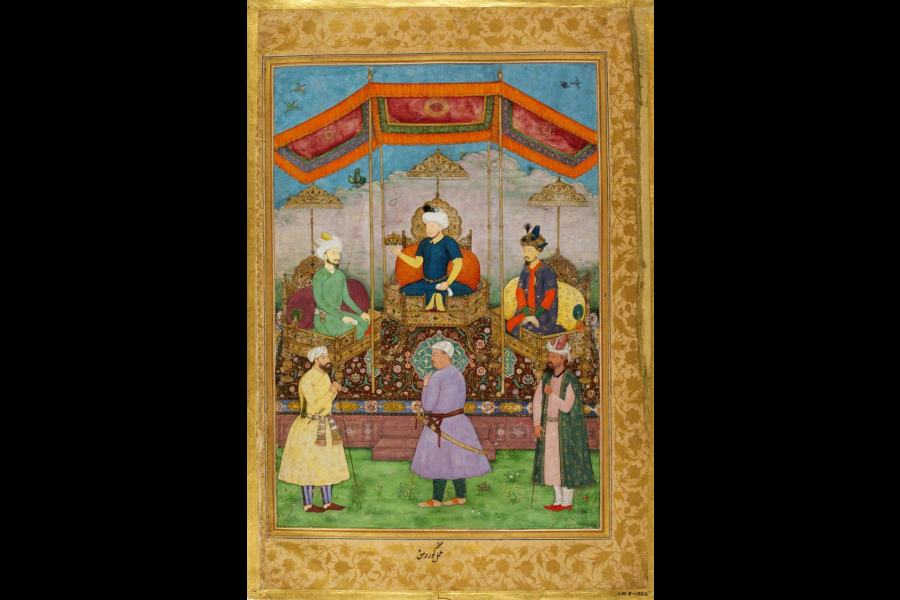
Book: BADSHAH, BANDAR, BAZAAR: COMMERCE AND EVERYDAY LIFE IN THE MUGHAL WORLD
Author: Jagjeet Lally
Published by: Penguin
Price: Rs 399
In this new book in “The Story of Indian Business” series, Jagjeet Lally emulates the style of a storyteller narrating the different dynamics of commercial and everyday life in the Mughal period. Lally relocates the discussion on the Mughal period to a thoroughly source-based analysis of one of the most dynamic phases of India’s economic, especially commercial, history and the cosmopolitan nature of the people who lived in it, going beyond the communal binary dominating the public discourse on the period in recent times. His outstanding command over a huge amount of research on the field, including his own, as well as his ability to weave stories from a wide range of primary sources, helps him in this task.
Lally’s narrative goes beyond the much-used Mughal court histories and royal autobiographies and starts with eye-witness accounts of the commercial life of the period, such as those penned by Baba Nanak, the bhakti saint who, nevertheless, hailed from a commercial family of the Panjabi Khatri caste and often used commercial references in his poetry, Banarsidas, the Jain merchant trying to make a fortune in the bazaars of Agra, or Sir Thomas Roe, an English diplomat getting frustrated as he was losing the competition with Portuguese and Dutch merchants to secure the favours of Emperor Jahangir, thanks to the poor quality of gifts he was being sent by the East India Company. Gradually, Lally sketches the opulence of the Mughal cities such as Shahjahanabad, bustling with goods from the old and the new worlds, including coffee and tobacco, and people of all backgrounds and communities, not only from the descriptions of Chandar Bhan Brahman, Shah Jahan’s personal secretary in the heyday of the empire, but also from the writings of Dargah Quli Khan, who noticed how Delhi bounced back even after being ravaged by Nadir Shah’s invasion. Through Lally’s stories, the reader gradually gets the picture of how a commercial society was sprouting in Mughal India even before colonial intervention, and how the Mughal rule of law and administration helped in its development. Thus, despite other avenues being open, a Brahmin widow often opted for her case to be tried as per sharia law in the Qazi’s court, thanks to the standardisation of law brought forth by Aurangzeb, while the fear of lawlessness would make a merchant like Banarsidas mourn when Akbar passed away. Lally narrates how an Aggarwal boy would usually grow into a merchant — proficient in basic Persian as well as in secret shorthand scripts such as Baniyan, Mahajani, or Mudia — facilitated and controlled by a family network, how a Mughal prince would need to prepare for an eventual succession struggle and thus cultivate networks for financing his bid, how European companies also grew in the same landscape and were assisted often by Indian mercantilists such as Mancherji Khurshedji whose growth and fall were entangled with the fate of the Dutch company. Mughal ladies would invest in trade actively too, sometimes as builders of caravanserais, like Nur Jahan, and sometimes as owners of ships, like Mariyam uz-zamani.
The constraint of space might not have allowed the author to deal in details about the historiographical debates, such as the one concerning the nature of the eighteenth century, but this is a delightful overview for those interested in knowing about a period when India controlled a quarter of the global economy.