
Polythene bags under 50 microns in thickness are openly available in the city despite a ban on them in the state.
The administration has failed to deter their use. The frequency of challans issued against violators is far too less to create any fear.
And that is despite Patna High Court pulling up the administration and even ordering security for Patna Municipal Corporation (PMC) staff in its drive against violators. The corporation had earlier told court it was unable to launch such drives in the absence of security.
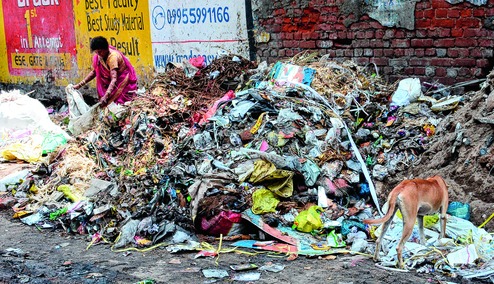
Use of polythene bags is largely to blame for choking of drains and is major contributor to pollution in the Ganga.
Plastic waste comprises 6 per cent of the soughly 1,000 tonnes pf solid waste Patna generates daily.
The state government banned the use of polythene bags below 50 microns in thickness in consonance with central rules in February 2011. Then deputy chief minister Sushil Kumar Modi, who was also environment minister, had said the government was contemplating a blanket ban on use of polythene bags, but that has remained a pipe dream.
The PMC has taken steps to restrict use of plastic bags but implementation was never effective. Shops and vendors continue to hand out the bags to customers.
"We do not carry anything for buying grocery or vegetables," said Reenu Srivastava, a Kankerbagh homemaker. "We are aware the government banned polythene less than 50 microns thickness but the same is supplied to us. We buy it and people, too, ask for it," said a grocery shop owner on condition of anonymity.
Plastic Waste Management Rules 2016 say plastic carry bags will be available only to shopkeepers and street vendors pre-registered with the local bodies on payment of a certain registration fee.
Despite there being a provision to impose a fine ranging from Rs 1,000 to Rs 5,000 on shopkeepers found selling things in polythene bags of thickness less than 50 microns, it has not deterred shop owners and neither does the PMC conduct drives to check it.
"Though a few raids were conducted and fines realised, PMC could not undertake the drive regularly for lack of proper force," high court advocate Prasoon Sinha, who appeared on behalf of PMC in the polythene bag ban case, said.
But environmentalist A K Ghosh blamed the government. "Just banning polythene bags will not serve any purpose," Ghosh said. "If the government really wants to ban it, it should first stop its production. On the one side you are banning an item and on the other allowing its production. It seems some lobby is working behind the scenes and pressurising the government to not stop production of polythene bags." He agreed it was impossible for government agencies to check if each and every shop was complying with the ban order.
Centre for Environment and Energy Development (CEED), which is advocating for plastic-free states, feels the government and citizens need to play a significant part in creating a plastic-free Bihar.
"Use of poly bags multiplies the piles of plastic debris across the state," said Pragya Shanker, media officer with CEED India. "The reckless disposal of plastic waste results in environmental degradation, as plastic takes thousands of years to decompose, thereby causing a serious threat to human, animal and marine lives. Laws come and go, but we never seem to pay much-needed attention to them. In order to immediately address pollution caused by plastic products we need to generate political and public will." Shanker added that India, not too surprisingly, is among the top four contributors to white pollution in the world.
"Non-biodegradable waste is not only choking the state's sewage, but also impacting the environment," said social activist and Save Ganga crusader Guddu Baba. "We expect the state to completely ban non-recyclable plastic as non-biodegradable plastic waste in the state is on the rise."