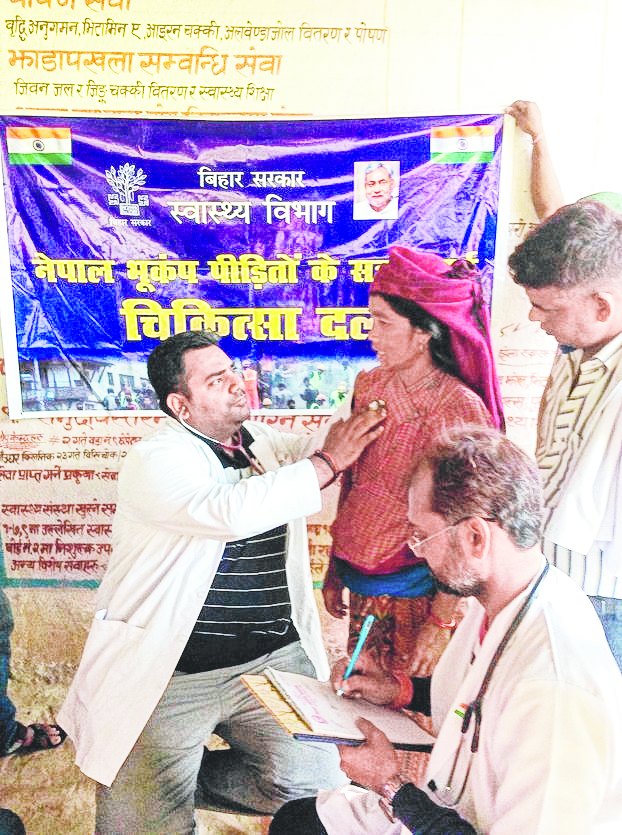

Patna, May 4: The first team of doctors the state government sent to Nepal to help treat the earthquake victims returned late on Sunday night.
The 14-member medical team, comprising doctors drawn from State Health Society, Bihar, the state chapter of Indian Medical Association and some private hospitals, was one of the first Indian teams to reach Dhading, one of the highest altitude areas in Nepal and close to the epicentre of the earthquake. The Nepal government has also declared Dhading as one of the most affected areas.
The team also provided medical aid to the people of another badly affected area, Gorkha. In response to their help in Dhading, Gorkha and Mugling in Nepal, the team received an appreciation letter from the office of the consulate-general of India in Birganj and from the district health authorities in Gorkha.
Sharing his experience in Nepal, Dr Ajay Kumar, who led the team, told The Telegraph: "More than a week has passed since the earthquake hit Nepal. Relief operations must be scaled up urgently, more so in view of the advancing monsoon. The ongoing relief work is not satisfactory. People are dying owing to the delay in rescue operations."
"Ongoing relief efforts continue to focus on reaching a greater number of areas, in particular the remote and inaccessible areas, where many of the poorest and most affected people remain," said Dr Ajay, before adding: "In Dhading, the hospital had collapsed, only a portion was intact. We treated almost 12 patients there with broken limbs and those suffering from physical and mental trauma. We also assisted in surgeries."
"The bigger challenge was to make temporary toilets and houses there. There is a scarcity of food and shelter, while on the other hand, rainfall would make rescue operations more difficult," he added.
"In Gorkha, we treated 924 patients while manning three health outposts there. We distributed food and water we had bought. We also distributed essential drugs and contributed medicines to the store," Dr Ajay said.
"Bodies were seen lying near hamlets with animal carcasses in the mountainous areas with chances of infectious and other communicable diseases looming large in the region," said another doctor from the team. He added: "Collapsed latrines must be rebuilt and animal carcasses must be cleared to avoid a sanitation nightmare."
Narrating the horror the people were struck with, Dr Ajay said: "Due to recurrent aftershocks, people have been spending nights on the streets. The tourists used to take pillows and bedsheets from their hotel rooms and spend the night on the road fearing earthquake. There are many patients in need of psychiatric help."
"The United Nations Disaster Assessment and Coordination (UNDAC) teams have travelled to Dhading and Gorkha, where the team has set up a humanitarian hub for the area," said a doctor, adding: "In Gorkha, the UNDAC team found a dire need for shelter, particularly tents and blankets. Access to some remote villages remains a key challenge, as many landing zones are unsafe owing to debris, altitude and current weather conditions. As the road access is limited, some remote villages can only be accessed by helicopters."
"There are rescue teams from Germany, Czech Republic and Switzerland in Gorkha but owing to inaccessibility of the area, they are facing difficulty in landing their helicopters for relief work," said Dr Ajay.