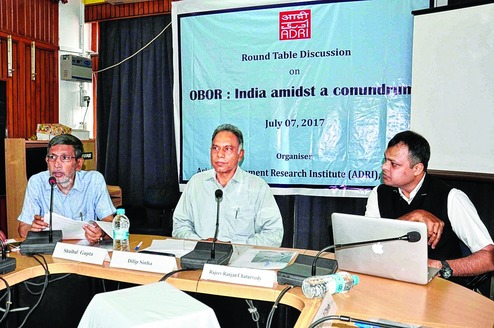

The pros and cons of one belt-one road (Obor) project of China and India's stand on the issue came up for deliberation here on Friday during a discussion organised by Asian Development Research Institute.
Ranjan Chaturvedy, research associate at the Institute of South Asian Studies-National University of Singapore, and retired Indian foreign service officer Dilip Sinha were the key speakers in the event attended by members of trade bodies and local intelligentsia.
Considered an ambitious project of Chinese President Xi Jinping, Obor, on the face of it, aims at improving connectivity among countries of Asia, Africa and Europe. India has been opposed to the initiative as the China-Pakistan Economic Corridor (CPEC) has been made a part of Obor. India has raised objections over CPEC projects in Pakistan-occupied Kashmir, claiming it to be a sovereignty-related issue.
Chaturvedy said: "There might be more to Obor than we come across in media. The Indian government rolled out issues like blue economy, which are very important in the context of Obor."
The concept of blue economy, which gained currency after publication of Gunter Pauli's book, The Blue Economy: 10 years, 100 innovations, 100 million jobs, can be termed as a model which would shift the society from scarcity to abundance using locally available means.
Chaturvedy said India was a different country now and would not tolerate any aggression in any form.
Dilip Sinha raised geopolitical as well as economic aspects while expressing doubt about the success of Obor.
ADRI member-secretary Shaibal Gupta welcomed the guests who took part in the discussion.