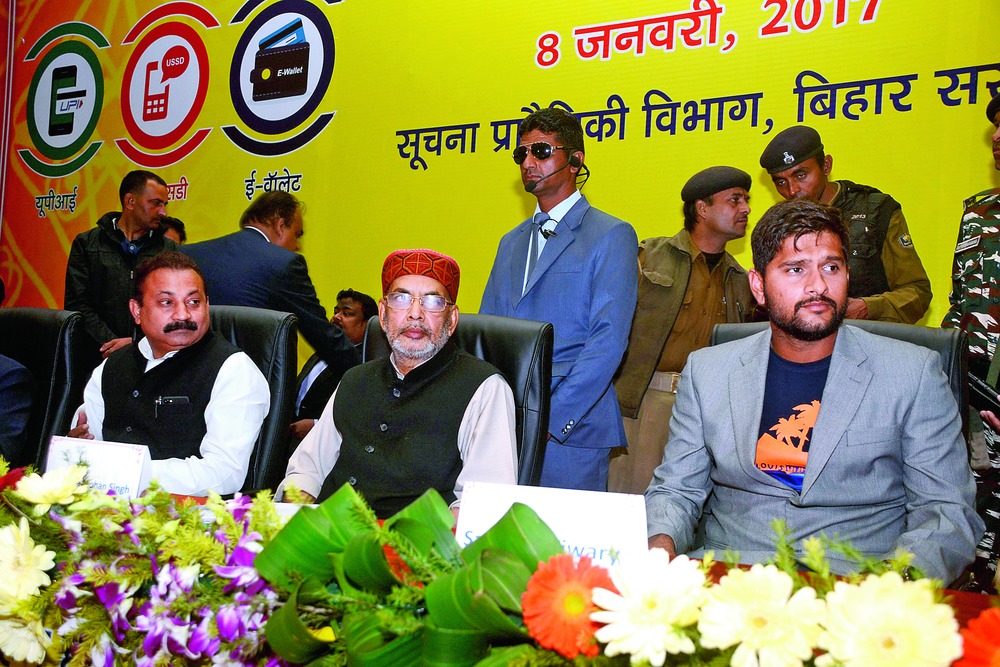

Union minister Radha Mohan Singh and state information-technology minister Ashok Choudhary on Sunday sparred over demonetisation at the Digi Dhan Mela, organised by the state information-technology department under the aegis of Niti Aayog to create awareness about cashless transactions.
Choudhary tore into Singh's claims that the cashless push will help the economy grow in the coming years and help check corruption.
Choudhary, who spoke last at the event, pointed out that the forced electronic transactions have raised several concerns. If the Centre is really serious in implementing a cashless economy it should withdraw all kind of charges on such transactions with immediate effect, he said.
He has a point, because charges on such transactions often catch people unawares. Choudhary, who is also the state education minister, demanded that the right to digital access should be made a constitutional right through immediately promulgating an ordinance and later through a separate bill.
Choudhary is the state Congress president and his party has been organising demonstrations against demonetisation.
His third demand was that information about digital transactions and biometric data must be immediately protected from overseas agencies through appropriate legislation.
"I raised the issue as still there is confusion among people going for cashless economy,"
Choudhary told The Telegraph later. "The Union government is going for cashless economy hurriedly without any planning, due to which the people are suffering a lot."
The state minister's outburst over demonetisation was in response to Singh highlighting the benefits of demonetisation. Singh, during his 35-minute speech, indirectly charged the Congress and other Opposition parties protesting demonetisation as anti-poor.
"The basic idea behind cashless economy is to bring transparency in economy," he said. "Out of 125 crore population in the country only 52 lakh people having income between Rs 5 and 10 lakh are filing (income tax) returns. Similarly, only 24 lakh people having income above Rs 10 lakh per annum are filling returns. The government aim is to check such tax defaulters."
The minister said that with around 40 crore smartphone users and 50 crore Internet users, a cashless economy can easily be attained if the state government and the people cooperate with the Centre.
"With around 107 crore Aadhaar cards and the government moving towards linkage of bank account with Aadhaar cards, the government will have details about all bank transactions," he said.
Choudhary was sceptical. He pointed out that in India there are just 75 ATMs per one lakh people, and that the Reserve Bank of India had set a target to open 1,600 bank branches in the state by December 31, 2016, but had set up only 75.
The common people's reaction to the Digi Dhan Mela, which was organised at the Adhiveshan Bhawan and had 35 stalls, was mixed.
Narendra Kumar, a distributor with the state milk cooperative federation (Comfed) who was there at the event, said: "The Comfed people are asking us to go for cashless transactions and even asking us to install point of sale (PoS) machines, but there is no clarity on relaxation of service charge during cashless transactions through PoS machines."
Echoing the views of Narendra Kumar, another Comfed distributor Gopal Prasad said: "The banks charge 0.75 per cent for transactions up to Rs 2,000 while the rate is 1.4 per cent for transactions above Rs 2,000. For small traders like us who make paltry profit, going for PoS machine is not judicious."
At the Mela, 1,170 new bank accounts were opened by 18 different banks that participated and around 623 payments were made through Aadhaar cards.
The biggest attraction at the event was people being acquainted with the BHIM (Bharat Interface for Money) app, which is an effort by the central government to make digital payments a habit. Around 2,472 people downloaded the app.