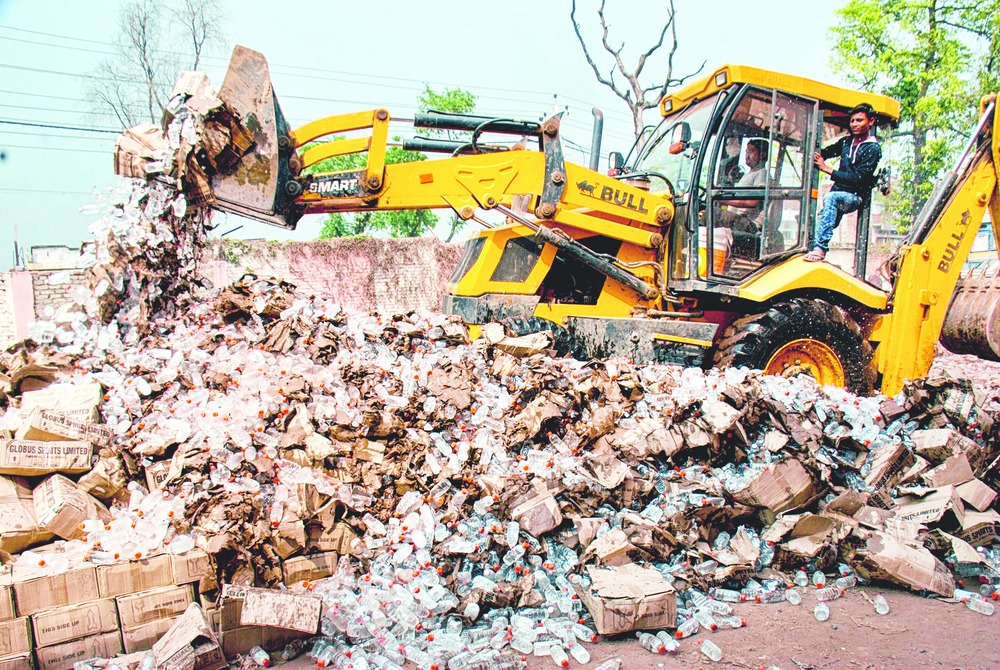

The government's total prohibition is not only costing the exchequer dear but also the liquor manufacturers stuck with supplies for the dry state.
When chief minister Nitish Kumar announced complete prohibition on Tuesday afternoon, the Bihar State Beverages Corporation Limited (BSBCL) had a stock of 2.7 crore liquor bottles in its depots across the state. As the corporation wasn't required to pay for the liquor immediately and only on being sold to the retailers, it is averse to destroying the stock. Destroying the liquor stash across the state would make the corporation liable to pay in crores. In Muzaffarpur district alone, the corporation has a leftover stock of Rs 40 lakh.
"We have asked the liquor manufacturers to take back their stock in our depots after a talk with the excise department," said BSBCL managing director Mithilesh Mishra. "If we destroyed the bottles, we would have been liable to pay for the stock."
Mishra said even if all the bottles were priced at a minimum of Rs 100 and the corporation destroyed the stock, it would amount to a liability of almost Rs 300 crore.
But returning the stock to the liquor manufacturers isn't short of problems, sources in the liquor industry said as the alcohol sent to Bihar cannot be sold in other states.
Every liquor bottle that was bound for Bihar had "for sale in Bihar only" stickers or labels on them. Bottles of beer had the message on the caps as well. A regular drinker would not have missed the silver "Bihar Excise" seals on the bottle caps. So, even if the government now returns the "Bihar Excise" stock to the manufacturers, the companies will be saddled with the trouble to either repackage or rebottle the alcohol incurring more expenditure.
"All manufacturers paste labels on liquor bottles for sale and consumption in a particular state. This is done to indicate that the manufacturer has paid the import duty to the government concerned," said a liquor marketing entrepreneur, Karan Gandhi, in Patna. "Based on this process, the state government where the liquor is manufactured issues export permit. If the manufacturer does not put the label for sale of liquor in a particular state then the origin state might charge tax for it. Besides, the manufacturers are asked to emboss 'Bihar Excise' on caps of most liquor bottles."
He explained that if the manufacturers have to replace the labels and caps, it would lead not only to extra costs but also wastage of sizable volumes of liquor. "Few liquors such as wine and beer become unfit for consumption within a few hours after being opened. Re-labelling of other bottles would add to the expenses too. Besides, manufacturers would have to wait for a few months before the Bihar excise department pays back the import duty paid by them at the time of supply to the beverage corporation," added Karan.
Sources in the corporation said it received a letter from the excise department on Tuesday evening, directing to clear the leftover liquor stock from the depots at the earliest. On Wednesday morning, the corporation sent back a reply, requesting the department to allow returning the liquor bottles to the manufacturers. By the evening, the request was approved.
"Once the stock was sold to retailers and they paid the corporation only then was it needed to pay the manufacturers, after keeping a certain percentage of the commission," beverages corporation managing director Mishra said.
"However, a majority of our stock in the depots remain unsold so it is most feasible to return the stash to the manufacturers."