Patna inched closer to becoming a smart city after the Patna Metropolitan Planning Committee, led by urban development and housing minister Maheshwar Hazari, on Monday approved the city's master plan (2015-2031).
The master plan was approved at the very first meet of the committee. The meet was attended by, among others, department principal secretary Chaitanya Prasad, and the 30-member committee chosen from among elected people's representatives of local bodies.
As per the new master plan, the state capital would be spread over 1,167sqkm of which 400sqkm would be marked as green cover. Over 600sqkm has been marked as urban area, which includes setting up of two satellite towns to cater to the pace of urbanisation and population growth in the next two decades. Further, it has been proposed that over 16 per cent of the total area be used for roads.
The master plan, prepared by the Centre for Environmental Planning and Technology (CEPT), Ahmedabad, would include Bihta, Danapur, Khagaul, Daniyawan, Fatuha, Khusrupur, Maner, Masaurhi, Naubatpur, Phulwarisharif, Punpun and Sampatchak blocks. The plan area has been divided into seven zones - residential, commercial, mixed land, industrial, public and semi-public land, urban agriculture zones and no-development zones.
Residential areas have further been classified into high density, medium density and low density and the residential units in these areas will be supported by retail outlets with adequate parking facilities.
Commercial zones classified into retail and wholesale areas will have provision for markets and cinema halls with parking space, hostels and government offices among others. Industrial zones include all types of industry, bus and truck terminals, railway freight and passenger terminals, petrol pumps, parking space and godowns, among others.

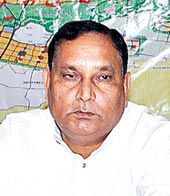
Maheshwar Hazari at the
meet on Monday. Picture by
Ranjeet Kumar Dey
Urban agriculture areas are marked by low density areas with major agricultural usage. The objective of the new master plan is to sustain the population growth for around 20 years. The plan was brought into the public domain in August last year with suggestions and opinions sought from different quarters.
Hazari, while exuding delight over the approval, said: "With the passage of the master plan, Patna has now a bright chance to qualify for the smart city project, the selection competition for which will be held in 2017. The plan would give much-needed impetus for developing the city at a par with Delhi and Mumbai."
"Although the move was long overdue, we as builders welcome today's decision," said Sachin Chandra, honorary secretary, Confederation of Real Estate Developers' Associations of India, Bihar. "This a big gift to residents as now several projects, stalled after NGT's order last month, would see the light of day. Approval of the master plan would also help Patna when the next round of selection for the smart city mission project is undertaken in March 2017."
Abhishek Singh, a banker, said: "It is heartening to hear that the city's master plan has been approved. Patna will now be developed like other metro and big cities. The move would not only give an impetus to development of Patna, but also the areas on it's brinks."
But some committee members raised objections. Sanjay Kumar Singh, deputy chairman, Patna Metropolitan Planning Committee, said: "The plan was approved without arriving at a consensus. The government should have taken some more time before finalising the plan after soliciting views from other members too."
Delay in the approval of the master plan had put the state government in the dock as the National Green Tribunal on September 16 directed the state government to stop all constructions in Patna on a built-up area of more than 20,000sqm till the master plan for the city was approved.
The NGT order had stopped construction work related to projects worth thousands of crores in Patna, putting the development agenda on the backburner.