
Patna, Dec. 5: The debate on whether government's involvement in appointment of judges to higher courts poses a threat to the independence of the judiciary goes on.
The Supreme Court had in October struck down the National Judicial Appointments Commission (NJAC), which sought to replace the collegium system for appointing judges to the higher judiciary.
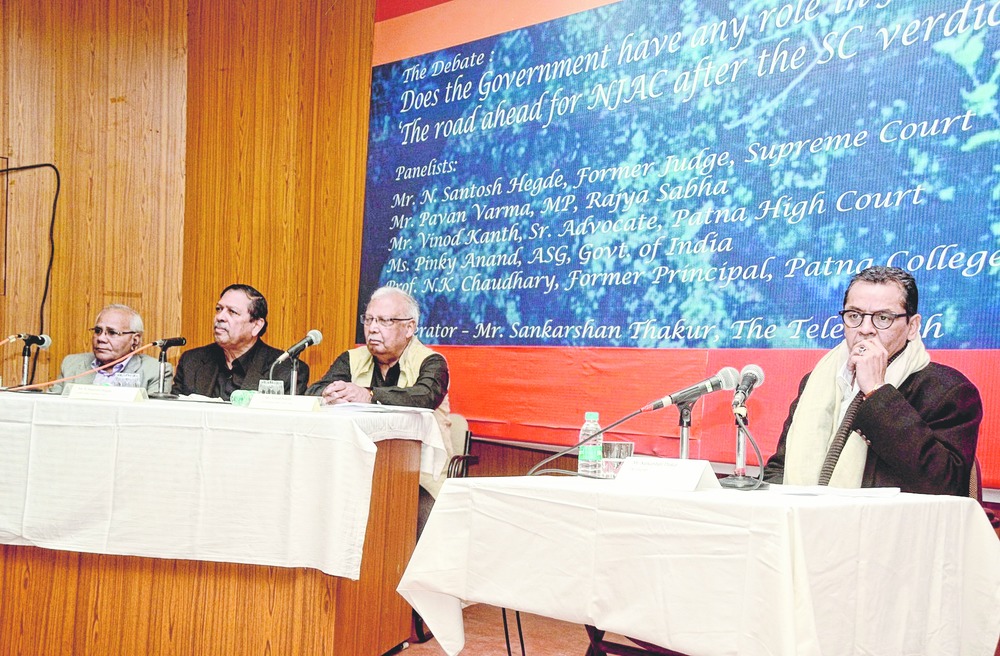
The motion for the 5th Pradhan Jwala Prasad Memorial debate today was "Does the government have any role in judicial appointments - the road ahead for NJAC after the SC verdict". The speakers included former Supreme Court judge Justice N. Santosh Hegde, author and Rajya Sabha member Pavan Varma, senior Patna High Court advocate Vinod Kanth, additional solicitor general Pinky Anand and Patna College former principal N.K. Chaudhary. Sankarshan Thakur, The Telegraph's roving editor, moderated the debate.
While Hegde, Kanth and Chaudhary stood for the motion, Varma and Pinky stressed that in order to curb corruption and fill large-scale vacancies of judges' posts, the collegium system must go. But at the end of the debate, the house was undecided and the speakers agreed to carry the discussion forward.
Starting the debate, Justice Hegde - who has had a long stint in the judiciary, having been solicitor-general of India and Lokayukta (ombudsman) for the Karnataka government - said the government wants to take over judicial appointments by introducing NJAC, which is not fair. He, however, favoured reforms in the existing collegium system. Hegde said: "The post of judges is not advertised. Everything is done on the basis of knowledge of the person who is appointing judges. It requires transparency."
Pinky Anand said there are many countries, such as Canada, where the executive has power of judicial appointments. She said striking down the NJAC won't work, there should be better consensus between the legislative, executive and judiciary to bring about changes in judiciary. Echoing her, JDU Rajya Sabha MP Varma said judicial reform is the need of the hour, as the biggest losers because of slow delivery of justice are the people. "Of 1,017 sanctioned posts of judges in high courts and Supreme Court, there are around 406 vacancies, the maximum in Allahabad High Court. These vacant posts are the main reason behind slow judicial delivery," Varma said.
Patna High Court advocate Vinod Kanth and Patna College former principal N.K. Chaudhary said the decision to strike down NJAC was historic in the Supreme Court's history. But they also said that the collegium system requires reform and transparency.
Navras School of Performing Arts and Jeevak Heart Hospital have been organising Pradhan Jwala Prasad Memorial debate since 2010. Pradhan Jwala Prasad, father of city cardiac surgeon Ajit Pradhan, was an engineer of the state government and the first chairman of Bihar State Housing Board, Patna. He later served Asian Development Bank, Manila, for 18 years.