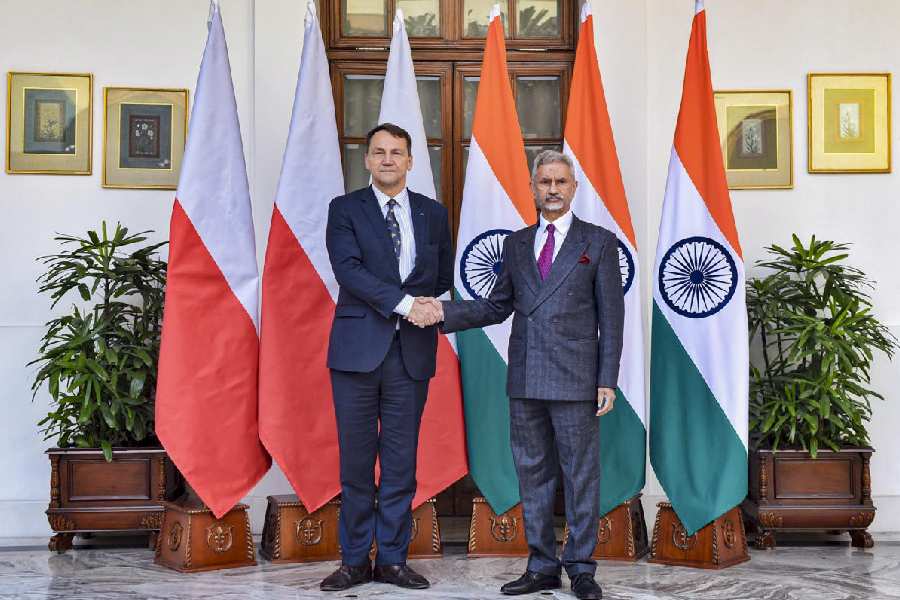
External affairs minister S. Jaishankar on Monday indicated that tariffs were not the only way countries were being targeted selectively, but did not elaborate.
He brought up the “selective targeting” twice during the opening segment of his meeting with Polish counterpart Radoslaw Sikorski, who is also Poland’s Deputy Prime Minister, which was open to the media.
The first time, he did so on his own, and the second time in response to Sikorski agreeing with his observations.
India has repeatedly described the sanctions and tariffs imposed by the West on companies doing business with Russia as selective and hypocritical, citing how the US and many European countries continue to do business with Moscow in their areas of interest.
In his opening remarks, Jaishankar said: “In the recent past, both in New York last September and in Paris this January, I have candidly shared with you our views on the Ukraine conflict and its implications.
“While doing so, I have also repeatedly underlined that the selective targeting of India is both unfair and unjustified. I do so again today.”
Responding to this specifically in his opening remarks, Sikorski said: “I also completely agree with you on the unfairness of selective targeting by tariffs and we Europe know something about that also…. We fear that this is progressing to a global trade turbulence.”
Jaishankar acknowledged Sikorski’s remarks and added: “Of course, the selective targeting is not limited to tariffs — I think there have been other forms of selective targeting. But we will discuss that.”
He also made known India’s displeasure over Poland coming out with a joint statement with Pakistan, during Sikorski’s visit to Islamabad in October, that mentioned Kashmir.
The joint statement said both sides had discussed the issue of Ukraine and Jammu and Kashmir, and “stressed the need to find peaceful solutions to conflicts in full respect of the principles of international law and the UN Charter”.
Alluding to this obliquely, Jaishankar said: “You are no stranger to our region and are certainly familiar with the longstanding challenge of cross-border terrorism.
“I hope at this meeting to discuss some of your recent travels to the region. Poland should display zero-tolerance for terrorism and not help fuel the terrorist infrastructure in our neighbourhood.”
Taking heed of Jaishankar’s comment that bilateral relations need “constant tending”, the Polish minister agreed on the need to counter trans-border terrorism.
He underscored that Poland was familiar with this scourge while citing a recent attempt to target a railway line in his country.