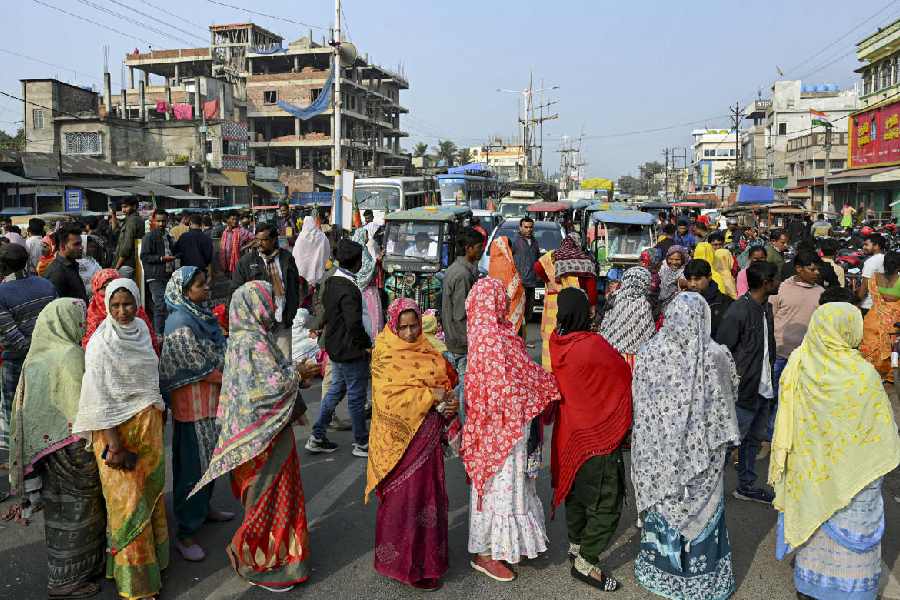
The Supreme Court on Monday questioned elements of the Election Commission’s logic for scrutinising an estimated 1.25 crore Bengal voters for “logical discrepancies” and asked it to display all these voters’ names at their panchayat, block and ward offices.
It also directed the commission to accept the Class X board exam admit card as a valid document for the SIR exercise.
The directives gladdened the Trinamool Congress, which has been making both these demands, and whose leaders had filed some of the petitions on which the order came.
The three-judge bench also said that once a particular “logical discrepancies” list has been put up in public, the voters who find themselves on it would have 10 days to respond by raising objections and furnishing documents.
It said the political parties’ block-level agents (BLAs) can help the voters in this, either through authorisation letters or thumb-marked consent letters, providing huge relief to the aged and ailing who have suffered in the long queues at the hearings.
However, the relevance of the 10-day deadline remained unclear since a voter cannot know which official to contact, or where and when, unless served with a notice for a hearing. So far, notices have been issued to only 40 lakh voters for “logical discrepancies”, with similar plans for another 54.5 lakh.
The bench, headed by Chief Justice Surya Kant, questioned one of the key criteria on which these notices have been sent — an age difference of 15 years or less between mother and offspring.
“How can a 15-year age gap between a mother and a son be a logical discrepancy? It is not as if we don’t have child marriages in India,” Justice Joymalya Bagchi, one of two judges from Bengal on the bench, the other being Justice Dipankar Datta, told the commission’s counsel, senior advocate Rakesh Dwivedi.
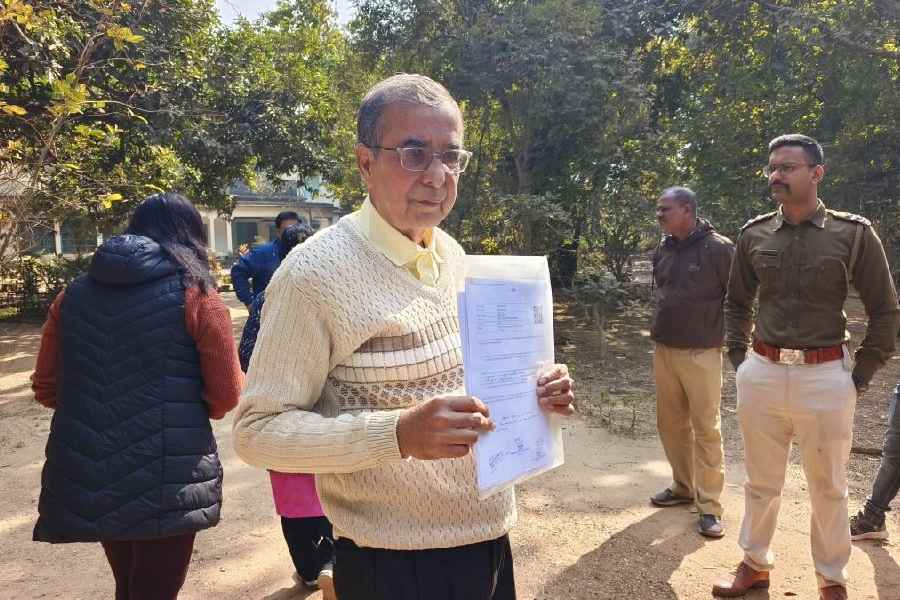
The oral observation came after senior advocate Kapil Sibal, appearing for Trinamool MP Derek O’Brien, complained the commission had included under “logical discrepancies” the names of voters whose enumeration forms showed age differences of 15 years or less — or 50 years or more — with their parents.
The court is dealing with separate petitions that Trinamool MPs O’Brien and Dola Sen, as well as others, have moved expressing fears of a large-scale deletion of voters from the rolls during the SIR.
Admit card
Trinamool has been demanding that the commission accept the Madhyamik admit card — which carries the date of birth — as proof of a voter’s identity and eligibility.
The commission currently accepts only the board’s (pass) certificate (which, in the case of Madhyamik, carries the date of birth), and neither the admit card nor the mark sheet (which, in the case of Madhyamik, does not carry the date of birth).
Trinamool’s argument has been that many who possess the admit card never passed the exam and would therefore not have the (pass) certificate.
On Monday, senior advocate Kalyan Banerjee, representing one of the petitioners, raised the subject.
Justice Bagchi told Dwivedi that the commission’s official media release had stipulated that the Class X admit card would be accepted, and it could not go back on this now.
“The admit card issued by the (Bengal school) board has a presumption under the law. If it is given, it has to be accepted,” Justice Bagchi said.
Justice Datta, too, told Dwivedi that insisting “only on the pass certificate” will not do, and “you will have to allow the admit card”.
At one point, Dwivedi had an emotional outburst, saying: “If the Election Commission of India cannot be trusted, then let it not conduct the elections.”
He said the poll panel was discharging its constitutional and statutory duties and had during the ongoing SIR examined several glaring inconsistencies.
He said one voter’s name had figured in 230-odd places, and two couples had claimed to have 100 and 50 children, respectively. The poll panel was bound to examine such matters, he argued.
Justice Kant later dictated the order, which had not been uploaded on the court website till late evening.
“The Election Commission of India has issued notices to certain persons described as falling under the category of logical discrepancies. With a view to enable these persons, we direct that their names be displayed at all gram panchayat bhavans/ block offices/ ward offices,” the order said.
“The state government shall provide adequate manpower to the Election Commission for the display at the panchayat bhavans/ block offices/ wards.
“In this regard, we direct that every district collector/ authority shall meticulously comply with the directions issued by the ECI and the state government to the staff for the smooth conduct of the special intensive revision….”
The court directed the Bengal director-general of police “to ensure smooth conduct of the process and ensure that there is no law-and-order problem”.