
A company based in Japan is set to carry forward the mission of Super 30 founder Anand Kumar on a larger scale.
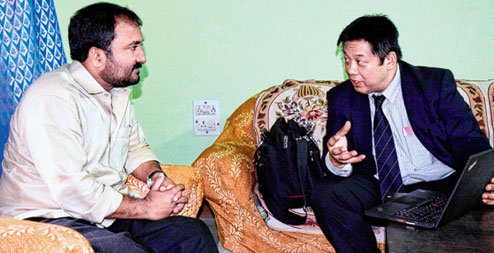
Japanese industrialist Takanobu Tanaka met Anand on Sunday and sought his assistance to improve the quality of education in the state. He visited Patna to partner with Anand for providing quality education at the primary level to students studying in government schools and those who cannot afford to go to privateones.
Tanaka's company Ricoh is working towards achieving the United Nation's Millennium Development Goals and to support community development efforts in the developing countries. Tanaka told Anand that he was overwhelmed when he saw a feature on Super 30 on a Japanese television channel. "I was overwhelmed with emotions when I saw the students of the institution so passionately involved with their education. Therefore, I decided to come here and carry our mission forward," he said.
The channel, NHK, had shot a detailed documentary on Super 30 a few years ago.
Tanaka's company Ricoh strives to solve social problems through technology, products, services and human resources to contribute to development of sustainable society. Appreciating the man behind Super 30, he said: "It is inspiring to know how Anand shapes up students from the poorest sections and make it easy for them to find jobs."
In April, Tanaka is likely to come to Patna again and interact with Anand, students and teachers to make them understand how technology could make things easier for them.
He said: "In the first phase, we would focus on primary education and later take it forward in other directions, including environment education. The focus would be on content development by involving stakeholders so that solutions could be sustainable and bring generational change."
Tanaka said since many children in India cannot study because of poverty, they wanted to make technology accessible to schools and make them use it effectively by ensuring capacity building.
Anand, who was last year invited by Tokyo University for educational collaboration, said: "It was good that a developed country like Japan was eager to help poor students in Bihar and make optimal use of their talent. What I am doing is on a smaller scale. But, if more such organisations come forward, things would certainly change."