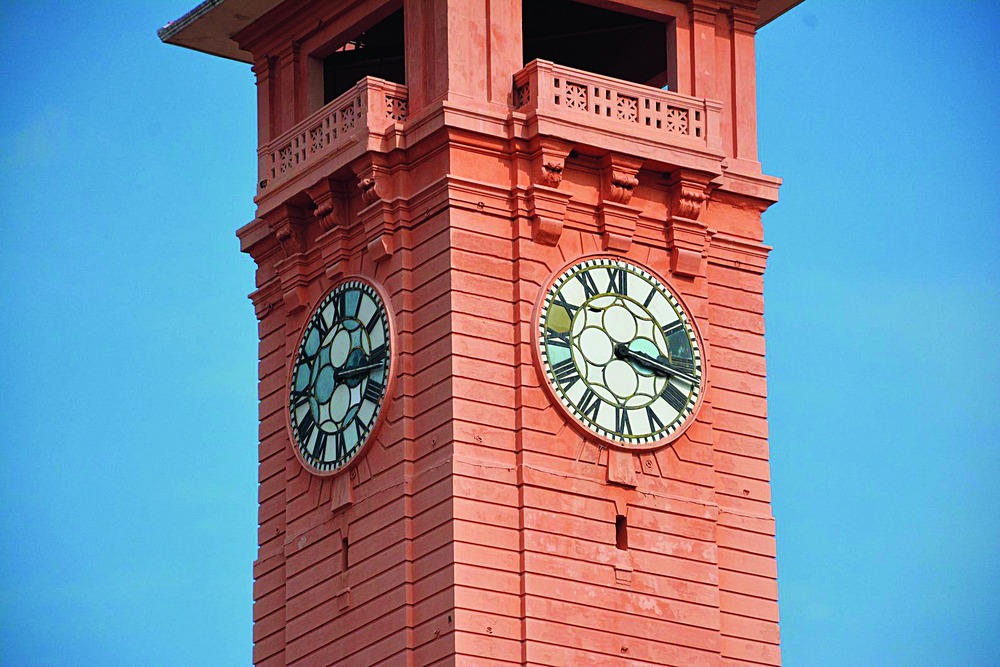

Picture by Nagendra Kumar Singh
The 82-year-old iconic clock tower at the Old Secretariat is ticking again.
The Calcutta-based Anglo Swiss Watch Company repaired the clock in a month-long exercise during which parts of the clock were taken to Calcutta.
Officials in the building construction department claimed the clock would work for another 100 years.
"The pinion and several other parts of the clock were taken to Calcutta. The procedure lasted three weeks, after which the parts were returned and the clock started functioning again last week," said a senior official in the building construction department.
Supratim Chatterjee, an executive in the maintenance wing of Anglo Swiss Watch Company, said they completely overhauled the clock. "While several parts of the clock had to be repaired, we have replaced a few others with new ones. Moreover, we also oiled all the parts. We have given a guarantee of one year on the repairs undertaken," said Supratim.
One of the finest pieces of Churchill pattern of clock towers - such clocks have a patterned round face and larger digits than usual in India - the secretariat clock in Patna was fitted on the tower of the Old Secretariat in 1924. Gillett and Johnston, clockmakers from Croydon, England, made the clock. Originally, the clock tower was 198ft high but a part of it fell down during the massive earthquake in 1934, reducing it to its present height of 184ft from the ground till the lightning conductor.
The Churchill-pattern clock has a pendulum weighing over two quintals and its minute and hour hands have a combined weight of over 50kg. Its hour hand is 4.5ft long and the minute hand 5.5ft. The hands and digits of the clock are made of bronze and iron. While winding the watch takes around 15 minutes, another 15 minutes is required to wind the bell.
Sources said around Rs 50,000 was sanctioned annually for the clock's maintenance. Employees looking after the clock have to climb 276 steps to wind and maintain it.
The Old Secretariat, including the splendid tower built by the British during World War I, was designed by New Zealand-born architect Joseph Munnings of M/s Power, Adam and Munnings, Sydney.
Its grand architectural style is a blend of neo-Gothic and pseudo-Renaissance.
Munnings borrowed the design for it from the Secretariat building from the Union Buildings of Pretoria (South Africa) built by Herbert Baker, an architect of secretariats, Council House and the New Delhi capital area.
Munnings, who designed the new capital in Patna, was the consulting architect of the newly formed state of Bihar and Odisha during 1913-1918. His principal works included the Secretariat, Government House and Council Chamber in Patna.