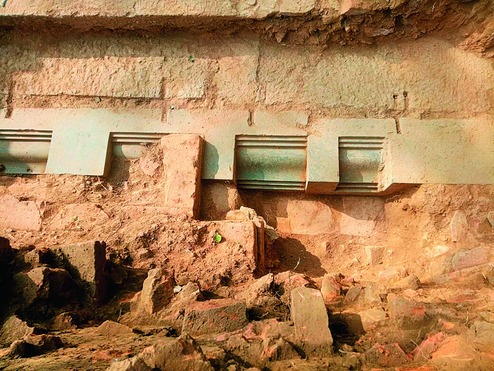

Lakhisarai: The excavation team from Visva-Bharati University, Santiniketan, has confirmed the discovery of a large Buddhist monastery at Jainagar Lali Pahari in Lakhisarai township, which British archaeologist Alexander Cunningham had mentioned in 1842.
Late on Saturday, the team found a broken Buddha tablet and other artefacts, from the site where excavation has begun from December last year.
Excited team members said the discovery of such structural evidence below the earth could unfold the ancient history of this area, where Buddha had spent three monsoons as mentioned in Buddhist texts.
The team till now has discovered nine cells at the excavation site, which are interconnected and have lime-brick floors. The frontal structure of a black-stone portico has also been found along with a platform used by monks to perform rituals. The cells are mainly for meditation and the recovery of Buddha-related items and some pottery used in performing rituals has further substantiated such claims.

"Discovery of pottery generally used by Buddhist monks and the replica of Buddha suggested this place was a big monastery," claimed Anil Kumar, the head of the department of archaeology at Visva-Bharati, who is guiding the excavation here.
"In the outer part of the monastery, there was arrangements for security and drinking water for monks. A tank connected with the nearby Kiul river through canal suggests that," said the professor.
"Excavation has been conducted far away from the main structure of the centre of the monastery located in the west but the findings so far indicate its existence," he claimed.
"Trees make excavation towards the main portion of the monastery difficult but we have sought permission from the forest department to cut the trees there," he added.
According to the professor, Cunningham who earlier excavated in Lakhisarai in 1842, also mentioned the existence of the monastery in his report.
"We have so far read about the place in history books but finding such buried evidence delights us," said Siddharth Saha, a team member.
While another team member, Sweata Singh said how local residents of Lakhisarai cooperated and encouraged the excavation team to find ancient chapters of this place.