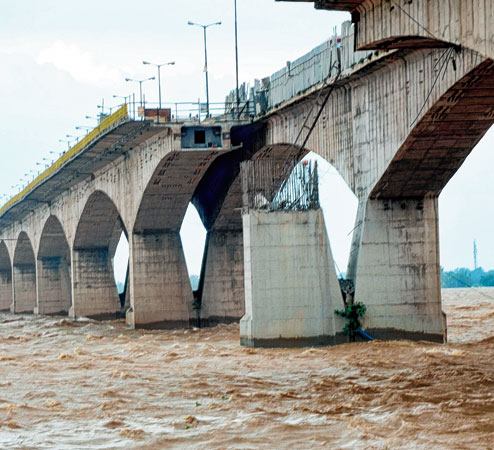

The Gandhi Setu, which has fallen into disrepair, is set to get an overhaul, the work for which is likely to start from December following selection of Afcons Infrastructure Ltd. by the ministry of road, transport and highways for the work on Wednesday.
Afcons will be working in Bihar for the first time and it has a track record of executing a big infrastructure projects in India and abroad.
Sources claimed that the formalities related to the project is likely to be completed by the end of this month, and the firm will be given two months as mobilisation period.
The project is required to be completed in 42 months from the date of award of contract, which means that the bridge is likely to be seen in its new form by 2020.
The bridge will be rehabilitated utilising steel-structure technology. The Union cabinet on July 22 approved rehabilitation of the Setu at an estimated cost of Rs 1,742.01 crore. Of the total investments, Rs 237 crore is expected to be spent on dismantling the structure that will be replaced by the steel framework.
The rehabilitation work would be executed as per the detailed project report for the same prepared by Mumbai-based SN Bhobe & Associates Pvt. Ltd. A senior official in the ministry said: "Three firms, Gammon India Pvt. Ltd., Hindustan Construction Company and Afcons were shortlisted in the technical bidding completed in August."
Sources claimed that Gammon India had quoted Rs 1,648 crore in its bid for executing the project; Hindustan Construction Company had quoted Rs 1,624 crore, while Afcons had quoted Rs 1,372 crore.
The report submitted by SN Bhobe & Associates states that the central hinges in the Setu have deteriorated over time. Although the condition of concrete appears to be satisfactory by and large, a number of central hinge bearing appear to be damaged beyond repair. Due to relative deflection of adjacent span at the location of the hinge, expansion joints have been damaged. The condition of foundation and substructure was good. Hence, the report recommended replacing the existing superstructure while retaining the foundation and sub-structure.
On the technique to be adopted for erecting the steel framework for carrying out repair, a senior official in the road construction department, said: "Steel girders will be used to make a truss (triangles with square-shaped boxes underneath). The square-shaped boxes would act as castings, in which concrete would be filled. The load of the vehicles would be transferred to the truss and the pillars would only have to bear the weight of the truss, which would be much lower."
The entire work has been divided into two phases - upstream and downstream. Sources claimed that work on upstream would be taken up first and it is only after start of vehicular movement on that stream, that work on the other stream will start.
Upon completion of repair work, vehicles would drive at a speed of 100kmph on the 5.575km-long bridge.