|
 |
| Nitish Kumar and Sushil Kumar Modi |
New Delhi, Feb. 25: There is a discernible whiff of unease between Bihar’s ruling allies. And for the first time in this decade-old partnership, tensions between the JD(U) and the BJP have arisen from local rather than external causes.
It is neither about the fabled animosity between chief minister Nitish Kumar and his Gujarat counterpart Narendra Modi, nor rooted in the collapse of seat-sharing talks in the ongoing Uttar Pradesh elections. It stems from mounting suspicion in JD(U) ranks that the BJP is trying to undercut its social base and slowly nose ahead of Nitish.
Over the past couple of months, JD(U) bosses have watched with muted ire and rising concern the BJP’s pro-active courtship of a constituency it considers its own — extremely backward communities and Mahadalits, both of which have been recipients of targeted positive discrimination initiatives under Nitish and both of which were responsible for delivering him a landslide victory in the November 2010 elections.
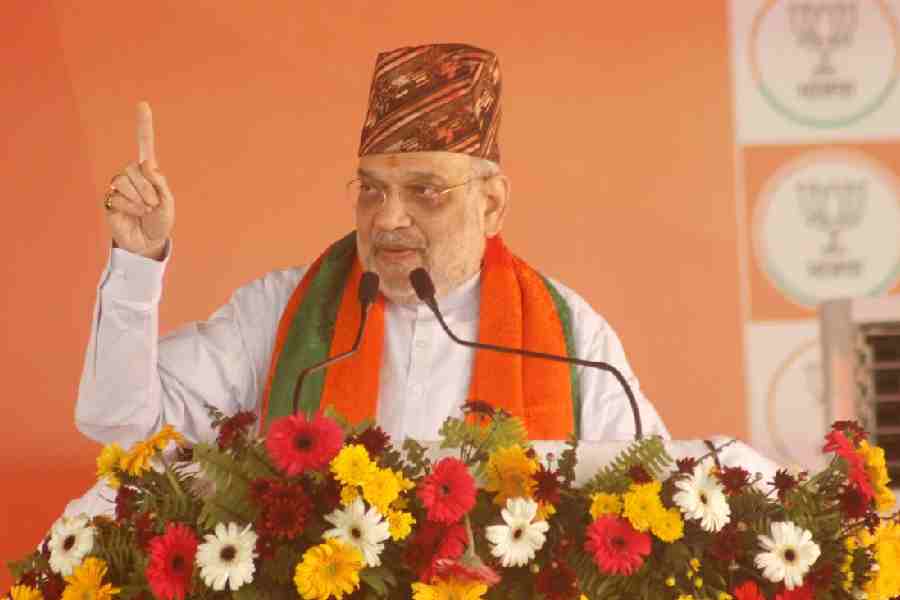
The BJP, which essentially brings urban and upper caste votes into the alliance kitty, now appears taken by the ambition to expand into the new underprivileged votebanks which the JD(U) considers its preserve. It has been organising a slew of events, big and small, across the state with a view to winning over new social sections — community-specific rallies for Sahnis, Mahtos and Ravidas followers, “mahabhoj” (communal feast) events for Mahadalits, sandhya sabhas (evening — or prayer — meetings) in backward pockets. To the JD(U) all of this has the ring of smart subterfuge — BJP cadres trying to encash NDA government schemes to seduce new votaries.
It is not known whether it has formally conveyed its concerns to the BJP, but off the record, senior JD(U) leaders are beginning to ask questions. “Why should the BJP openly woo caste groups that are patently loyal to us?” wondered one. “Every political party has a right to go among the people and get them on their side, but there are certain ‘maryadas’ (niceties) that must be respected in an alliance, you can’t even be seen to be trying to erode the ally’s votebank.”
The BJP, on the other hand, asserts the “imperatives of being a national party” and maintains it is doing “nothing wrong” in going out to the people. “We are allies in this government but we are also a political party and we, like everybody else, have the right to how and where we can do better. This is nothing that should bother anyone, least of all the JD(U),” a senior party leader said.
The carving of Mahadalits and EBCs as a separate socio-political constituency was a deliberate strategy that Nitish began to unfold early in his first term as chief minister. It came of age during the 2010 Assembly polls with both social blocks turning out overwhelmingly to back Nitish. There is a sense, perhaps overly proprietary, in the JD(U) that as an ally, the BJP should keep its hands off that constituency. But there is probably more than just that bothering them. Some in the JD(U) believe that the BJP’s mid or long-term “plot” is to emerge ahead of the JD(U) in Bihar. The BJP not merely ran the JD(U) close in the last elections, securing 91 to the JD(U)’s 115, it also had a much higher strike rate of success per seat contested. “Perhaps the BJP believes that with a little more support, it can outstrip us,” a JD(U) leader said, clearly annoyed. “They do not realise that without the backing of the JD(U), and the name of Nitish Kumar, they would not have got to 91 in the first place. It was a vote for Nitish Kumar, not for the BJP.”
Although, like its ally, the BJP is not ready yet to make a public spat of it, the party contests that view. “The JD(U) should also be aware that Nitish Kumar would not have been able to defeat Lalu Prasad without it, it is our joint effort that ousted him and it is our continuing joint effort that keeps Nitish Kumar in power,” a BJP leader said.
The NDA government under Nitish has so far had a smooth seven-year run. Nitish and his deputy, Sushil Modi of the BJP, have functioned almost friction-free. The same, however, cannot be said of their parties. Many in the BJP believe that Modi has “sacrificed our immediate and long-term political interests” in the interest of keeping the alliance intact. Often, the deputy chief minister has been charged by senior party colleagues of being “too subservient” to Nitish. Similarly, there are sections in the JD(U) that consider the BJP an “evil necessity” that should be “divested” at the first given opportunity. These sections, moored in “secular-socialist” thinking, appear convinced that Nitish will “not suffer” if the alliance were to break, an eventuality the chief minister seldom counts out of the equation given his strong reservations about Narendra Modi.