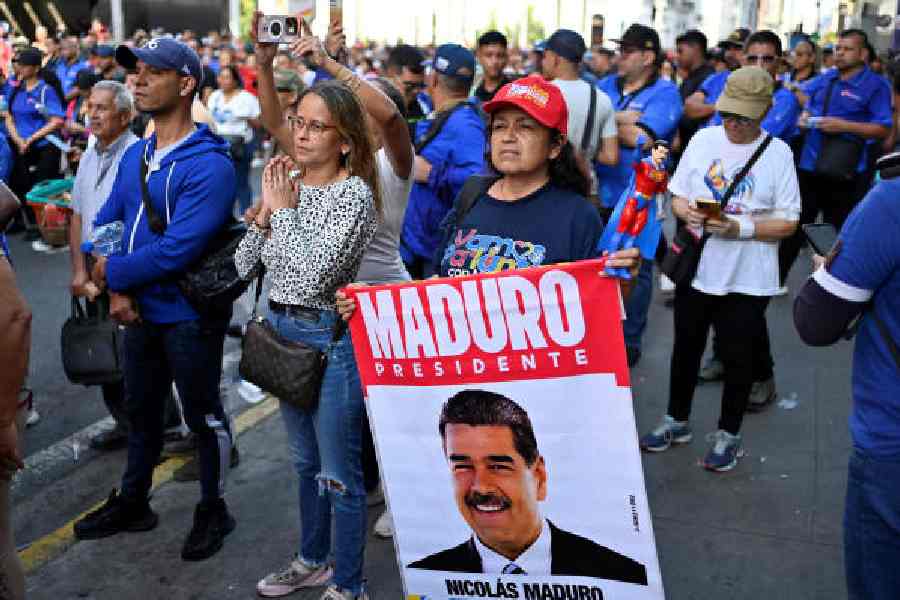
Even before American forces blasted their way into Venezuela’s capital and seized President Nicolás Maduro on Saturday, the nation was already facing dire economic prospects.
The partial blockade imposed by the US on Venezuela’s energy exports was expected to shutter more than 70 per cent of the country’s oil production this year and wipe out its dominant source of public revenue, according to people briefed on Venezuela’s internal projections compiled in December.
The Trump administration’s decision last month to begin targeting tankers carrying Venezuelan crude to Asian markets had paralysed the state oil company’s exports. To keep the wells pumping, the state oil company, known as PDVSA, had been redirecting crude oil into storage tanks and turning tankers idling in ports into floating storage facilities.
This strategy merely bought the company some time before it ran out of storage for the pumped oil its unable to sell. TankerTrackers, a shipping data firm, estimated late last month that Venezuela had enough spare storage until the end of January.
But production could collapse swiftly after that, the people briefed said.
If the blockade held, the Venezuelan government expected national oil production to collapse from about 1.2 million barrels per day late last year to less than 300,000 later this year, said the people briefed — a drop that would significantly reduce the government’s ability to import goods and maintain basic services. The people had access to the projections and discussed them on the condition of anonymity because they were not authorised to speak publicly.
Maduro’s capture has only added more uncertainly to these projections.
Oil tankers on a US sanctions list will continue being blocked from leaving or entering until the Venezuelan government opens its state-controlled oil industry to foreign investment — presumably giving priority to American companies — US secretary of state Marco Rubio said on Sunday on Face the Nation on CBS News.
“That remains in place, and that’s a tremendous amount of leverage that will continue to be in place until we see changes, not just to further the national interest of the United States, which is No. 1, but also that lead to a better future for the people of Venezuela,” Rubio said.
But Venezuela’s interim government already appears to be testing the seriousness of that threat. At least 16 oil tankers hit by US sanctions seem to have made an attempt to evade the blockade and leave Venezuelan ports since Saturday, in part by disguising their true locations or turning off their transmission signals.
If they manage to breach the blockade and export the crude, Venezuela’s oil industry could buy itself some time to adjust to the new reality, the people close to the industry said.
But if the blockade holds, the country would face a catastrophe, they added.
In a worst-case scenario considered by Venezuela’s government, this year’s national oil production would be limited to only the fields operated by the American company, Chevron. It has a unique permit from the Trump administration to work in Venezuela, and is the only company regularly shipping oil from the South American nation since the start of the partial blockade on December 11, shipping data shows. This scenario would force PDVSA, Venezuela’s largest employer, to furlough tens of thousands workers and slash employee benefits, the people
briefed said.
PDVSA and Venezuela’s communication ministry, which handles questions from news organisations, did not respond to requests for comment.
In recent years, Venezuela’s economy had seen some modest economic recovery after years of hyperinflation and food shortages that led millions of Venezuelans to flee the country. But Trump’s economic pressure campaign has snuffed out that progress and now threatens to turn an anticipated recession into another economic collapse.
Venezuela’s new leader, Delcy Rodríguez, was initially scathing in her criticism of the Trump administration, saying that its goal was “the seizure of our energy, mineral and natural resources”.
On Sunday night, however, her tone softened in a conciliatory statement addressed to Trump. “We extend an invitation to the U.S. government to work together on a cooperative agenda, oriented toward shared development, within the framework of international law, and to strengthen lasting community coexistence,” she wrote on social media.
New York Times News Service